Maiden Names and Married Names
Posted by Sally Jenkins in Writing on June 4, 2012
I have an unusual maiden name – ‘Mumby’ – and it’s rare that I stumble across it anywhere else but I found it on a tiny war memorial in the small church at Croft Castle, near Leominster. I was so surprised that I had to take a picture of it (it’s in the bottom right-hand corner).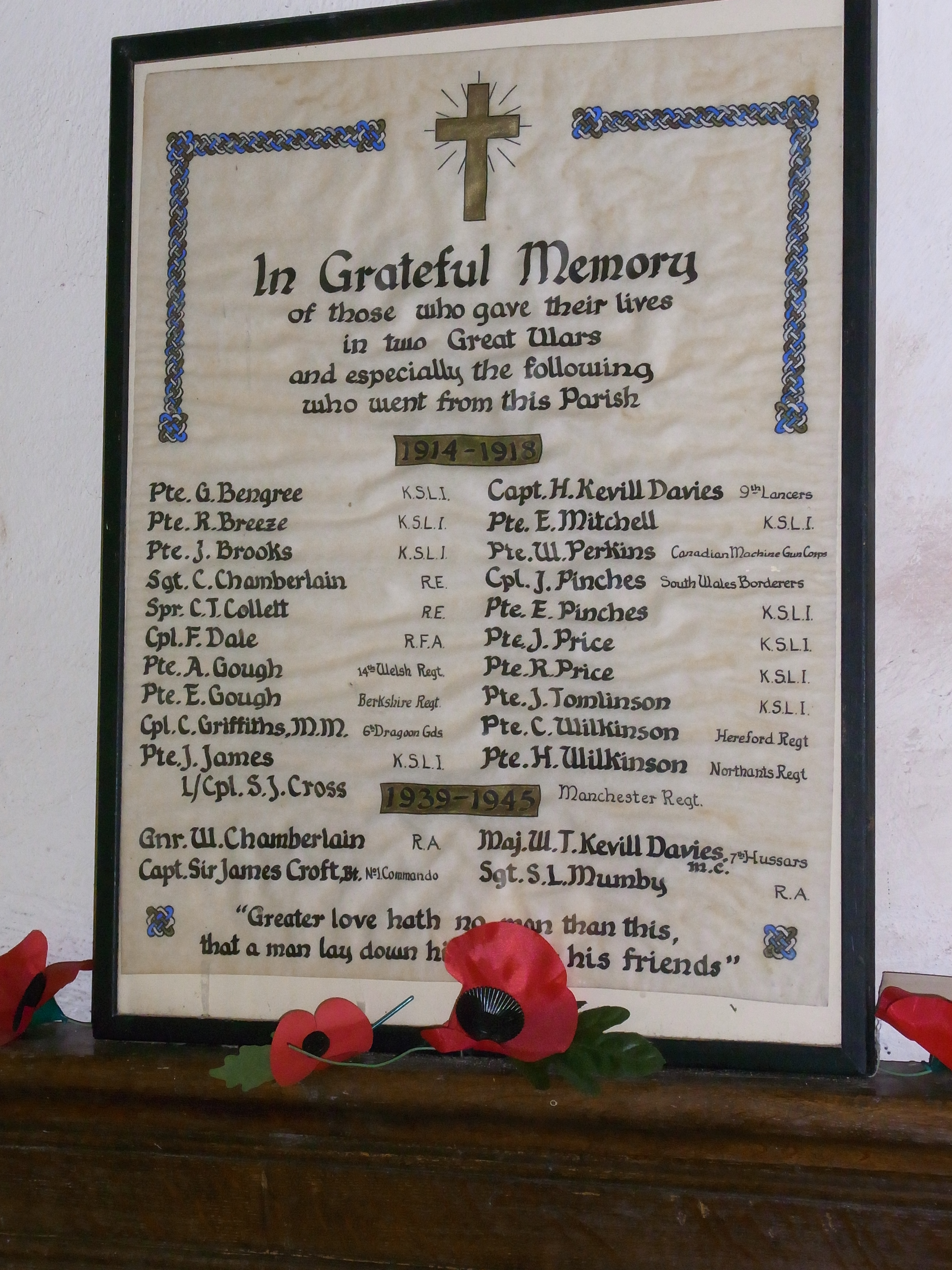
This got me thinking about creating female characters by looking at what they choose to do with their surname when they get married and what motivates them to behave in this way. I think we women fall into one of several camps when we walk down the aisle:
- The majority of us go with convention and take our husband’s name – so maybe we don’t want to rock the boat or stand out from the crowd
- Keeping our maiden name – this is the course usually followed by the famous but I know ‘ordinary’ women who have done this and get quite cross when they get lumped together with their husband as Mr & Mrs ‘Husband’s surname’. Could this be the basis for a fictional character desperate to carve her own way in the world or afraid of living in her husband’s shadow?
- Going double-barrelled – some couples choose to join their surnames together when they tie the knot. Could this a social-climbing couple? Double-barrelled names always sound quite posh to me.
- And there’s the choice of Mrs or Ms, if you don’t want the whole world to know you’re married. Why does a character who’s married want to keep it hidden?
Plus don’t forget until quite recently married women were often addressed by their husband’s Christian name as well as his surname, for example Mrs John Smith. An elderly lady in a story might unintentionally annoy her daughter-in-law by sending birthday cards addressed in this way.
Then what happens when we get divorced? Many of us (understandably) decide to revert back to our maiden names but those with young children might choose to keep their married name to avoid confusion. Or what about the high-flyer who’s made a name for herself in her married name – does she drop it or resentfully keep it?
So next time you’re dreaming up a female character think about her marital status and the surname and title she’s chosen to use – it might make you think about her in a whole new way.
Ireland’s Own
Posted by Sally Jenkins in Markets on May 28, 2012
I’ve never submitted a story to Ireland’s Own. It’s a magazine I’ve seen mentioned in womag circles but until I spotted it in my local WH Smith’s a couple of weeks ago, I’d never actually seen a copy.

The magazine has a very traditional feel, appealing mainly to the older generation. It contains lots of features, some of which are Ireland specific and a much smaller number that don’t have an Irish connection. In the edition I have in front of me, there are four 1-page articles in the ‘Just a Memory’ section – so if you grew up in Ireland there may be an opening here for your work.
There is one short story published each week. I’ve read two of these and they strike me as being quite gentle. One was about an old married couple where the husband had retreated into a silent world. His wife (from whose point of view the story was written) adopts a stray dog and this animal finds his way into the man’s heart and gives him a reason for living again. The second story was written from a child’s point of view and tells how she finds a new friend for her grandfather. Neither story featured anything particularly Irish other than the character names.
I’ve done a quick trawl of the internet and the only submission guidelines I can find for the magazine are those on the trusty Womag’s blog. Take a look here – the guidelines for articles and fillers are also included.
If any of you have recent experience of being published by Ireland’s Own, do let me know.
Meanwhile, I’m going to try emailing the magazine for Writers’ Guidelines and tweak a story previously rejected by People’s Friend – maybe by changing a few names to Patrick and Bridget!
Competition Round-Up
Posted by Sally Jenkins in Competitions, Poetry, Short Story on May 24, 2012
Some competition news for you today:
Balsall Writers’ Competition 2012
Balsall Writers’ Competition 2012 is open for submissions of short stories (up to 2200 words) and/or poems (up to 42 lines).
There is a £100 first prize, £75 second and £50 third prize. The entry fee is £4. It is an open theme with a closing date of 31/10/2012 and the results will be announced a month later.
An entry form is required and this can be found here along with full details about the competition.
Erewash Writers’ Group Competition Update
Debbie has been in touch from Erewash Writers’ Group with an update on the charitable donation part of their 2012 competition – this donation has now reached £50.00. Entrants to the competition can nominate a favourite charity to receive this money, the names will be put into a hat and drawn at the end of the competition. The closing date for the competition is 27th June 2012 and details are here.
5minutefiction First Birthday Competition
And a quick reminder that the 5minutefiction First Birthday competition closes on 1st June 2012. Entry is only £2 and the first prize is £100 plus e-anthology publication for the top entries. The e-anthology from the site’s earlier competition is now available here – for less than the price of a magazine!
Good Luck if you decide to enter any of these!
Email Antics
Posted by Sally Jenkins in Computers & Technical on May 21, 2012
I’m in the middle of switching email addresses – and it’s causing me a lot of grief!

I’ve used the same web mail address since we got our first home PC back in 1999 and for most of that time it’s worked fine. But over the last few months the service has been crashing out, refusing to load my inbox and freezing when I press ‘send’. I’ve been reluctant to switch to a new provider because:
- I liked my email address (it didn’t include any annoying numbers or dots to make it unique from every other person with my name)
- Like most writers I always have ‘stuff out there’ which obviously has the old address on as a contact point
- I guessed it would be a lot of hassle to change
However, there was only so many times I could put up with losing a carefully drafted email plus we’ve recently upgraded to BT Infinity at home – so I decided to bite the bullet and join the @btinternet.com clan.
I was lucky with my new email address – all I had to do was slip in my middle initial to make it unique and still appear businesslike. Then I jumped for joy when I saw that it was possible to import contacts from other email providers – but sat down heavily again when I realised my old provider was not amongst those listed as compatible. It looked like I had a long ‘copy & paste’ job ahead of me.
But there was good news when I found an option to get mail forwarded from other email addresses. I filled in the prompts and clicked ‘new mail only’. At least now it wouldn’t matter if I forgot to keep monitoring my old email – all those competition wins that are bound to come in over the next few months would be automatically forwarded to @btinternet.com!
Then, before my very eyes, my new inbox filled up with over 2,000 emails.
Every single email from my old address had been imported to the new!
This had advantages and disadvantages. I could open messages and click to add the sender to my new contacts list but a massive deletion job is now necessary. And I’m not finding it easy to delete whole page after whole page because I keep spotting something that might be useful…just like when I try sorting out books for the charity shop.
Somehow I reckon this job is going to drag on and on. Maybe it would be easier to go back to sending messages via pigeon or even in a bottle (which explains the odd illustration to this post – just in case you were wondering!)
Despite all this I can still be contacted via the ‘About Sally Jenkins’ page of this blog or please leave a comment below.
Annie Murray – Author Talk
Posted by Sally Jenkins in Authors, Books, Events on May 17, 2012
Yesterday I went to hear Annie Murray speak at my local library. Annie writes regional sagas set in Birmingham, each one  covering various segments of the 20th century up until the 1980s. I had expected her to be an older lady who had lived in the city all her life, with a family tree connected to the area for generations. How wrong can you be?
Annie is around my own age (which to my daughters does probably mean ‘an older lady’!) and she only lived in Birmingham for around 5 years during the 1980s. But this brief stay in the city was enough to ignite her passion for the city and it’s heritage. She has been producing novels set in the area for 20 years.
Annie describes her books as being like a ‘family album’ – charting the ups and downs of ordinary people. It is people who interest her rather than history and she adds just enough of her research to the books to give a flavour of the time.
“I’m often told how vivid my novels are,” she says, “but local people subconsciously imprint their own memories of the area on to the story – thus adding to what I’ve written without realising it.”
I asked Annie if she plans her books in great detail. “No,” she explains. “I know the beginning, the end and how many years it will span. I write a half page synopsis for my publisher but then my writing is like driving in the dark. My view forward of what’s going to happen is limited like the distance illuminated by a car’s headlights.”
Like most writers, Annie has had to combine her writing with bringing up a family and it’s often put on the back burner as she deals with her other responsibilities. But that doesn’t mean her work is completely stalled. Annie thinks that writers unconsciously dwell on their work all the time and that we should all learn to work with this.
As always, it was inspiring to listen to an author who has ‘made it’ and if Annie can write sagas spanning generations without a detailed plan maybe there’s hope for the rest of us that struggle to outline everything in advance!
The Famous Five are 70!
Posted by Sally Jenkins in Authors, Books on May 14, 2012
70 years ago, in 1942, Enid Blyton’s ‘Five On A Treasure Island’ was first published and, to mark the occasion, some of today’s celebrated

1st edition (Photo credit: Wikipedia)
children’s illustrators have been redesigning the covers of these adventure books. Quentin Blake has started the ball rolling with the Treasure Island cover which can be seen by clicking here. Compare Blake’s illustration with that of the first edition, which I’ve used to illustrate this post. I think I prefer the original but that maybe because it’s more the style I associate with the books from my own childhood. Other illustrators who’ve been commissioned for the new covers include Helen Oxenbury, Chris Riddell, Oliver Jeffers and Emma Chichester Clark.
It was Enid Blyton’s Famous Five that gave me the reading bug many years ago. I devoured her tales of Julian, Dick, George, Anne and Timmy the dog. How I wished I could join them as they swigged ginger beer, shared their ice creams with Timmy and slept on deserted islands on beds of springy heather.
I tried reading the Secret Seven but they just didn’t hit the mark in the same way as The Five.
Malory Towers was another of Blyton’s series’ that had me hooked. I read them over and over again. Even now the names Darrell, Gwendoline, Sally and Mary Lou immediately conjure up those characters that I loved as a girl. Boarding school sounded like a fantastic place to be.
And did anyone else read The Magic Faraway Tree? The story centred around a huge tree which had different lands at the top each day. It might be The Land of Dreams, The Land of Tempers or The Land of Presents. A group of children climbed the tree and, needless to say, had adventures in the different lands alongside the inhabitants of the tree, Silky and Moonface. My favourite thing in these books was the Slippery Slip – a helter-skelter type slide which allowed the children to whizz down the centre of the tree. I reread these books aloud to my daughters when they were young and enjoyed them just as much the second time around.
Enid Blyton comes in for a lot of bad press but in my opinion she did nothing but good for children’s literature. Her captivating stories enticed generations of youngsters to enjoy reading and books – and children who read for pleasure grow into adults who buy books and continue to read for pleasure.
Does anyone else have good memories of Enid Blyton’s books – or was I the only Blyton junkie in the early ’70s?
Related articles
- Five new Famous Five covers (bookwitch.wordpress.com)
- 21st-century Famous Five (guardian.co.uk)
What Makes A Good Poem?
Posted by Sally Jenkins in Competitions, Poetry on May 10, 2012
It was a good meeting at my writing group last week. There weren’t many of us but everyone had brought something to read and had also written it with a market in mind, including Woman’s Weekly, People’s Friend, National Women’s Register short story competition (restricted to NWR members only, unfortunately) and a Writers’ News competition.
But Iona had also written a beautiful poem that was looking for a home. It was a moving verse about a soldier trying to find peace. I liked the poem because it was accessible. It rhymed (and none of the rhymes were forced) and the language was easily understood. This led onto a discussion about whether poems should or shouldn’t rhyme and how some, much praised, poems are often difficult to understand.
I rarely write poetry (because I’m not much good at it) but when I do attempt the odd verse I automatically make it rhyme and try to give it some sort of recognisable meter. More often than not it tells a story too – I find purely descriptive poems difficult. But my poems usually end up sounding rather childish and I don’t know whether this is because of the rhyming or just a reflection of my poor writing.
Of course, not all free verse is difficult to understand, I’ve just discovered ‘You’re Beautiful’ by Simon Armitage – have a read, it’s wonderful.
What do you think makes a good poem? Should it have a recognisable form and meter or should the poet be free to compose however he or she wishes?
And just in case you’ve come over all poetic, I’ve found a free to enter poetry competition. Blue Mountain Arts is offering prizes of $300, $150 and $50. You can enter by email as many times as you like and the closing date is June 30th 2012. Full details are here. Interestingly they state, “Poems can be rhyming or non-rhyming, although we find that non-rhyming poetry reads better.”
Free Writing Books on Kindle
Posted by Sally Jenkins in Books, Resources on April 30, 2012
Those of you with a Kindle might be interested to know that there’s currently a range of books about writing, available for free (yes, £0.00) on Amazon.

Cover via Amazon
These include:
- The Writer’s Idea Book by Jack Heffron
This book has the subtitle ‘How to Develop Great Ideas for Fiction, Non-fiction, Poetry and Screenplays’. Heffron has been a professional editor for more than 15 years, has published many short stories in literary journals and won awards for his writing. Apologies, (this is embarrassing) but I’ve just been informed that this book is no longer free (thanks, Shirley!) but I’ve left the details here just in case the price is removed again (fingers crossed) - The Author’s Craft by Arnold Bennett.
‘Arnold Bennett writes in a very amusing and accessible style in this short manual of advice for authors which will be useful even to today’s writers,’ says a review. - Write Good or Die edited by the thriller writer Scott Nicholson.
This is subtitled ‘Survival Tips for the 21st Century’. One reviewer said, ‘It’s a gem of a book, not least because I came away from reading this with the thought that if the writers within this book can do it? Why can’t I?’.
I haven’t had chance to read any of these myself yet so can’t give a personal recommendation but I have just downloaded The Writer’s Idea Book in the hope of finding some inspiration. By the way, free books do tend to come and go on Amazon – so if you’re interested in any of these it’s probably worth getting them sooner rather than later.
Many thanks to Philip Mallinson whose post on Writing Magazine’s Talkback Forum alerted me to these books.
Iain Pattison
Posted by Sally Jenkins in Authors, Competitions, Resources on April 26, 2012
Whatever type of writing you do, there’s a lot to be learned from reading the output of those ‘further up the ladder’ and finding out about their working methods.
Iain Pattison is a prolific short story writer and has been widely published in magazines and anthologies. Twist endings are one of his specialities. He is also the author of Cracking the Short Story Market which covers all aspects of short story writing.
So it is fair to assume that Iain’s work and advice is worth reading if you are writing short fiction. Iain is currently one of the featured writers at The Word Hut. There’s an interesting interview with him here in which he reveals his background, views on the growing ease of self-publishing plus a bit of sensible advice for budding writers. The site is also showcasing one of his winning stories An Ugly Way To Go – have a read, it will make you smile.
If Iain’s writing and advice inspire you to pick up a pen or put fingers to keyboard, then The Word Hut are running a short story competition for stories up to 1000 words, closing date 13th May 2012.
Or you might like to try writing a piece of flash fiction including the words knit, blunder, perform and tingle. Helen Yendall is running this competition on her blog and full details can be found here. The prize is a copy of Linda Lewis’ brand new book ‘The Writer’s Treasury of Ideas’ and the closing date is 9th May 2012.
Good Luck and, in the wise words of Iain Pattison, “Keep churning out work. Be a word factory. Soon as you’ve finished one story, start another.”
P.S. Iain is judging the Writers’ Bureau Short Story Competition this year (first prize £500 and closing date 30th June 2012).
 Sally Jenkins