Short Stories for the Weekly News
Posted by Sally Jenkins in Markets on January 21, 2011
The Weekly News prints three short stories a week. However, it is a market that is sometimes overlooked by writers targeting women’s magazines because it is published in newspaper format and can be difficult to find in the newsagent. I buy my copies in WHSmith or Tescos.
The Weekly News is aimed at a family audience of males and females across all ages. The short stories accepted for publication reflect this. It is not a market for romance or anything too ‘female’ orientated. In an interview for a past issue of Writers’ Forum Jill Finlay, the fiction editor said, “We like funny stories or happy endings but also something slightly darker, edgier – blackmail, the occasional murder – but please, more black humour than shock-you crime.”
Jill is also a fan of twist in the tale endings and topical stories.
Stories range in length from around 800 to 2000 words. They are generally written in the third person and often from a male point of view.
I studied a couple of recent issues and in the first all three stories had a twist ending although they covered different topics:
- A story that appeared to be about a manned mission to Mars turned out to be children playing a game
- A story that appeared to be about a pilot flying a plane turned out to be a man driving to the airport and back in the middle of the night to lull the baby to sleep
- A disgruntled train commuter on her last journey to work before she switched jobs – to Customer Services Manager for the train company.
In the second issue I looked at, twists were popular again:
- A supermarket car park attendant issuing cash fines to customers parking illegally in disabled spaces turns out to be an ordinary woman just pocketing the money for herself
- A lady joins the gym to get fit for her 50th birthday party but hates it. However she does find a keep fit routine that suits her and is able to make a grand entrance to the party – as a belly dancer.
- A lady in bed and unable to sleep yet again because of the noise from the party next door. She finally cracks, gets up and goes to the shed to get something before joining the party – with two bottles of wine.
Some of the plots above may have lost something in my re-telling (apologies to the authors) but you get the idea of the type of thing that Jill Finlay chooses for The Weekly News fiction pages.
Submission is by email only to jfinlay@dcthomson.co.uk. Further detailed guidelines can be found on Womagwriter’s Blog.
And if you’re visiting my blog for the first time, click here for details of my free prize draw.
Improve Your Reader’s Mood
Posted by Sally Jenkins in Books, Competitions, Markets, Writing on January 17, 2011
As you write do you consider how your words will affect your reader’s mood? Will he be uplifted to a better place or left wondering whether or not to slit his throat? 
The Reading Agency and BBC Headroom have worked with reading groups to identify a selection of ‘Mood-busting Books’ that should leave you with a smile. The list includes The Uncommon Reader by Alan Bennett, Cold Comfort Farm by Stella Gibbons, My Family and Other Animals by Gerald Durrell and The No.1 Ladies’ Detective Agency by Alexander McCall Smith.
I think it’s hard to write something that makes a reader a happy. It’s so much easier to make a story out of tragedy or misfortune – after all if everything is going swimmingly for your characters, where’s the conflict that we are told is an essential element of every piece of fiction? A death, divorce or double-dealing fraudster immediately threw up dozens of plot lines but it’s harder to make a compelling piece of fiction out of happy family life. Making your reader feel good is much more of a challenge than making them feel sad.
Judges of short story competitions often complain that there are too few entries that make them smile. Imagine wading through a couple of hundred stories dwelling on the harsher side of life – the one story that can make you laugh and raise your mood must make it to the short list.
So why not read one of the mood-busting books above and then practise some ‘feel-good’ writing – January is dismal enough without making it worse with massive amounts of melodrama.
To get the creative juices flowing, here are a few places to target with your smiley stories and pick-me-up poems:
- The Marple Short Story and Poetry competition is offering a special prize for the best humourous poem submitted
- East of the Web publishes short stories online and has a humour section – unfortunately there is no payment other than a page to publicise yourself, including links to your own blog/website.
- Chicken Soup for the Soul publishes inspirational books, comprising a selection of short pieces on a particular theme designed to encourage, comfort or amuse. They are currently looking for submissions around themes such as weddings, Canada and marriage. The full list is here.
And if you just want something to cheer yourself up during these grey weeks – enter my free prize draw.
Two American Short Story Markets
Posted by Sally Jenkins in Competitions, Markets, Writing on January 13, 2011

Image via Wikipedia
The beauty of the internet is that it brings the world into our living-rooms. We can target markets across the globe without worrying about the cost of international postage and how to include a stamped addressed envelope for a reply.
Here are two American websites to which I’ve submitted work:
- Long and Short Reviews specialises in romantic fiction. Their main function is to review full-length novels, however every Thursday they publish a short story. Stories must be between 1000 and 1500 words and contain a strong romantic element and a ‘happy ever after’ or at least ‘hopefully happy ever after’ ending. Payment is minimal ($5 plus a free 1 month advert if you have a book that you want to promote) but they include a short biography with each story in which you can include your website/blog. Full submission details are here. I submitted a story originally written for the UK women’s magazine market. It had done the rounds here without success but I didn’t want to consign it indefinitely to my desk drawer. The story is available to read here on the Long and Short Reviews site. By the way Long and Short Reviews has a sister site, Whipped Cream, that deals with erotic fiction – so don’t be shocked if you see that mentioned in the submission guidelines on the site!
- The second market is a regular competition organised on the Readingwriters site. Each competition has a different theme and varying word count so you need to check the current requirements. I like these competitions because they are free to enter but offer a $100 prize and the judging procedure allows you to see how near (or otherwise) you were to winning. The stories that got through the first round of judging are listed on the website, then a bit later those that got through the second round of judging and finally the winner’s name plus ‘honourable mentions’ are published. The winning story is posted on the site along with a critique by the judge.
So why not send your work across the pond and see if you can make it big in the US!
Failing that, sign up for email updates to this blog and enter the prize draw for a set of Stieg Larsson books. For details, click here.
The Other Hand by Chris Cleave
Posted by Sally Jenkins in Books on January 10, 2011
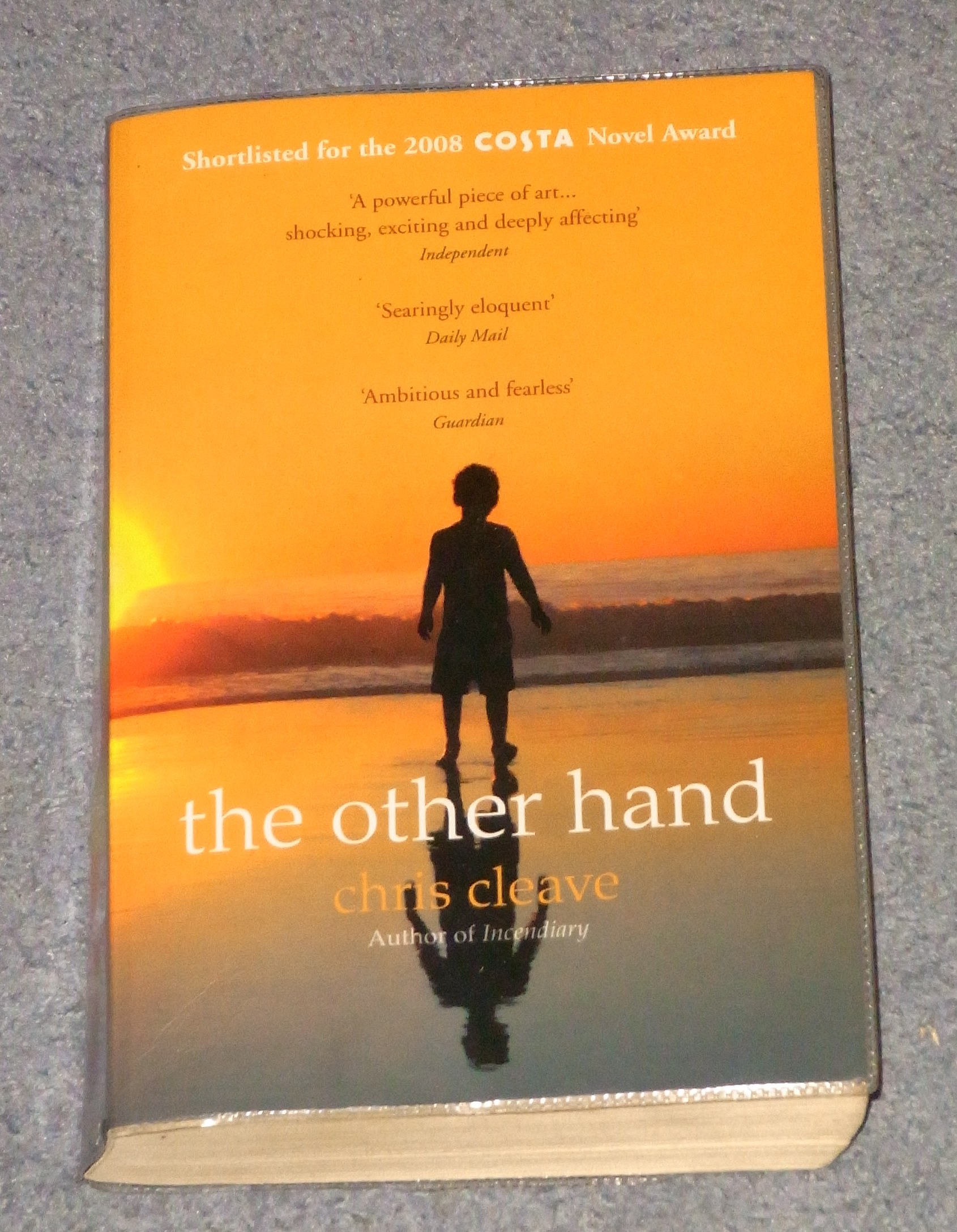 If you’re trying to find a way of structuring your novel take a look at The Other Hand by Chris Cleave, which was shortlisted for the 2008 COSTA Novel Award. It is a compelling story about two very different women. Their first meeting is brief and takes place before the story begins but two years later their lives collide again.
Point of view in the book alternates, a chapter at a time, between these two main protagonists. Each character’s version of events deals with the present day and also includes flashbacks over the previous two years. But the really clever bit in this book is the way author drip feeds information to the reader – just as we think we know the history of these two women, another surprise is dropped in.
Chris talks about the structure of the book on his website and the difficulties that he encountered. He says, “Using two narrators is difficult though. To differentiate their vocabulary, grammar and idioms is quite straightforward if you make an effort to understand and inhabit the characters, but the hard thing is how you handle the overlaps and the gaps in the characters’ knowledge. When both narrators have witnessed an event, which one will you choose to recount it? Or will you let both of them tell it, and play with their different perspectives on what they’ve seen?”
Chris’s difficulties are compounded by the fact that he is a man trying to get inside the minds of two women from very different backgrounds. But Chris sees that as an advantage – because he must concentrate so hard to become a character so different from himself, there is no danger of him accidentally using his own voice instead of that of his characters.
He describes a novel as an intricate engine and says, “if you change one little piece here, it can throw the whole thing out of equilibrium way over there.”
The terrible events in this book haunt the reader because they are probably happening to someone, somewhere, right now. I’d love to tell you more about the story itself but the blurb on the back of the book reads, “once you have read it, you’ll want to tell your friends about it. When you do please don’t tell them what happens. The magic is in how it unfolds.”
And how the story unfolds is all down to the clever structure – something the Telegraph describes as “a feat of literary engineering.”
It’s a book well worth reading (if you’re in the US, this book is available there with the title ‘Little Bee’).
And if you fancy some free books to read don’t forget the easy to enter prize draw running on this blog. Click here for more details.
Become a Weekend Writer
Posted by Sally Jenkins in Markets, Successes, Writing on January 6, 2011

Image via Wikipedia
If you’d like to get published in the weekend newspapers have a look at my article in the February 2011 edition of Writing Magazine.
It’s extremely difficult to get a feature in one of the weekend nationals unless you have a well-established track record in journalism. However, many of the papers have ‘filler’ slots and actively ask for people to fill them. To list just a few:
- Confessions of a Tourist in the Sunday Times
- What I’m Really Thinking in the Saturday Guardian
- Just Back in the Saturday Telegraph (which I seem to have missed out of the article)
There’s also the letters’ pages to consider (the tabloids tend to pay whilst the broadsheets don’t) and have a look at your local regional weekend papers – these are often easier to break into than the nationals, especially if you have a story with local human interest.
As always market research is the key to success with any of these markets – buy and read several issues before you submit. It’s essential to get the tone and content of your piece just right.
If you’d like to know more about this area of writing then have a look at the full article in Writing Magazine.
Don’t forget the prize draw running on this blog at the moment, click here for more details. If you’ve already entered and haven’t received your confirmation email, please check your spam folder.
Books to be Won!
Posted by Sally Jenkins in Competitions on January 3, 2011
One of my goals for 2011 is to grow the readership of this blog – it can feel quite lonely sitting here, prattling away and  not knowing if anyone will read it!
I plan to do this in 2 ways:
- Include information that can be ‘used’ (e.g. markets, competitions and writing tips etc.) in as many posts as possible
- Hold a prize draw
The draw prize is the 3 best-selling books in the Millennium Trilogy by Stieg Larsson. If you’ve already enjoyed these novels about Lisbeth Salander, the girl with the dragon tattoo, then they’d make a great gift for a book-loving friend.
To be in with a chance of winning, all you have to do is use the box to the right of this page to sign-up for email updates. This means that each post on my blog will be sent directly to your inbox. You can un-subscribe at any time (although I hope you won’t!).
Simply enter your email address at the Email Subscription heading to the right of this post. You will receive a confirmation email asking you to confirm your subscription and then, hey presto!, you’re done.
Everybody on the subscription list on Friday 4th February will be entered into the draw – including those of you that already subscribe. I will contact the winner via email and when he/she has confirmed their name and address, I will announce the result here. I will also give a plug to the winner’s blog, book or anything else (writing related) they wish to publicise.
Please note the books can only be posted to UK addresses (excluding the Channel Islands).
N.B. If you prefer to manage your blogs via RSS Feed you can still enter the draw. Just add this blog to your feed, contact me via the form on my ‘About’ page and I will enter you into the draw.
Another couple of things I’ve thought of since originally posting this:
- If I can’t get hold of the winner within 14 days of the draw taking place then I reserve the right to re-draw (so let me know in advance via the contact form on my ‘About’ page if you’re going away).
- If your confirmation email isn’t coming through – check your spam folder in case it’s hiding there
Best of Luck!
The Enfield Mayor’s Poetry Competition
Posted by Sally Jenkins in Competitions, Poetry on December 30, 2010
I’ve just come back from visiting my mother-in-law in North London. She took me to see the lovely new library in Enfield and whilst I was there I picked up some information on The Enfield Mayor’s Poetry Competition with a £500 first prize. There is £200 and £100 for second and third places plus a special prize of £50 for a poem using Enfield as its theme. The closing date for the competition is 31st January 2011 and it will be judged by Mario Petrucci.
The competition is open to anyone aged 16 or over. Poems must be previously unpublished and not exceed 50 lines. Entries should not identify the author but a cover sheet should be included giving contact details. No entry form is required. The entry fee is £3 per poem or £10 for 4 poems. Full details and comprehensive rules (including where to send your poems) can be found by clicking here.
The purpose of the competition is to raise funds for the mayor’s charity appeal which, this year, is supporting the arts in Enfield.
Best of luck to all you poets out there!
Can men write romance?
Posted by Sally Jenkins in Authors, Writing on December 27, 2010
Can a man get inside the mind of a woman as she falls in love? Can he describe the emotional roller coaster we women travel when we think we’ve found ‘the one’? If, as many believe, men are from Mars and women are from Venus, then how can a male know what goes on in the female mind?
I started thinking about this after reading the latest issue of Romance Matters (the magazine of the Romantic Novelists’ Association) . It features an interview with Roger ‘Gill’ Sanderson. Roger writes medical romances for Mills and Boon and has published 47 books since 1996. He says, ‘Love is a universal emotion. If you’ve been in love you must have sympathy with women.’ However, he does admit to asking for help occasionally, especially in the area of women’s clothing!
Roger isn’t the only man writing romance. Bill Spence is also a member of the RNA and writes historical sagas as Jessica Blair. He served in the RAF during World War II and started his writing career with Westerns before moving on to sagas in the early 1990s.
Michael Taylor is another British author who has found success in writing about love. He came to talk to my writing group a couple of years ago and was as far from the pink, fluffy Barbara Cartland image of a romance writer as you can get. His books are set in the past and he spends a lot of time researching his novels.
Michael says, “Men are at least as capable as women of feeling emotion, and are no less as vulnerable in love and out of it.”
He says that he found the romance, ‘Lorna Doone’ (also written by a man), moving and sensitive and one of the inspirations that started him writing.
In fact in 1906 ‘Lorna Doone’ was chosen by male students at Yale as their favourite novel – perhaps showing that men and women are not as different as we might think.
I haven’t yet read any of Roger’s or Bill’s books but I have read ‘Clover’ by Michael Taylor. I enjoyed the well-drawn characters and authentic period setting but I think it might have turned out to be quite a different book if Michael had been a woman. One of the main protagonists is Ned Brisco, who is trying to build and fly an early aircraft. If the author had been female, I think more emphasis would’ve been given to the heroine trying to make her mark on the world and less on the technicalities of this invention.
But it’s not possible to say which would have been the better book. Men and women can both write well about love because it is a universal emotion. However, the two sexes will give a different emphasis to other parts of the supporting story depending on their own interests and outlook on life.
Variety is the spice of life so – Vive la difference!
Merry Christmas Everybody!
Posted by Sally Jenkins in Resources, Writing on December 23, 2010

Image via Wikipedia
Christmas is coming and time is in short supply so just a quick post to wish you all:
A Very Happy Christmas and a Successful Writing Year in 2011!
And in case you get bored over the next few festive days here are a couple of websites to keep you busy.
If you’re looking for a market for your work try www.magazinesabout.co.uk
This site allows you to search on a subject, such as knitting, in order to find a magazine to target with your article.
Or if you’re looking for inspiration try www.sixtysecondwriter.blogspot.com
This site provides lots of prompts for short fiction – but of course you could use them for any sort of writing.
Reader’s Digest 100 Word Story Competition
Posted by Sally Jenkins in Competitions, Writing on December 19, 2010

Image by העין השביעית • the7eye.org.il via Flickr
See Results update at the end of this post.
Reader’s Digest are running a 100 word story competition. Stories should be original, unpublished and exactly 100 words long (99-worders will be disqualified). The title will not be included in the 100 words.
Email your stories to theeditor@readersdigest.co.uk by January 31. The winner will receive £5,000 and the two runners-up a £100 book token each. All 3 stories will be published in Reader’s Digest.
There is also a schools’ section to the competition with the winner in each of the 2 age groups getting £1000 in high street vouchers plus £1000 for the winners’ schools.
Full details of the competition can be found here.
However; there has been some controversy in writing circles about the terms and conditions of this competition. These state that ‘contributions become world copyright of Vivat Direct Ltd (t/a Reader’s Digest)’.
This means that Reader’s Digest take the copyright of all stories entered, not just the winning stories that are published in the magazine – therefore you couldn’t then publish or enter your (winning or losing) story in a similar competition elsewhere. There has been discussion about this on the Writers’ News Talkback Forum, with the participants split between those willing to give up copyright on their story for the chance to win £5,000 and those who thought that writers should never give up copyright on anything without some form of payment or acknowledgement.
Gill Hudson, editor-in-chief of Reader’s Digest, explained the policy to Alex Gazzola in the January issue of Writers’ News.
“We’ve had to do it this way beacuse, with the small team we have, and the sheer practicalities of thousands of entries, I don’t think we could run this competition if we had to deal with all the various rights, permissions and queries that could potentially arise.”
You will have your own opinion about whether you want to give away your carefully crafted 100-word story in exchange for a chance at a £5000 jackpot. Personally, I think it’s worth the gamble. I do recycle work that is rejected by its original target market or fails to make the grade in a competition. However, I usually find that the work has to be tweaked in some way before it can be resubmitted, this may mean lengthening or shortening it or changing the tone slightly to fit the new market. I expect this would be the case if I wanted to recycle my 100 word story for another micro fiction market – it may have to be moulded to fit a set theme or again, made longer or shorter to suit the new requirements.
So, I will make a note on the filed copy of my entry, to remind myself to wait until the results of the Reader’s Digest competition have been announced and then (if I lose) to change the story substantially before resubmission.
POST UPDATED 21 APRIL 2011
The winner is announced here. The standard of writing was so high that Reader’s Digest have decided to feature one story a day on their website – please leave a comment if yours is featured so that we can all admire it!
 Sally Jenkins