Archive for category Resources
Iain Pattison
Posted by Sally Jenkins in Authors, Competitions, Resources on April 26, 2012
Whatever type of writing you do, there’s a lot to be learned from reading the output of those ‘further up the ladder’ and finding out about their working methods.
Iain Pattison is a prolific short story writer and has been widely published in magazines and anthologies. Twist endings are one of his specialities. He is also the author of Cracking the Short Story Market which covers all aspects of short story writing.
So it is fair to assume that Iain’s work and advice is worth reading if you are writing short fiction. Iain is currently one of the featured writers at The Word Hut. There’s an interesting interview with him here in which he reveals his background, views on the growing ease of self-publishing plus a bit of sensible advice for budding writers. The site is also showcasing one of his winning stories An Ugly Way To Go – have a read, it will make you smile.
If Iain’s writing and advice inspire you to pick up a pen or put fingers to keyboard, then The Word Hut are running a short story competition for stories up to 1000 words, closing date 13th May 2012.
Or you might like to try writing a piece of flash fiction including the words knit, blunder, perform and tingle. Helen Yendall is running this competition on her blog and full details can be found here. The prize is a copy of Linda Lewis’ brand new book ‘The Writer’s Treasury of Ideas’ and the closing date is 9th May 2012.
Good Luck and, in the wise words of Iain Pattison, “Keep churning out work. Be a word factory. Soon as you’ve finished one story, start another.”
P.S. Iain is judging the Writers’ Bureau Short Story Competition this year (first prize £500 and closing date 30th June 2012).
Quotes About Writing
Posted by Sally Jenkins in Resources on April 16, 2012
In the last week I’ve come across a couple of quotes posted on Facebook about writing and I thought you might like them as much as I did.
Jackie Sayle posted the first one, by the German novelist and short story writer, Thomas Mann, in the Bring Back Fiction to Women’s Magazines! group. I related to it instantly – what do you think?

This one, posted by Marilyn Rodwell, made me feel inspired – hope it does the same for you!

Out of My Depth!
Posted by Sally Jenkins in Authors, Resources, Writing on March 26, 2012
I’ve mentioned before my intention to enter the Good Housekeeping Novel Writing Competition and I’ve been beavering away at my entry since January. I wrote 20,000 words and then paused to take stock and prepare my entry which had to consist of the first 5,000 words plus a full synopsis. The synopsis was a challenge because until then I’d been writing without a detailed plan but after some thought I managed it.
Then I decided to send the 5,000 words and synopsis to novelist Patricia McAughey (who writes as Patricia Fawcett) for a critique. Patricia reads for the RNA New Writers’ Scheme and also runs a reasonably priced private critique service for all types of fiction except fantasy, sci-fi or children’s. She can be contacted through her website for a quote.
Patricia sent me a detailed report which very tactfully told me that my story didn’t work because I was still in ‘short story’ mode. She said, “Slow down. You are rushing things. I know it is tempting to try to get all the ideas down but you are writing a longer piece and there is no rush. Relax.”
She went on to explain that I was giving the reader no idea about the setting. One of the scenes was in a Derbyshire cafe but I didn’t describe the interior, the waitress, the view or even indicate whether the place was full or empty. Patricia suggested painting a broad picture of the scene and then honing in on small details such as a woman trying to get a pushchair through the gap in the chairs.
There was a similar problem with my characters. Patricia said, “… I don’t have any great affection as yet for either of the two central characters simply because I don’t know enough about them…”. I had omitted rather obvious details like what the heroine did for a living or what she looked like!
It wasn’t all doom and gloom. I did get words of praise for my dialogue (which I love writing) and my synopsis.
So if you’re trying to move from short stories to longer fiction, take a moment to check that you’ve added depth to your writing. Make sure you haven’t skimmed over the setting or the characters’ backgrounds. Have you described what it smells like in the kitchen? Have you mentioned what your hero is wearing as he meets the heroine for the first time?
Later this week Patsy Collins, a successful short story writer and debut novelist, will be guesting on this blog and attempting to explain how she made the leap from short stories to seeing her first novel published.
How Do You Create Your Characters?
Posted by Sally Jenkins in Resources, Writing on February 16, 2012
How do you make the people in your fiction (longer fiction especially) well-rounded, believable individuals that the reader might care about?
In short stories it isn’t always necessary to know all the details about a character, for example it may be enough to know that the heroine is a grandmother and not her exact age or her previous profession (if any). But when attempting to write something longer, facts like these become important so that the writer can concoct a suitable back story for the lady, so it may be useful to know in what decade she was a teenager, at what age she left full-time education and whether or not she became a working mother. The life which the grandmother lived before the novel opens will have a bearing on how she acts and reacts within the story – so both the author and the reader need to know what went before.
Some writers advocate filling in a questionnaire about each character, covering physical appearance, hobbies, education etc (a sample questionnaire can be found on Stewart Ferris’ website here). This is a useful way of keeping track of facts such as eye colour and height (easy things to forget as you get deeper into the plot).
However, I find it very hard to just jot down a sentence or two about the big things such as a character’s personality, attitude to life and motivation. In order to get know a protagonist I have to start writing scenes from his or her point of view. It’s only as I write that I realise what I don’t know about a character and therefore what I need to put into their back story to make them act in a certain way in the present. This means I don’t do much planning before I write because I have to write in order to create the characters.
Some writers cut pictures from magazines and use these as prompts for their characters. But this only covers their physical appearance – so I’m not sure it would help me.
Nicola Morgan advocates interviewing your main character (her list of suggested questions is here and they are pretty searching!) Most of these I couldn’t have answered when I initially decided on the people I needed in my story but now I’ve written a bit from each point of view I’m going to pretend I’m a chat show host and start asking questions.
What about you – how do you develop your characters?
Writing Competitions – the way to win
Posted by Sally Jenkins in Books, Competitions, Resources on September 19, 2011
In my quest for success I’ve started reading ‘Writing Competitions – the way to win’ by Iain Pattison and Alison Chisholm. It covers short story, poetry and article writing contests.
Chapter 2 deals with targeting the right sort of competitions to increase your chances of success. Iain and Alison advise a few ways of doing this:
- Forget the big internationals and concentrate on small competitions that will attract fewer entrants. Not many of us are likely to get anywhere in something like the Bridport but we might stand a chance of being placed in a local writing competition. I would much rather win a book token in a small competition than see my entry disappear into the black hole of well-publicised literary contest.
- Choose a competition with a difficult theme – this will put many entrants off because it’s too much of a challenge and a previously written story can’t be recycled to fit the subject. Competitions with an open theme attract the most entrants.
- Try competitions where entry is limited by the rules – for example competitions restricted to unpublished writers or to writers of a certain age or to those living in a specified area
Iain and Alison also advise targeting contests where the entry fee is high compared to the prize fund. This is because we are all naturally mean and therefore the number of entrants will be low. I’m afraid my own natural meanness won’t let me endorse this advice but I can see that there is logic in this method of choosing where to send your work. So if you’re not as tight with money as me, you might want to try it.
And speaking of relatively small competitions (& I don’t mean that in a derogatory way), Bev Morley is running a short story competition on the theme of ‘Christmas’ via her blog. First, second and third prizes are £50, £25 and £10 respectively plus publication in a Kindle anthology, up to 12 further stories will also be included in the anthology. The word limit is 3,000 and closing date 30th September. Entry by email only and the fee is £3. Full details are here.
‘Writing Competitions – the way to win’ is worth a read if you want to increase your chances of success in competitions.
Work Your Way Magazine
Posted by Sally Jenkins in Markets, Resources on September 12, 2011
The launch issue of Work Your Way Magazine dropped through my letter box recently. It’s a quarterly magazine aimed at freelance, self-employed and entrepreneurial mums – categories that lots of us writers fall into.
In her first ‘Letter from the Editor’, Mary Cummings describes the magazine as a ‘celebration of all you fabulous mums who have split the nine to five office scene and are now working from home’.
Mary has used a variety of freelance contributors (I know because I am one!) to source the wide range of features in the magazine. The areas covered include:
- Family – features on Raising Confident Kids, Parenting a Child with Special Needs and A Day in the Life of a Freelance Mum
- Work – features on Coaching To Help You Move Forward, Good Customer Care and an interview with Carol Savage of mydish.co.uk, who secured a £100,000 investment from Deborah Meaden on Dragon’s Den
- Top Tips – features on How Much Should I Charge?, Blog for Business (that’s me!) and Cash in Your Bookcase
- Health and Well-being – features on A Good Night’s Sleep, What to Avoid When Working from Home and Yoga
The magazine also has a flourishing website which is currently asking for online contributions. Click here for details.
Work Your Way features in Writing Magazine this month (October 2011 issue) as a case study for Elaine Everest’s article How to Set Up a Start-up. In it Mary describes how she got the magazine off the ground.
If you fancy getting your hands on a copy of Work Your Way and picking up some useful information about the freelance life, visit the website for details of how to subscribe.
San Francisco and Writer’s Digest
Posted by Sally Jenkins in Competitions, Non-writing, Resources on September 5, 2011
I’m back!
I had my bike ride – it was across the Golden Gate Bridge & I had my icecream – in the heart of San Francisco. (Apologies for the white lie about my holiday but I’m currently wrangling with my car insurance over the theft of my car a few weeks ago and it made me feel vulnerable about announcing to the world that the house would be empty.)
Amongst many other things we visited the San Francisco Museum of Modern Art. It contains a video installation that explores the art of story telling ‘without a beginning or an end and with no character or plot development’. I’m sure if we tried this as writers our work would be swiftly rejected. Maybe it’s different in the art world…
I also bought a copy of the US writing magazine ‘Writer’s Digest’. It seemed quite thin compared to our own Writing Magazine and Writers’ Forum but there are a few things of interest on its website:
- A series of writing prompts – responses of up to 500 words can be posted on the site or you could just use them to kick-start your own writing
- Various competitions such as one here for a 1500 word story.
- Writing Tips
- Writing articles cargorised by genre such as Romance, Horror, Memoir etc.
So, if you fancy an insight into the US writing scene, take a look at the site.
48 Minutes to a Magazine Article
Posted by Sally Jenkins in Resources, Writing Exercises on August 11, 2011
This post is being brought to you in association with Sally Quilford’s 48th Birthday Celebrations on August 11th 2011.
Many of us whinge that we don’t have enough time to write. Home and work commitments are always getting in the way -I use this as an excuse for my lack of writing as much as anyone. So, here is a 7 day plan that involves writing for just 48 minutes per day and by the end of it you should have a short article all ready to go.
- Day 1 – visit a large newsagent and spend 48 minutes finding your market. Look for a magazine that covers something you know at least little about (i.e. write what you know so that the research isn’t too onerous). Check out the list of staff in the front of the magazine and compare to the ‘by’ lines on each article in order to check how much is written in-house and much is freelance provided. Buy the magazine you think you could write something for. (N.B. In a perfect world you would buy 2 or 3 issues of the magazine over a number of weeks/months in order to get a feel for which articles are regular columns and which are the one-off freelance features that we are aiming at) .
- Day 2 – make yourself a cup of coffee and sit down with a large sheet of paper. Set a timer for 48 minutes and then brainstorm! Dream up as many article ideas as possible for your chosen publication. For example, if you’ve chosen a dog magazine then your list could include ‘How to Choose a Dog Walker’, ’10 Tips for Taking Your Dog on Holiday’ or ‘Famous People and their Dogs’.
- Day 3 – choose which of the articles shows the most promise and spend 48 minutes writing an outline. Include an introduction (not too long – get straight to the point of the article), each point that you want to make and a conclusion.
- Day 4 – pitch the idea, via email, to the editor of the magazine. If you want some help on how to put together the perfect pitch have a look at Simon Whaley’s article here.
- Day 5 – start writing the article. If you don’t want to stop after 48 minutes that’s fine – keep going whilst the enthusiasm is high! Hopefully by now you’ll have stopped looking for displacement activities like cleaning out the kitchen cupboards.
- Day 6 – finish writing the article. Then find someone to read it aloud to – this will help you spot clumsy sentences, missing words, bad grammar etc. (this bit can be in addition to the 48 minutes since it can involve the rest of the family and therefore isn’t strictly ‘writing time’).
- Day 7 – spend the last 48 minutes having a final read through the article and then, submit !
For the purposes of simplicity I have assumed that the above activities will take place on 7 consecutive days. In reality there will probably be a gap between days 4 and 5 whilst you wait for a response to your pitch (fill this gap by starting work on a second idea). It might also be wise to leave a gap between days 6 and 7 so that you can re-read the article with fresh eyes before sending it off.
That just leaves me to wish Sally a ‘Happy 48th Birthday’ and thank her for the challenge to write a blog post based on ’48’.
The New Writer Magazine
Posted by Sally Jenkins in Competitions, Markets, Resources on July 25, 2011
The New Writer is a subscription only, quarterly writing magazine. Each edition includes a mix of features, fiction and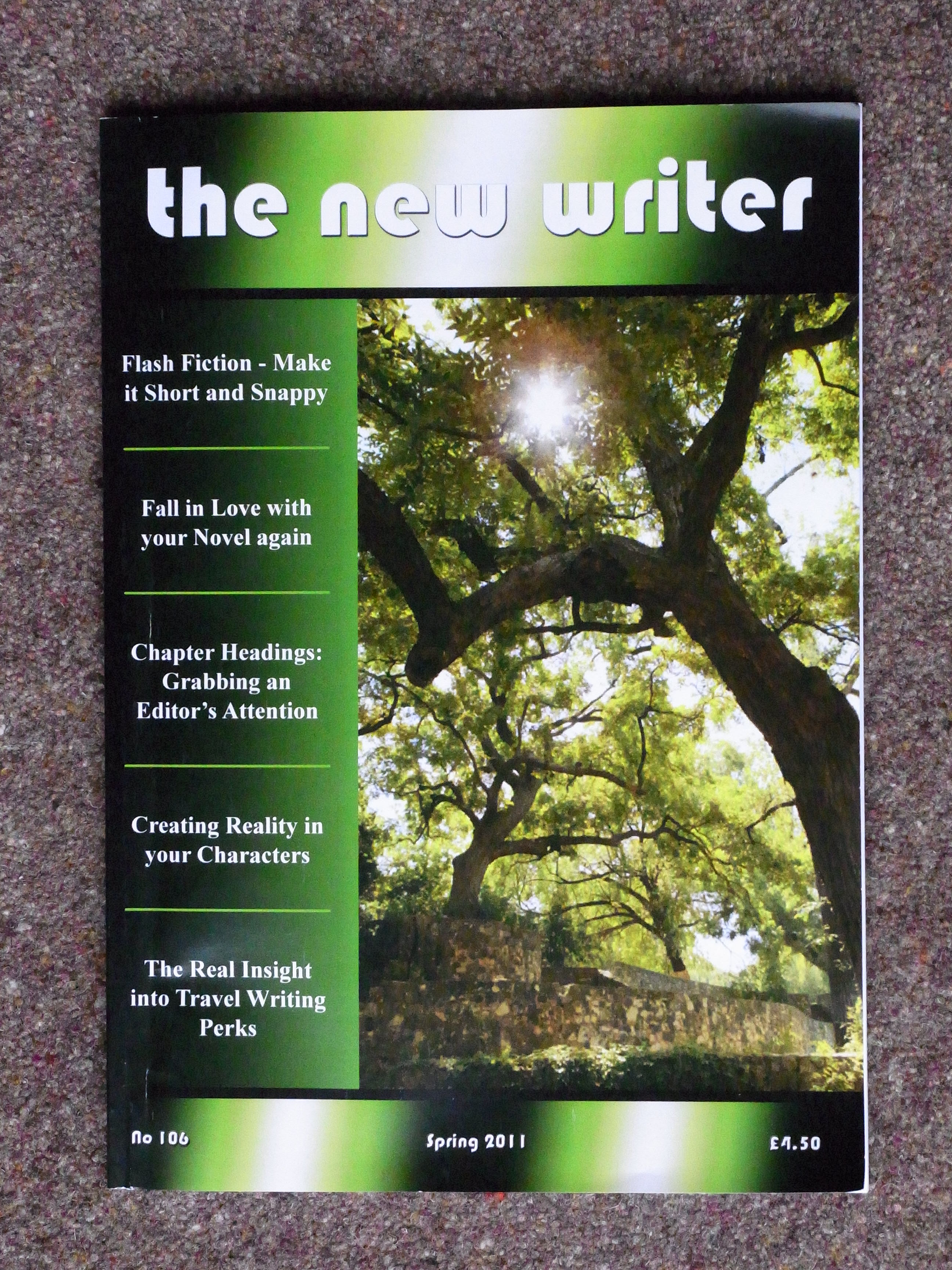 poetry along with regulars such as a Writers’ Circle Clinic by Simon Whaley.
The New Writer doesn’t have the glossy finish of Writing Magazine or Writers’ Forum nor does it have pages of adverts. I think the magazine has a cosy, friendly feel. The Spring 2011 edition included features on ‘First of a Million Kisses’ by romance writer Sally Quilford, ‘Travel Writing Perks’ by Roy Stevenson and ‘Make it Short & Snappy’ by me (!).
The magazine is open to unsolicited articles and features (for which it pays a small amount). Poetry is also accepted but fiction is restricted to guest writers, subscribers’ stories on a given theme and competition entrants.
The New Writer runs an annual Prose and Poetry Competition with 5 categories:
- Micro fiction – up to 500 words (2 entries for £5 or 3 entries for subscribers)
- Short stories – 500 to 5,000 words (1 entry for £5 or 2 entries for subscribers)
- Single poems (2 entries for £5 or 3 entries for subscribers)
- A collection of 6 – 10 poems (£12 entry)
- Essays, articles and interviews on any writing related subject – up to 2,000 words (1 entry for £5 or 2 entries for subscribers)
The annual closing date is 30th November and the prizes are:
Micro Fiction: 1st prize £150, 2nd £100, 3rd £50.
Short Stories: 1st prize £300, 2nd £200, 3rd £100.
Single Poem: 1st prize £100, 2nd £75, 3rd £50
Poetry Collection: 1st prize £300, 2nd £200, 3rd £100.
Essay/article/interview: 1st prize £150, 2nd £100, 3rd £50.
If all this has whetted your appetite then you can obtain a free back issue by sending an A4 SAE to the address shown on the website here (scroll to the bottom of the page for the offer).
Novel & Short Story Critques
Posted by Sally Jenkins in Competitions, Resources on June 16, 2011
Do you ever get that feeling that you can’t see the wood for the trees? You’ve edited and polished the words over and over again but you’re still not sure whether they’re any good? Or maybe you’ve had a string of rejections from the women’s magazines but can’t work out want you’re doing wrong?
Sometimes it helps to get the impartial opinion of a professional – someone who’s achieved success in the writing world and has a good idea about what editors are looking for. I’ve come across two such writers who offer critiquing services at reasonable prices:
- Patricia Mcaughey is a successful romantic novelist from Plymouth and she writes as Patricia Fawcett. She is a member of the Romantic Novelists Association and the West Country Writers’ Association. It was through the West Country Writers’ that I met Patricia at their annual Congress. Patricia charges £25 to critique the first 3 chapters of a novel plus the synopsis. A critique of a complete novel is £50 and Patricia is happy to look at any genre except children’s, horror or science fiction. She prefers to receive hard copies of manuscripts through the post but can be contacted via email in the first instance – patriciamcaughey@btinternet.com. Patricia currently has a website under construction.
- I’ve mentioned Joanna Barnden before on this blog. Joanna is a successful womag writer, Open University tutor and runs very inspiring writing courses. Joanna’s critiquing service costs £10 for one story (including a re-read after you’ve improved the story following her original comments) or £50 for 6, either sent in a single batch, or one after another over as long a period as you wish. The second way often works best as you can use it as a mini-correspondence course to improve your general writing techniques. This price applies to stories of 3000 words or under; for longer works she would be happy to quote on an individual basis. As well as critiquing the story Joanna will also give market advice. Joanna can be contacted via her website or email – info@joannabarnden.co.uk.
Alternatively, why not have a go at the Laurel House Creative Workshops competition which provides every entrant with a 400 word critique of their story. Entry fee is £4 and the winner will receive £100. Closing date 4th July. Full details here.
-
You are currently browsing the archives for the Resources category.
 Sally Jenkins