Posts Tagged Agatha Christie
5 Questions About Writing With . . . Sophie Hannah
Posted by Sally Jenkins in 5 Questions About Writing on October 7, 2025
Sophie Hannah is a Sunday Times, New York Times and Amazon Kindle No. 1 bestselling crime writer, and the author of the new Hercule Poirot mysteries, at the request of Agatha Christie’s family and estate. 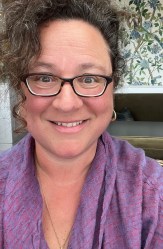
Her books are published in 51 countries and have sold more than five million copies worldwide. She won the UK National Book Awards Crime Novel of the Year prize in 2013, and the Dagger in the Library Award in 2023. Her murder mystery musical, ‘The Mystery of Mr E’ is available on Amazon Prime and Apple TV now. Sophie is an honorary fellow of Lucy Cavendish College, Cambridge, and the founder and coach at Dream Author Coaching.
How do you discipline/motivate yourself to write and do you set daily targets?
I have to use my higher brain, and make it the boss, rather than letting my primitive brain be in charge. My primitive brain always wants to do the easiest, most fun thing in the moment – which usually isn’t writing lots of words! But my higher brain knows it really matters to me that my book gets written, so I need different motivation. I need determination, resolve and commitment, rather than desire in the moment, and I need to understand that I don’t need to want to write at this very moment in order to write. When I allow my higher brain to impose this sort of discipline, and when I obey it, I am always thrilled to have written. And then my free time, my leisure time, is so much more genuinely enjoyable, because there isn’t that persistent soundtrack in the back of my mind going: ‘You should be writing, you slacker!’
What are the most important qualities required by a writer? Do you have them?
Imagination, creativity, passion, self-discipline and an unwavering belief in one’s work and in the possibility of success. Yes, I have all these qualities! Though I should point out that I do not have self-discipline in many other areas of life – but luckily, for my writing, I do!
How do you market yourself and your books?
I am so passionate about all the creative offerings I produce – from poetry, to fiction, to self-help books, to murder mystery musical movies … I want to share them with as many people as possible because I believe they are genuinely entertaining, insightful, unique – so I kind of rave about them whenever I can, to whoever will listen, because I believe that if you discover my work, it will brighten up your day! (I think this might be called ‘organic marketing’!) I also have a website, an author newsletter, and regularly check people on X.com, Facebook and Instagram. Lots of people also discover my writing via my Dream Author Coaching program for writers and/or anyone who wants to write. The other thing to bear in mind about marketing, specifically if you’re a writer, is that you have to be doing it because you genuinely believe your book will be an amazing treat for whoever buys and reads it. I’ve seen so many authors trying to market their books by saying, ‘My book is out today and please, please consider buying it or else I might end up sleeping under a bridge while feeling very unloved.’ This is not marketing, it’s being unhelpfully needy, and it’s not going to make anyone want to buy your book. It’s crucial to make your audience want to buy your book for their sake, not for yours.
Which writing resources have you found useful, e.g., books, courses, organisations, websites etc.?
I’ve been on several Arvon courses which I have loved! I also did a wonderful MA in Novel Writing in 1993/1994 at the University of Manchester, which was incredibly helpful and inspiring. Other writers are my main source of inspiration – when I read brilliant books by other people, I think, ‘I want to write something as amazing as that.’ I also get huge inspiration from my coaching programme Dream Author – my clients are amazing people who keep going on to achieve new and brilliant success!
A top tip for other writers?
Your thoughts and beliefs, not the circumstances, create your results – so make sure to think in an inspiring way!
About No One Would Do What The Lamberts Have Done – published June 2025
 You think it will never happen to you: the ring of the bell, the policeman on the doorstep. What he says traps you in a nightmare, and there seems to be no way out. It starts with the words, ‘I’m afraid…’
Sally Lambert is afraid too, and desperate enough to consider the unthinkable. Is it really, definitely, impossible to escape from this horror? Maybe not. There’s always something you can do, right? Of course, no one would ever do this particular something – except the Lamberts, who might have to. No one has ever gone this far. Until Sally decides that the Lamberts will…
‘No one writes twisted, suspenseful novels quite like Sophie Hannah.’ Liane Moriarty
About The Last Death of the Year – to be published 23rd October 2025
The brilliant Belgian detective rings in the New Year with a chilling murder investigation on a Greek island in this all-new holiday mystery from Sophie Hannah, author of Hercule Poirot’s Silent Night.
New Year’s Eve, 1932. Hercule Poirot and Inspector Edward Catchpool arrive on the tiny Greek island of Lamperos to celebrate the holiday with what turns out to be a rather odd community of locals living in a dilapidated house. A dark sense of foreboding overshadows the beautiful island getaway when the guests play a New Year’s Resolutions game after dinner and one written resolution gleefully threatens to perform “the last and first death of the year.” Hours later, one of the house’s residents is found dead on the terrace.
In the light of this shocking murder, Poirot reveals to Catchpool the true reason he’s brought him to the island—the life of another community member has been threatened. Now both men resolve to ensure that the first murder will be the last…
World Book Night 2012 Part 2
Posted by Sally Jenkins in Authors, Books, Events, Promotion on April 23, 2012
I went to the local hospital today to distribute 24 World Book Night copies of Sophie Kinsella‘s book The Secret Dreamworld of a  Shopaholic.
The aim of World Book Night is to encourage people who don’t usually read to pick up a book and get into the reading habit. As writers this is something that we should support – because if there are no readers what’s the point of writing?
I started in the A & E department of the hospital. I explained to the receptionist what I was doing and gave her a book. She was delighted and promised to pass it around her colleagues, adding that they often swapped books. So that was one book given away but unfortunately not to a non-reader. This was a trend that continued for the rest of my ‘giving’ session.
I only approached women (because Sophie Kinsella writes chick-lit) and I avoided people who were actually reading a book as they waited to see a doctor but it is very difficult to tell by a person’s appearance whether or not they are a reader. So inevitably I unknowingly spoke to keen readers and they almost bit my hand off at the offer of a free book. The non-readers I came across were simply not interested in giving the book a try – no matter how much I tried to sell it as a ‘light, easy read’. The exception to this was a lovely, chatty cleaner who was very grateful for the book and said she didn’t normally read but once bought a 48 hardback book set of Agatha Christie novels – they look lovely on her shelf but she’s never opened one of them!
One person turned down the book because she didn’t like Sophie Kinsella and another because she had already read the book. Three people knew about World Book Night and a paramedic told me she’d recently seen a book left on a park bench in a polythene bag, labelled ‘Read Me’.
I enjoyed being a ‘giver’ and intend to apply again next year but I’m not sure that World Book Night is achieving its aims. I’m sure that most of the books must end up with people who are already hooked on reading. It’s very difficult to persuade a complete stranger, who says they’re not interested in reading, to take a book. I got the feeling that some of them thought there was some ulterior motive or catch to it. Similarly, once you discover someone is a reader, it’s awkward to withdraw the offer of a book – plus if I’d restricted myself to non-readers I would have been at the hospital all day trying to find enough of them willing to give reading a try.
How did anyone else get on?
Alzheimer’s Blogging Competition Entry
Posted by Sally Jenkins in Competitions on March 14, 2011
A diagnosis of Alzheimer’s disease strikes fear into the heart of anyone. As a writer, it scares me to think that when I eventually retire from the day job to finally spend more time at my keyboard, this debilitating condition might rob me of the ability to string words together coherently.
I wouldn’t be the first writer to suffer in this way. It is well-known that Terry Pratchett suffers from Alzheimer’s and he has spoken publicly about the disease many times, in some ways becoming the contemporary face of Alzheimer’s. He now dictates his work, either using voice recognition software or to his PA, Rob Wilkins.
In 2009 the Guardian published an article claiming that Agatha Christie may also have been suffering from the disease towards the end of her life. Experts in Canada studied a selection of Christie’s novels written between the ages of 28 and 82 and counted the numbers of different words, indefinite nouns and phrases used in each. They discovered that Christie’s vocabulary size decreased noticeably (by between 15 to 30%) as she neared the end of her life and that her repetition of phrases and indefinite word usage (something, thing, anything) in her novels increased significantly. Agatha Christie, was never diagnosed with dementia but the authors of this study believe that the changes in her writing are consistent not with normal ageing, but with Alzheimer’s disease.
The results of the Christie study mirror those of a similar analysis of the early and late works of the novelist, Iris Murdoch. Her vocabulary had diminished in her final work and, on average, it contained fewer words and clauses per sentence. Murdoch was diagnosed with Alzheimer’s the year after her final novel was completed.
If diagnosed early there are drugs that can help the sufferers of this terrible disease but up until now the problem has been in making that early diagnosis. However, a brain scan is now being trialled by the NHS that spots the early signs of Alzheimer’s and can diagnose the disease in less than 24 hours. This would replace the often inconclusive memory tests that are currently used by doctors to spot the disease.
For those currently living with Alzheimer’s disease and those that care for them, there are aids available to make life a little bit easier, such as alarms to indicate when a sufferer has got out of bed or opened a door or window. These are available through The Disabled Shop.
One in ten people over the age of 65 will develop Alzheimer’s and more than half of those over the age of 85 will succumb to the condition. But only £12 per patient is spent annually on research into Alzheimer’s, compared with £289 per patient spent on cancer – this is an imbalance that can’t be right.
This blog post has been written in response to the Alzheimer’s Disease Blogging Competition, which is aiming to increase awareness of the disease and raise money to fight it. There’s a great list of blogging related prizes plus the chance of paid blogging assignments – if you’ve got a blog then click on the link for details of how to enter. More entrants mean a higher profile for Alzheimer’s Disease.
Alternatively, if you don’t blog, click here to make a donation.
 Sally Jenkins