Posts Tagged Arvon Foundation
5 Questions About Writing With . . . Jane Holland
Posted by Sally Jenkins in 5 Questions About Writing on December 2, 2025
Jane Holland is a published poet, and a bestselling, award-winning novelist who writes in multiple genres under multiple pen-names, including her popular WWII Cornish Girls saga series as Betty Walker. 
She’s written over 70 novels, and lives in Cornwall with two adorable cats and a large family.
How do you discipline/motivate yourself to write and do you set daily targets?
Thankfully, after 70-odd novels, writing is still hugely exciting to me, but I do usually need to manipulate myself into starting work because, like most people, I prefer thinking about work rather than doing it. I may go to a coffee shop, turn off WIFI, listen to music on headphones, and bribe myself with coffee and a treat. As soon as I’ve got a few words down, it gets easier. Or I may write longhand for a few hundred words, which feels more creative, and add more as I type it up. Increasingly, I use dictation software – Dragon Anywhere app on my phone – and upload my rambling thoughts straight into a Word doc for editing. I can achieve a 1000-word rough draft (my daily minimum) in ten minutes like that.
What are the most important qualities required by a writer? Do you have them?
Leading on from my answer above, you need self-motivation and self-discipline. Talent is common. Skill can be acquired. But if you frequently let days slide by without writing, you’ll struggle to make it as a professional. You must be dogged too, robust and able to shrug off criticism, to keep going and believe in yourself regardless of rejections and mockery. You need to be a workaholic egotist. And yes, that’s me. Humility is corrosive to a writer.
How do you market yourself and your books?
I run occasional ads on Facebook and Amazon, though increasingly these yield little return. My mainstay is X/Twitter which I enjoy, though a bearpit at times, and I’ve found many new readers by chatting there. I really like YouTube but I’m inconsistent with posting, so my videos don’t get many views. I underuse TikTok and Instagram for the same reason. My new Substack has brought a few sales, but its longer content requires too much energy that I’d rather put into writing new books. Producing new, readable novels several times a year seems the best and most organic way to find a readership.
Which writing resources have you found useful, e.g., books, courses, organisations, websites etc.?
I’ve consulted The Writer’s Journey (especially the original edition) by Christopher Vogler for every single novel I’ve ever written. It’s endlessly useful at helping me structure my novels and avoid things dragging partway through.
The Bestseller Code by Archer and Jockers is also worth a read if you want to write commercially.
I’ve been on many Arvon Foundation residential courses and recommend going on at least one, if only for the unique experience of being stuck in the middle of nowhere for 5 days with a group of other writers. In particular, it can kickstart a project if you’ve lost your way.
A top tip for other writers?
Finish your novel. No excuses. Until you’ve done so, even if it’s disintegrating under you, you cannot hope to fully understand what you’ve done, and then do it again, and do it better. Leaving a novel unfinished is the kiss of death. Ignore self-doubt and push through to the bitter end. Then start a new one soon after; don’t linger over edits. (Also, I find planning the novel out in advance hugely helpful when it comes to finishing what you start. I used to worry this would stop me writing it, but the opposite is true!)
 About The Spiritualist’s Daughter – published November 2025
Victorian London is under siege. Who are you going to summon?
After the death of her spiritualist father, Ophelia Savage must continue their psychic evenings or risk losing everything. But a series of macabre events leaves Londoners panicked, and then rival psychics start mysteriously disappearing.
Will she be next?
5 Questions About Writing With . . . Sophie Hannah
Posted by Sally Jenkins in 5 Questions About Writing on October 7, 2025
Sophie Hannah is a Sunday Times, New York Times and Amazon Kindle No. 1 bestselling crime writer, and the author of the new Hercule Poirot mysteries, at the request of Agatha Christie’s family and estate. 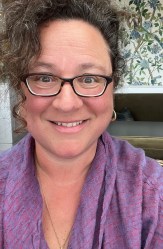
Her books are published in 51 countries and have sold more than five million copies worldwide. She won the UK National Book Awards Crime Novel of the Year prize in 2013, and the Dagger in the Library Award in 2023. Her murder mystery musical, ‘The Mystery of Mr E’ is available on Amazon Prime and Apple TV now. Sophie is an honorary fellow of Lucy Cavendish College, Cambridge, and the founder and coach at Dream Author Coaching.
How do you discipline/motivate yourself to write and do you set daily targets?
I have to use my higher brain, and make it the boss, rather than letting my primitive brain be in charge. My primitive brain always wants to do the easiest, most fun thing in the moment – which usually isn’t writing lots of words! But my higher brain knows it really matters to me that my book gets written, so I need different motivation. I need determination, resolve and commitment, rather than desire in the moment, and I need to understand that I don’t need to want to write at this very moment in order to write. When I allow my higher brain to impose this sort of discipline, and when I obey it, I am always thrilled to have written. And then my free time, my leisure time, is so much more genuinely enjoyable, because there isn’t that persistent soundtrack in the back of my mind going: ‘You should be writing, you slacker!’
What are the most important qualities required by a writer? Do you have them?
Imagination, creativity, passion, self-discipline and an unwavering belief in one’s work and in the possibility of success. Yes, I have all these qualities! Though I should point out that I do not have self-discipline in many other areas of life – but luckily, for my writing, I do!
How do you market yourself and your books?
I am so passionate about all the creative offerings I produce – from poetry, to fiction, to self-help books, to murder mystery musical movies … I want to share them with as many people as possible because I believe they are genuinely entertaining, insightful, unique – so I kind of rave about them whenever I can, to whoever will listen, because I believe that if you discover my work, it will brighten up your day! (I think this might be called ‘organic marketing’!) I also have a website, an author newsletter, and regularly check people on X.com, Facebook and Instagram. Lots of people also discover my writing via my Dream Author Coaching program for writers and/or anyone who wants to write. The other thing to bear in mind about marketing, specifically if you’re a writer, is that you have to be doing it because you genuinely believe your book will be an amazing treat for whoever buys and reads it. I’ve seen so many authors trying to market their books by saying, ‘My book is out today and please, please consider buying it or else I might end up sleeping under a bridge while feeling very unloved.’ This is not marketing, it’s being unhelpfully needy, and it’s not going to make anyone want to buy your book. It’s crucial to make your audience want to buy your book for their sake, not for yours.
Which writing resources have you found useful, e.g., books, courses, organisations, websites etc.?
I’ve been on several Arvon courses which I have loved! I also did a wonderful MA in Novel Writing in 1993/1994 at the University of Manchester, which was incredibly helpful and inspiring. Other writers are my main source of inspiration – when I read brilliant books by other people, I think, ‘I want to write something as amazing as that.’ I also get huge inspiration from my coaching programme Dream Author – my clients are amazing people who keep going on to achieve new and brilliant success!
A top tip for other writers?
Your thoughts and beliefs, not the circumstances, create your results – so make sure to think in an inspiring way!
About No One Would Do What The Lamberts Have Done – published June 2025
 You think it will never happen to you: the ring of the bell, the policeman on the doorstep. What he says traps you in a nightmare, and there seems to be no way out. It starts with the words, ‘I’m afraid…’
Sally Lambert is afraid too, and desperate enough to consider the unthinkable. Is it really, definitely, impossible to escape from this horror? Maybe not. There’s always something you can do, right? Of course, no one would ever do this particular something – except the Lamberts, who might have to. No one has ever gone this far. Until Sally decides that the Lamberts will…
‘No one writes twisted, suspenseful novels quite like Sophie Hannah.’ Liane Moriarty
About The Last Death of the Year – to be published 23rd October 2025
The brilliant Belgian detective rings in the New Year with a chilling murder investigation on a Greek island in this all-new holiday mystery from Sophie Hannah, author of Hercule Poirot’s Silent Night.
New Year’s Eve, 1932. Hercule Poirot and Inspector Edward Catchpool arrive on the tiny Greek island of Lamperos to celebrate the holiday with what turns out to be a rather odd community of locals living in a dilapidated house. A dark sense of foreboding overshadows the beautiful island getaway when the guests play a New Year’s Resolutions game after dinner and one written resolution gleefully threatens to perform “the last and first death of the year.” Hours later, one of the house’s residents is found dead on the terrace.
In the light of this shocking murder, Poirot reveals to Catchpool the true reason he’s brought him to the island—the life of another community member has been threatened. Now both men resolve to ensure that the first murder will be the last…
5 Questions About Writing With . . . Ian McMillan
Posted by Sally Jenkins in 5 Questions About Writing, Poetry on August 5, 2025

Ian McMillan (Credit: Photo, Adrian Mealing)
Ian McMillan is a writer and broadcaster who presents The Verb on BBC Radio 4 every week and its sister programme The Adverb. He hosts both the annual T.S.Eliot Prize Readings and the Academy of Urbanism Awards. He’s written poems, plays, a verse autobiography Talking Myself Home and a voyage round Yorkshire in Neither Nowt Nor Summat. His latest book with Bloomsbury is My Sand Life, My Pebble Life, a memoir of a childhood and the sea. Ian is poet-in-residence for Barnsley FC and was Barnsley’s Lockdown Poet. He’s a regular on Pick of the Week, Last Word and BBC Proms Plus. He’s been a castaway on Desert Island Discs.
How do you discipline/motivate yourself to write and do you set daily targets?
I try to write every day and the motivation is always that if I don’t there will be blank pages in magazines and newspapers and books and there will be empty air on the radio. I prime myself for writing by going on my early stroll at 05.20 and then forcing myself to see five different things on a stroll I’ve taken for years; I pound my brain to make language from the things I notice and then when I get home I tweet the five things I’ve seen and then I’m set up for the day. For me it’s essential to write every day because if I don’t then I’m anxious that I might forget how to do it!
What are the most important qualities required by a writer? Do you have them?
A sense of wonder and a sense of discipline. Both of these can be cultivated and developed. A sense of wonder is essential because the world is, for all its faults, a wonderful place and as a writer it’s my job to report on it. I try to remind myself that the so-called ordinary is really extraordinary, even if it doesn’t seem like it in the drizzle! Discipline is so important: I have to write every day, I have to rewrite every day, I have to read every day and I have to reread every day.
How do you market yourself and your books?
I leave that up to my wonderful agent. I will say that, at least when you first start, you should say yes to every writing and performing opportunity but at the same time be wary of the people who don’t want to pay you and who say that doing something for nothing will be good exposure. There are certain things that I will do for nothing but it should never be expected that you will. You can’t spend exposure in the shop!
Which writing resources have you found useful, e.g., books, courses, organisations, websites etc.?
The Arvon Foundation was my writing school. I went on courses at their centre in Lumb Bank as a very young man and the things I learned there about writing and performing have stood me in very good stead over the years.
A top tip for other writers?
Always read as a writer. Examine each sentence as though you’ve written it and think how you might improve it. Think of yourself as the co-writer of anything you read, and remember that all writing, no matter who it’s by, can always be improved. Oh, and carry your notebook everywhere, or your phone if you want to leave yourself a voice note. That idea won’t remember itself!
About My Sand Life, My Pebble Life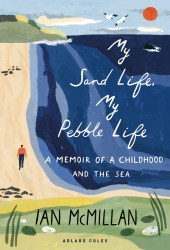 A memoir of a childhood and the sea. My life measured out in tides, coming in and going out and doing the same again. My life measured out in games of trying to spot the sea first.
A heartwarming and salt-water infused collection of coastal memories. In this perceptive and funny book, Ian transports us to a coastline rich in memories. He recalls his days by the sea, from Cleethorpes to Suffolk, from the coast of Northumberland to Blackpool, Scarborough, and the Isle of Skye. He walks barefoot to the sea to see the sun rise; he is attacked by seagulls, midges, and wasps; he eats a lot of fish & chips and it’s always the best yet; he nearly avoids a frisbee; he searches for jazz. In writing peppered with poetry, Ian recounts the memories and experiences that have shaped who he is today.
My Sand Life, My Pebble Life is available on Kindle and in hardback and audio formats.
 Sally Jenkins