Posts Tagged Historical Fiction
The Midnight Rose by Lucinda Riley
Posted by Sally Jenkins in Books on November 7, 2024
Previously I’ve waxed lyrical about Lucinda Riley’s Seven Sisters series on this blog. 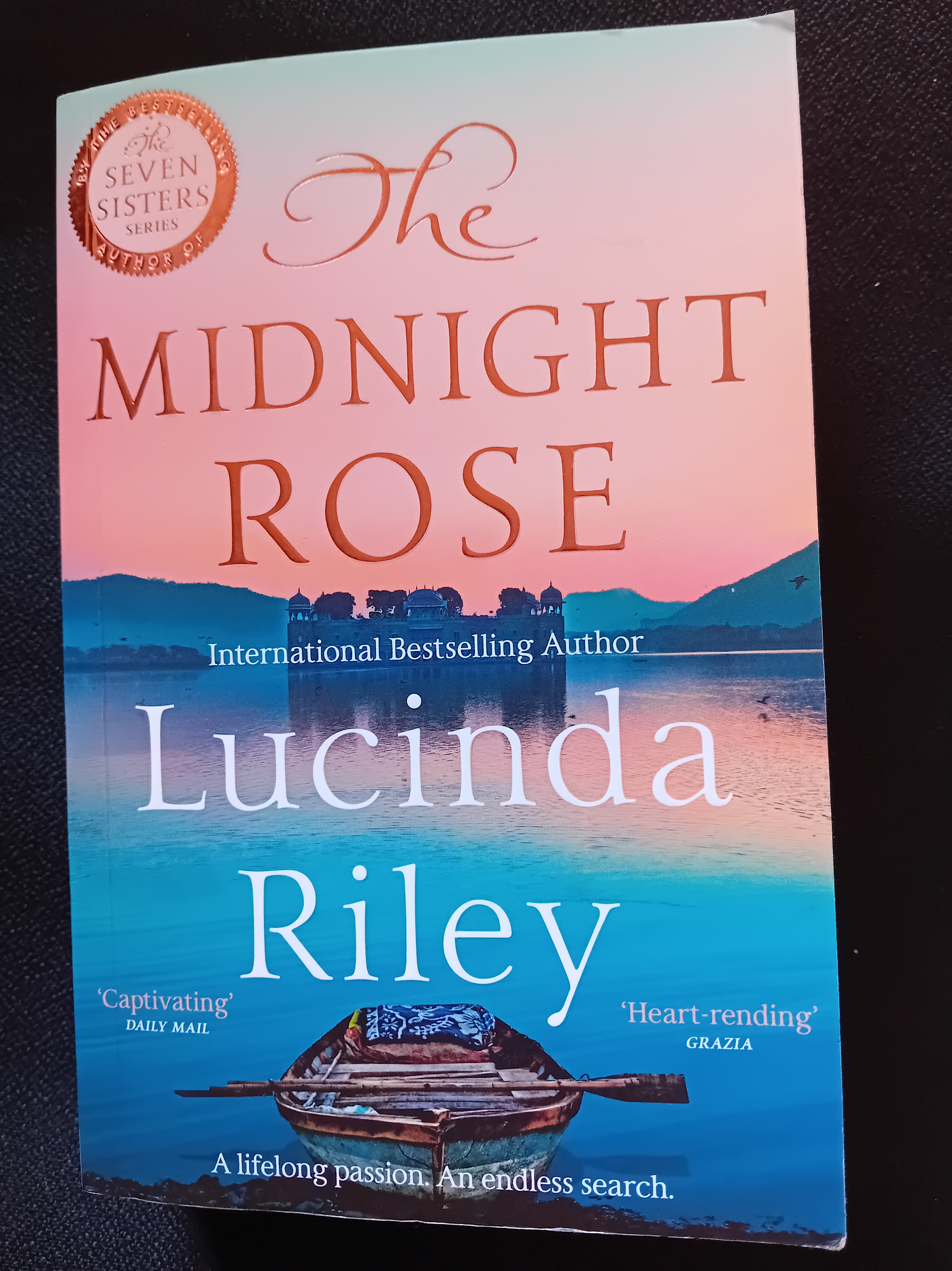 Tragically, Lucinda died in 2021 and the final book in that series was completed by her son, Harry Whittaker. I’ve now read, and thoroughly enjoyed, one of Lucinda’s earlier books, The Midnight Rose.
This book is also a dual timeline story and features a character searching for their roots, this time it’s a man, Ari Malik, and he’s following up the story that his great-grandmother’s son died at a young age. The ‘present day’ part of story is set in 2011 at a UK stately home which is being used as a filmset. The main protagonist is a young actress who is being hounded by the press. The historical story starts in India around 100 years earlier and features a mixed race love story at that same stately home, Astbury Hall.
In this book it feels almost like Lucinda is practising (in an already accomplished way!) for the feat of literary engineering that is the Seven Sisters. The Midnight Rose is a wonderful and educational work of fiction which combines the modern theme of celebrity with the enduring themes of social class, prejudice, family dynamics and love in all is guises.
A recommended read. And please leave a comment below to let me know what you think!
All Change at Jenkins Towers …
Posted by Sally Jenkins in Competitions, Events, Lifestyle, Non-writing, public speaking on February 6, 2024
There’s been a bit of stuff going on around here lately, which is making my long held vision of becoming a fulltime writer hover on the horizon. This is NOT because I have suddenly hit the New York bestseller lists and the money is pouring in, although as I write, Kindle Direct Publishing for Absolute Beginners has an orange ‘bestseller’ flag in Amazon’s Electronic Publishing category – which may have disappeared by the time you read this.

119419479 © Monkey Business Images | Dreamstime.com
My current situation has arisen because of redundancy from my part-time job in IT and being at very high risk of losing my library position as well (due to council cuts). On top of this, the gearbox in my old car is making clunky noises and will cost more than the car is worth to replace. So, there’s been a lot to think about and not a lot of writing or blogging has been happening.
However, I have not been totally idle. I’ve been preparing an author talk based around the inspiration for Little Museum of Hope. The first outing for the talk is Friday 9th February at Mere Green library in Sutton Coldfield – I’m keeping my fingers crossed that it will be well received!
And on the evening of Friday 23rd February I will be taking part in a Women’s Fiction panel at the Museum of Cannock Chase, organised by the lovely Kim Nash. It’s the first time I’ve been involved in a panel event so it will be an interesting experience.
Moving away from my life, I’ve spotted an unusual ‘competition’ for historical fiction writers from Sapere Books. On their website are a selection of outlines for historical fiction series. Choose one of the briefs and write a synopsis and the first three chapters of the first book in the series. As the prize will be a contract for a five-book series, ideas and outlines for the next four books in the series are also welcomed. The competition appears to be open to all writers, published or unpublished but do check all the details. The closing date is 31st May 2024.
Finally, if you enjoy reviewing WWII sagas, take a look at Helen Yendall’s latest book on Netgalley. I think it might tempt you!
Staffetta Partigiana – A Different Kind of Hero(ine)
Posted by Sally Jenkins in Authors, Books on June 6, 2023
I wasn’t familiar with the World War II Italian Resistance movement until I came across author Kat Devereaux and her debut novel Escape to Tuscany. Her fictional heroine is a brave young woman who is part of this movement. Kat kindly agreed to share some of her research and knowledge with us (plus her top writing tip!). Over to Kat:
When you think about the partisans who fought to liberate Italy during the German occupation, you might imagine Peppone. A communist hardliner with a red kerchief, a Stalin moustache and a fiery temper, Peppone (“Big Joe”) is the sympathetic antagonist of Giovanni Guareschi’s Don Camillo stories. He was played by Brian Blessed in the UK television adaptation, which tells you everything.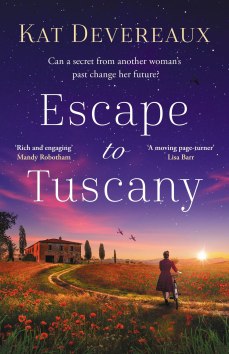
As with any caricature, there’s an element of truth to Peppone. Aligned with the Italian Communist Party, the Garibaldi Brigades were the heavy hitters of the resistance movement: organised, disciplined, and ferocious in battle. It’s not surprising that the image of the red-kerchiefed, gun-toting partisan is so iconic.
But there are many ways to resist. In my debut novel Escape to Tuscany, I chose to showcase another indispensable figure: the staffetta partigiana.
A different kind of hero(ine)
The resistance movements that sprang up after the German occupation of September 1943 had to work in extremely dangerous conditions. In the first months, partisan groups set up camp in the mountains, where local knowledge and harsh conditions worked to their advantage. As the war progressed and support for the partisans grew, the fight spread to the towns. And as Italy was liberated, city by city, partisan brigades played a leading role.
None of this could have been achieved without the staffette: the couriers who transported information, messages, supplies and armaments from place to place. Couriers needed to be inconspicuous and able to move easily even in crowded urban settings. They had to be able to pass through German checkpoints and elude the attention of sadistic Italian Fascist vigilante groups, such as the Black Brigades, who hunted partisans and their supporters. And they needed something to hold their cargo, something that wouldn’t stand out: a shopping bag, a school satchel, a bicycle basket.
So it’s no surprise that couriers were most often young women or teenage girls. My historical narrator Stella may be fictional, but she fits the profile of a courier perfectly. Just fourteen years old, she moves between her hometown of Romituzzo and the neighbouring towns of Castelmedici and San Damiano by train or bicycle, carrying intelligence, notes and even weapons. She has to fear violence from Germans and Fascists alike—sometimes she has to witness it. Stella operates in the shadows, unseen and undersung. But the stories she has to tell speak of tremendous courage.
Many women, many voices
I had a wealth of inspiration when writing Stella’s story. Thankfully for posterity, some of the women who worked as couriers during the occupation have left their testimonies behind. While most of these are in Italian, there are some English resources available. A wonderful place to start is the documentary Bandite, made in 2009 and available for free. You can find a subtitled version here https://youtu.be/iwJlwdBGBQ4.
For years after the Liberation, women partisans were denied the recognition they deserved. This has changed in the last decades, and now the staffetta on her bicycle is a symbol of antifascist resistance. That’s entirely as it should be.
My top writing tip
When researching a historical novel, it’s easy to get caught up in research and end up down a rabbithole. If you come across a book, video or other resource that’s absolutely fascinating but not relevant to what you’re writing at this precise moment, don’t get sidetracked. But don’t dismiss it, either: keep a note of it and store it somewhere easy to find. You never know what stories it might spark in the future.
Thank you, Kat!
Escape to Tuscany will be published on July 6th 2023 and is available to pre-order now. It is described as “A gripping and moving debut novel about two women, decades apart, whose fates converge in Florence, Italy. Perfect for fans of Patricia Wilson, Carol Kirkwood and Lucinda Riley.” Regular readers of this blog will know that I am a great fan of Lucinda Riley’s Seven Sisters series – so Escape to Tuscany sounds right up my street!
About the book:
Romituzzo, 1944
Just fourteen, Stella Infuriati is the youngest member of her town’s resistance network – a secret she keeps even from her parents. She works alongside her brother Achille to relay messages, supplies, and weapons to partisan groups in the Tuscan hills. Fuelled by courage and a fierce sense of purpose, Stella braves incredible danger and survives … but when peace comes in 1945, she vanishes.
Florence, 2019
Writer Tori MacNair arrives in Florence. Fleeing an emotionally abusive marriage, she’s come to build a new life in the city her grandmother taught her to love. As she digs into her family history, Tori uncovers decades-old secrets: the story of a brave young woman who risked everything to save her world.
Rosa – Kat’s Writing Assistant
About Kat:
Born near Edinburgh, Kat Devereaux lived all over the globe before finally settling in Italy in 2019.
As a writer, Kat loves big, controversial personalities, spectacular settings and high-stakes conflict. The rest of the time, she likes being very quiet in libraries. In her everyday life, she is a freelance writer and translator with a special focus on Italian literature, history and religion.
Researching the Past
Posted by Sally Jenkins in Authors, Books, Resources on February 9, 2023
I am delighted to have Choc Lit novelist, Victoria Cornwall, with me today, sharing research secrets from her new WWII novel, Waiting for Our Rainbow. Over to Victoria:
I have an interest in WW2, so researching for my latest release, Waiting For Our Rainbow, was particularly fascinating. From 1942, thousands of American soldiers began arriving in England, many of whom ended up in Cornwall. Who were these men? Where did they come from? What did they do while they were here?

Victoria Cornwall
My research began on the internet. I discovered it was the 29th Infantry Division who came to Cornwall, which gave me a starting point. Through Facebook and dedicated websites, I contacted several historians who were experts on the division and the training they undertook after their arrival in England. They answered many of my questions and provided me with lots of information. I also came across the US government’s advice booklet they issued to their soldiers to help them with the cultural differences they would face on their arrival to England.
I’d grown up knowing African American soldiers were also billeted to Cornwall. What role did they play? Why were their camps separate from the combat soldiers’ camps? I was concerned about writing this part of the novel because at the time racial tensions were particularly high. I could not ignore the important role they played, but I knew that if I wrote about it I wanted to remain true to the era and dialogue without contemporary attitudes and pressures making me water it down. Fortunately, I came across a collection of video interviews, where African American veterans recalled their experience of joining the army, the segregation they faced and their frustrations at not being given combat roles at the beginning. There is a pivotal scene in Waiting For Our Rainbow, where a small group of African American soldiers notice Joe, a white soldier, entering their encampment. The scene and dialogue that follows were inspired by those veterans’ memories and experiences.
Next was the local community… how did they feel about American soldiers invading their county? I was able to talk to some people who were there at the time, but I also read archived newspaper articles and a couple of childhood memoirs which were extremely helpful. I also read the BBC’s online memory collection, WW2 Peoples War, which is a brilliant resource.
My final research was to visit some of the places. Fortunately, I live in Cornwall so it was easy for me to do. It was a humbling experience to stand in the same places where American soldiers had once stood. They were young men, many with little to no experience of combat but, along with British and Canadian soldiers, they took part in the largest amphibious military assault in history – but they could not have done it without the help, knowledge and support of many others. Also taking part in the success of D Day were sailors, soldiers and airmen from Australia, Belgium, Czechoslovakia, France, Greece, the Netherlands, New Zealand, Norway, Poland and others. In addition, the skills of meteorologists, scientists, inventors and the French Resistance were used during its planning and implementation.
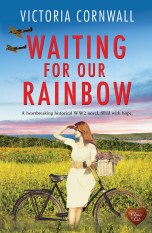 Waiting For Our Rainbow concentrates on Joe, an American soldier, and Anne, a young Cornish woman. Ultimately it is a normal romance between a man and a woman, yet it is set at a pivotal time in the history of the war that would affect their romance, the decisions they make and the course of their lives for decades to come.
Waiting For Our Rainbow was released as an Ebook on 31st January, 2023. A paperback and audio version will follow shortly afterwards.
About Victoria Cornwall
Victoria grew up on a farm in Cornwall and is married with two grown up children and three grandchildren. She likes to read and write historical romance with a strong background story, but at its heart is the unmistakable emotion, even pain, of loving someone.
Her books have reached the finals of the NEW TALENT AWARD at the Festival of Romantic Fiction, the RNA’s JOAN HESSAYON AWARD, the 2021 RNA’s Goldsboro Books HISTORICAL ROMANTIC NOVEL AWARD. Her books have also been twice nominated for the RONE Best Indie or Small Published Book Award by InD’tale magazine.
She is a member of the Romantic Novelists’ Association.
Find Victoria on her website, Twitter, Facebook, Instagram, YouTube and Pinterest.
About Waiting For Our Rainbow
Would you give your heart away if you knew it could only end in goodbye?
It should have been a time of romance and excitement for Anne – but it’s 1941 and the war is raging. So instead, she spends her days repairing spitfire wings and reminding herself that the real sacrifice is going on far away from her Cornish village.
When the news breaks that America has entered the war, it brings cautious hope to Anne and her family. And eventually, as the Jeeps filled with GIs roll in, it seems their little community is to play a pivotal role in the next stage of the fight.
But the Americans don’t just bring Hollywood glamour and optimism, they also bring something more tantalising – so when Anne meets handsome Joe Mallory, she has to remind herself of exactly why he’s there; that any relationship between them could only end in goodbye.
But is the inevitability of ‘goodbye’ powerful enough to stop what has already begun to blossom?
Buying Links:
Amazon UK
Amazon US
Kobo
Nook
iBook
Google Play
Why Write Historical Fiction?
Posted by Sally Jenkins in Authors, Books on August 16, 2018
Christine Hancock is my publishing ‘twin’. Her book, Bright Sword, was published by The Book Guild on the same day as The Promise: January 28th 2018. We write in different genres and have followed each other’s journey over the past six and half months. Christine has kindly agreed to guest on my blog today and explain something about historical fiction and why it’s got something for all writers and readers.
Why Write Historical Fiction?
When I started to write it seemed like the obvious thing to do. All my life I have read historical fiction. I don’t know why. To escape? To learn about the past? Perhaps I just thought the stories were better. I have enjoyed other genres: Science Fiction, Horror, Romance (when I was young.) Horses (when I was very young), but I always returned to Historical Fiction.
So, what actually is Historical Fiction? The Historical Novel Society defines it as:
To be deemed historical (in our sense), a novel must have been written at least fifty years after the events described, or have been written by someone who was not alive at the time of those events (who therefore approaches them only by research).
For example, if you want to write a book set in the 1960s, it is historical if you were born after that period, or if you were alive at the time, living in rural England but are writing about life in the USA. If you want to write what happened to you, if you remember it, it is something else.
After that, anything is allowed, any period and any place. It can be of any genre: romance, detective, adventure, biographical. Psychological thriller? It also includes sub genres such as time slip, alternate history and fantasy.
Some people aren’t interested in the past. They say only the future is important. But if we recognise that what happens today has happened before – in one form or another, we can learn how to deal with it, or live through it. I suppose that applies more to straight history books, but why not learn and enjoy the experience at the same time?
There is so much in the news to worry us nowadays, people want to escape. This is where historical fiction comes in.
Why concern yourself with the details of Brexit, when you can stand beside King Harold and his warriors at Hastings, defending your country against the Normans? Probably not the best example!
Worried about Trump? Imagine trying to survive in the court of Henry VIII or in Rome under Emperor Nero.
Weather too hot? Acclimatise yourself beside the Nile in Ancient Egypt or cool down at a 17th century Frost Fair.
Fed up with queues to see a doctor? Discover the problems of avoiding the Black Death, or any illness or accident, at almost any time before our own.
If you just want good read, why chose historical fiction?
The basic plot of a romance is boy meets girl, boy loses girl, boy finds girl. How interesting it can be when the clothing are tight breeches and a beautiful silk gown and when the hero must fight for his lady’s honour with a sword. There is so much space for misunderstanding when your character has to wait for the post instead of texting from his iphone.
People say to me “But don’t you have to do a lot of research?” Yes, but it depends on what you are writing. If it is a novel about the life of someone famous, Ann Boleyn, to take an overused example, you need to know every single fact – get it wrong and someone will notice and tell you!
 I’m sure writers of modern fiction have to do a lot of research: What car does my character drive? What clothes does she wear? What is the “in” drink to order? Then in a few years it is all out of date.
I write about the Anglo-Saxons in the mid tenth century. No need to work out which make of car they drove (a horse or they walked) what clothes they wore (tunic, long for women, shorter for men and cloak in cold weather) or which brand of ale or mead they drank. So long as I have the right king on the throne and avoid killing off a real-life character before their time, it’s fine.
Oh, and don’t have them eating roast potatoes with their dinner!
Never tried historical fiction? What do you enjoy reading? There’s sure to be something similar set in the past. You may never return to the present day.
Thank you, Christine. You’ve tempted me to give history a chance!
Christine Hancock lives in Rugby, Warwickshire and is a long term family historian and leader of her local history group. Byrhtnoth, the main protagonist in Bright Sword, is based on a real warrior who died in the 991 Battle of Maldon, made famous by the Anglo-Saxon poem of that name.
Bright Sword is available in bookshops and from all the main online retailers, including Amazon.
Read Christine’s blog or follow her on Twitter.
Snapshots of History
Posted by Sally Jenkins in Competitions, Markets on November 21, 2011
Do you have an interest in history? Have you ever written a story set in the past? Have you ever heard of the publication Snapshots of History?
Snapshots of History is a quarterly journal dedicated to all aspects of historical short story writing. It was set up in 2010 and comprises an ongoing serial, short stories, a members’ corner for information of interest plus a quarterly competition. The best entry receives £15 and is printed in the magazine. Runners up may also be included in the journal. There is a £3 entry fee for non-subscribers. Stories should be between 1,000 and 2,500 words and be set no later than the end of the Second World War – and historical accuracy is important.
An annual subscription to the magazine costs £7.50 or individual copies can be bought for £2.00.
Full details are available here.
Don’t forget that some of the women’s magazines also take historical short stories. Writer Joanna Barnden penned a guest post on the subject for the Womag Writer’s Blog. It contains general advice plus some market tips. Read it here.
 Sally Jenkins