Posts Tagged Writers and Artists
5 Questions about Verse Translation With . . . Mark Haywood
Posted by Sally Jenkins in 5 Questions About Writing, Poetry on February 24, 2026
Mark Haywood is a poet and verse translator.  As a poet, he enjoys working with the challenges of formal poetry, particularly the sonnet and the limerick, and has had several sonnets and sonnet sequences published in the UK, Canada and the USA. Some of his sequences have dealt with topics uncommon in the sonnet form, for example art criticism and jazz theory. Recently Mark has been translating some of Molière’s classic 17th century French comic plays into rhyming verse. Some of this work has been shortlisted and longlisted in the John Dryden Translation Competition, and two of these translations, The Learned Women and The Flying Doctor, have been published by Broadway Play Publishing Inc, New York.
Mark also composes music and has had two collections of piano music published, as well as some articles on jazz.
How did you get involved in verse translation?
Most of us can remember having to “translate” something at school – maybe from French or German, or even (if you’re my age) from Latin. At my school we had to “do” Molière’s comedy Tartuffe, and I really enjoyed it, once I’d understood it well enough. We translated parts of it out loud in class, and wrote out bits in English for homework. The original play is in verse, but we simply put it into prose.
That was half a century ago and since then I’ve written a lot of formal verse in English. One day I was reading George Chapman’s verse translation of Homer’s Odyssey, and I thought, “I wonder if I could translate a bit of a Molière play into rhyming verse…that would be a challenge!” I picked The Learned Women which I’d once read in English and which had really made me laugh (I was going to need a laugh), decided on a rhythm and rhyme scheme, took a deep breath, and jumped in!
What are the most important qualities required by a verse translator?
The most obvious quality is proficiency in both the source language and the target language of the translation. That doesn’t mean one has to be bilingual, or anything like it. We’re talking about written translation as opposed to live interpreting where everything is done in real time. With written translation there is time to study the source passage, to understand its meaning and spirit/nuances, time to think, to write, to revise.
This brings me to the next important quality – patience! When I’m translating into verse, I try dozens of different ways of saying essentially the same thing, before I find the potential rhymes, and then experiment with more permutations before the rhythm of the verse works properly. I’ve learnt not to get impatient with myself because eventually it will click into place, and the harder it was to get there, the more satisfying it is when it works.
How does a translator find a publisher?
I use Google to locate publishers interested in publishing translations, some publishers specialise in it. The Writers’ and Artists’ Yearbook is also a good source of guidance, with listings of publishers, prizes, societies and so on, as well as articles to help people hoping to get published.
Which translating resources have you found useful, e.g. books, courses, organisations, websites etc?
I approach my translations of Molière armed first with some existing prose translations of the play. These are to ensure I’ve understood the original text correctly. I avoid looking at any verse translations because I want my own versification to be completely original. Then, with a good French dictionary and an English thesaurus, I’m ready to go.
A top tip for would-be/newbie translators?
Persevere and enjoy it! Be patient and kind to yourself – especially if you’re translating something into verse. My Molière projects continue to teach me so much, not just about the play I’m translating, or about French, but about English as well. What began as a difficult slog has become a wonderful and addictive process.
About The Learned Women
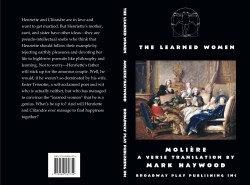 First performed in Paris in 1672, The Learned Women (Les Femmes Savantes) is one of Molière’s last and greatest comedies. It is a hilarious romp that pits pseudo-intellectual pretentiousness against plain common sense, and true love against self-seeking duplicity. As with all of Molière’s classic comedies, it is as relevant today as it ever was.
Mark’s translation is published (paperback and e-book) by Broadway Play Publishing Inc (December 2025) – click here for full details. It is also available here through Waterstones and here through Amazon.
How to Write a Novel Blurb
Posted by Sally Jenkins in Books, Promotion, Self-publishing on July 9, 2015
I’ve been playing around trying to write a blurb for my novel. The blurb is that important paragraph or two which appears on the book’s back cover and may also form part of the Amazon product description. It has to hook, entice and leave readers with absolutely no option but to buy the book!
Searching the internet for help brings up lots of tips and information.
- The website Blurb concludes that it should introduce the main character, create intrigue and not give away the whole story.
- SilverWood Books adds some more pointers. Write in the present tense, use evocative, emotive words and have a ‘shout line’ that encapsulates the novel and could act as a subtitle for the blurb.
- Digital Book World says the blurb should be short and dramatic.
- Alison Baverstock on the Writers and Artists website says, “Stand back and hover above; try to create mood, feeling and value for what you have written, rather than describing it in endless detail.”
I’ve come up with three possible blurbs but I’m too close to the book to judge them objectively. So, I’d be most grateful for any comments and/or votes in the poll below.
Here are the blurbs, subtitled with their ‘shout line’:
Nature or nurture?
Ignatius is the product of a domineering mother. Ian hardly knew his father. Sandra is a single mum living on the poverty line. They all want a better life and someone to share it with.
But now one of them has done something very bad for the second time…
Bedsit Three is a tale of mystery and romance. It won the inaugural Ian Govan Award and was shortlisted for both the Silverwood-Kobo-Berforts Open Day Competition and the Writing Magazine/McCrit Competition.
Single incidents shape our lives.
A stupid mistake ended Ian’s marriage. Now he’s trying to put it right.
Sandra got pregnant as a teenager. Now she’s fighting to make a good life for her daughter.
Maxine made an important decision behind her boyfriend’s back. His reaction devastates all their lives…
Bedsit Three is a tale of mystery and romance. It won the inaugural Ian Govan Award and was shortlisted for both the Silverwood-Kobo-Berforts Open Day Competition and the Writing Magazine/McCrit Competition.
Opposites attract.
Divorced Ian is middleclass and educated. Single mum Sandra has no qualifications and lives on the breadline. Both will fight for the very best for their offspring. Both would like someone special back in their lives.
But the ex-tenant of bedsit three has a secret waiting to engulf all three of them…
Bedsit Three is a tale of mystery and romance. It won the inaugural Ian Govan Award and was shortlisted for both the Silverwood-Kobo-Berforts Open Day Competition and the Writing Magazine/McCrit Competition.
 Sally Jenkins