An Easter Special Offer
Posted by Sally Jenkins in Promotion on April 11, 2017
The long Easter weekend is coming!
What’s the best way to relax? Indulge in an Easter egg and an easy read.
For sharing and hiding, I recommend this cornucopia of multi-coloured, foil-wrapped eggs or this warren of Lindt bunnies. For selfish, serious chocolate eating, go for this Thornton’s Continental Egg.
For reading material it has to be the short story collection, House Guests, full of contemporary short stories about modern life. Enjoy a plethora of twist endings, some humour plus a tiny bit of romance. And a guest story by Iain Pattison.
Best of all – House Guests is half-price until Monday 18th April 2017 – Happy Easter!
Flesch Reading Ease and Flesch-Kincaid Grade Level test
Posted by Sally Jenkins in Computers & Technical, Non-fiction, Resources, Writing on April 3, 2017
If you write for children it’s important to know that the language and sentence structures within your work are suitable for the age range of your target reader. For the rest of us, it can be useful to get an idea of how accessible our writing is, i.e. is it understandable to most people or are our sentences and words too long?
The children’s author Lorraine Hellier recently introduced me to a function within Microsoft Word that measures the readability of manuscripts. It’s very easy to set up. Within Word take the following steps:
- In the ‘File’ tab, click ‘Options’.
- Select ‘Proofing’.
- Ensure the ‘Check grammar with spelling’ box is selected.
- Select the ‘Show readability statistics’ box.
Next time the spell check facility is used within a document, at the end you will be shown a ‘Readability Statistics’ pane. Among other things this shows the Flesch Reading Ease Index, the Flesch-Kincaid Grade Level and the percentage of passive sentences.
The Flesch Reading Ease index works on a 100 point scale, the higher the index, the easier a document is to understand. A score between 60 and 70 is acceptable for most documents.
The Flesch-Kincaid Grade Level gives a manuscript a US school grade level. This link gives a conversion from US school grade to age and to UK school year. Roughly, the US grade + 1 = UK school year. For example 5th grade = year 6 = age 10/11.
Writers for adults will find the passive sentence percentage most useful. Eliminating passive sentences makes any writing more immediate and effective. We often write passive sentences without noticing, so this is a great tool for highlighting the need to go back through a story and rewrite these phrases.
How easy to read (and active!) is your work?
Two Competitions
Posted by Sally Jenkins in Competitions, Non-fiction, Short Story, Travel on March 23, 2017
I’ve been busy novelling for the last eight months or so and haven’t had time for competitions. However, a couple have popped into my inbox lately and, since I can’t use them, I thought I’d share them with you lovely people. Fingers crossed, one (or more) of you might have what it takes to be a winner!
Travel Writing Competition run by Travel for Seniors
This is free to enter and offers a first prize of £100 plus internet publication. They want 750 words on the theme ‘Travel for Seniors’ and the closing date is 31st July 2017. Entries can be fact or fiction.
Details are on the Senior Travel Expert website.
The Fiction Desk Newcomer Prize for Short Stories
This is aimed at ‘new and emerging writers who haven’t already been published by us, and have yet to publish a novel or full-length collection of short stories on paper‘. There is an entry fee of £8 and a first prize of £500 and second prize of £250. Closing date is 31st May 2017. Full details are on the Fiction Desk website.
Good Luck!
The Trouble with Goats and Sheep by Joanna Cannon
Posted by Sally Jenkins in Books on March 15, 2017
I know that at least one of my followers has read The Trouble with Goats and Sheep by Joanna Cannon but the rest of you may have an opinion on it too. I read it in a hurry this week – it was due back at the library and couldn’t be renewed due to another reservation, which shows how popular it is.
The story takes place over the famous hot summer of 1976 with flashbacks to 1967. It focuses on the disappearance of a woman and the repercussions this has on the rest of the people in the street. Much of it is from the viewpoint of a 10-year-old girl.
It took me a while to settle into the book because I was trying to read it too quickly. The pace very much reflects the languor of summer days that are too hot and school holidays that stretch forever into the future. The book needs to be read at this pace to appreciate the tiny details of daily life 40 years ago. The story is the slow peeling of secrets from the streets inhabitants – people aren’t always what they seem. I lived through that summer and, like 10-year-old Grace, collected Whimsies – little pottery animals that cost 10p. There’s lots of this exquisite minutiae and description in the book and don’t read it when hungry because a lot of biscuits are eaten too!
My only (very tiny) gripe is the brief mention of a bouncy castle – I don’t remember those being around as I grew up.
As a writer, this book has made me realise it’s the well-placed tiny detail that makes a reader believe in the story and want to stay in that imaginary world for just a little longer …
If, like me, your work tends to lack description, read The Trouble with Goats and Sheep and watch how the reader really can’t escape the heat of the sun and the watchful eyes of the neighbours.
Fundação Livraria Esperança – Madeira
Posted by Sally Jenkins in Travel on March 8, 2017

Don’t judge a book by it’s cover and don’t judge a shop by its entrance. Down a backstreet in Funchal this unpromising doorway led to a giant of a bookshop. There were books displayed in twenty rooms across several floors. It was an Aladdin’s cave – I only wish there’d been more than a handful in English!
This book shop is special because all the books are displayed by cover, not spine. So it’s possible to easily see the front cover of every book. The shop was founded in 1886 and has been within the same family ever since. There are around seventy different literary sections covering subjects such as Economics, Childrens, History, Education etc. etc. Even if (like me) you don’t speak Portugese it’s fun to wander around spotting best-selling author names such as John Grisham and the like. And the notices by the door are in English.
For more information see the shop’s Facebook page: https://www.facebook.com/FundacaoLivrariaEsperanca/


Call for Poems about Britain
Posted by Sally Jenkins in Markets, Poetry on February 28, 2017
The Emma Press is after your poems about life in Britain. They are looking for “poems about customs, rituals, festivals, holidays, celebrations and regular events that take place in the United Kingdom of Great Britain and Northern Ireland, on a micro level (what one person or one family might do) as well as on a larger scale.” Successful submissions will be included in an anthology about customs and rituals in Britain.
A maximum of three poems may be submitted and in order to submit you must be a member of the Emma Press Club. As far as I can see, this means that you have to have bought one Emma Press book in the calendar year you submit (& I think this can be an e-book costing £3.50) and this entitles you to enter submissions for the entire year. So it doesn’t appear to be any more expensive than paying a competition entry fee – and you get something back for that fee!
The closing date for submissions is 26th March 2017 and I suggest you read the full terms and conditions.
The customs, rituals and events of Britain is a very wide brief – why not grab a pad and pen and brainstorm some ideas?
Smashwords Adds New Distribution Channel
Posted by Sally Jenkins in Self-publishing on February 20, 2017
Regular readers of this blog will know that one of the reasons I chose to distribute Bedsit Three via Smashwords is the access it gives to Overdrive, a platform which supplies e-books to public libraries. My original blog post can be read here.
Recently Smashwords announced the addition of a new library distribution channel via Bibliotheca. Bibliotheca is the operator of the cloudLibrary™ digital lending platform which is used by over 3,000 public libraries in America, Canada, U.K. and Australia. So the Smashwords distribution network now includes almost all major library e-book platforms including OverDrive, Baker & Taylor Axis 360, Gardners UK (Askews & Holts and VLeBooks) and Odilo. Those of us indie authors choosing to distribute our e-books via Smashwords can now reach 30,000 public and academic libraries across the globe.
Many libraries today lack the funds to buy print books. E-books are a cheaper option and can offer a way into the library system for indie authors. Unfortunately e-books do not qualify for PLR payments so writers only receive their standard royalty on the e-book sale. But being in the library catalogue generates exposure that may lead a reader to purchase other books (print or digital) by the same author.
The biggest factor in the indie author’s decision about whether to take advantage of Smashwords wide distribution channels is the abandonment of Amazon KDP exclusivity and the potential benefits that scheme can bring.
Milton Keynes Short Story Competition
Posted by Sally Jenkins in Competitions, Short Story on February 10, 2017
Ever been to Milton Keynes? It’s famous for its concrete cows and the urban myth that it was named after the two economists Milton Friedman and Maynard Keynes. The town’s name actually came from the old village of Milton Keynes which was in the centre of the area designated for development as a ‘new town’ in 1967.
2017 is Milton Keynes’ 50th birthday and, to help the town celebrate its half-centenary, a short story competition has been organised. Hooray!
The competition is asking for stories in any genre but they must be set in Milton Keynes. Maximum number of words is 1050 and the closing date is 21st April 2017.
£100 goes to the winner, £50 to second place and £25 to third place. Fifty of the best stories will be selected for publication in a limited edition anthology.
Entry is FREE and judges include local Milton Keynes authors Carole Matthews, Karen Guyler and Scott Dorward.
Full information is available on Carole Matthew’s website.
And, by the way, Milton Keynes gets a brief mention in my psychological thriller Bedsit Three…
Benefits of Writing Competitions
Posted by Sally Jenkins in Authors, Books, Competitions on February 2, 2017
At the end of January Morton S. Gray celebrated the publication, by Choc Lit, of her first novel, The Girl on the Beach.  Morton’s success was the result of dogged perseverance and the culmination of a series of competition successes. Not surprisingly, she is now a great advocate of writing competitions and she’s here today to tell us how they helped her on the road to success:
Innocently entering a writing competition caused me to take my writing seriously! In 2006, a friend started a fledgling publishing business (sadly no longer trading) and she held a short story writing competition to raise the profile of the company. I entered, primarily to support her, and unbelievably won with my story “Human Nature versus the Spirit Guide”.
It was a wake-up call for me. I’d had a baby and not been well for a couple of years, so I was looking for a new direction. The competition win made me look at writing as a serious option for the future and it was relatively easy to combine with a small child still taking naps in the afternoon. I started to take courses to learn to polish my work. I entered several competitions and began to get shortlisted.
In 2008, I entered a Mills and Boon novel competition, the forerunner of their SYTYCW competitions. I quickly decided I wasn’t a Mills and Boon writer, as it is a particular way of writing and much harder than people might think to keep the focus on the main protagonists throughout a novel. However, the competition introduced me to several people with whom I’m still in contact.
Competitions give you a framework within which to work. They give you the discipline of a deadline and a word count. Not as many people enter these competitions as you may imagine, especially the smaller local ones. I’ve been involved in running a local competition and I was surprised not only by the relatively few number of entries, but by the fact that sixty percent of the entries were essentially the same story. Tip – think around the set theme for a while and don’t go for the obvious. Your entry will stand out if it is different.

Morton S. Gray
I continued to get shortlisted for flash fiction, poetry, short story and novel competitions. In 2013, I came second in the Romantic Novelists’ Association conference competition for the first chapter of a novel and that resulted in an appearance on the Tammy Gooding show at BBC Hereford and Worcester Radio. All good experience. Later that year, I shortlisted in the New Talent Award at the then Festival of Romance, with another first chapter. I met a different group of writers, many of whom I’m still in contact with in real life and online.
These encouraging signs for my writing kept me going. It is easy to get despondent when writing, as it can be a very solitary occupation. Don’t spend your life thinking no one will want to read your work, imagining that it’s rubbish, not up to scratch, not worthy of anything but the bin. Been there, done that! Keep going, keep writing and get your work out to competitions, send it to magazines, publishers, agents. Writing is a constant learning process and is generally about persistence. You need an imaginative spark, yes, but you also need to be willing to check your work over time and again to make it the best it can be. What is the point of a manuscript in a drawer?
I joined the Romantic Novelists’ Association New Writers Scheme and made sure I submitted a novel for critique every year. I also made a promise to myself to take part in the annual novel writing challenge NaNoWriMo and I’ve managed seven years running to write 50,000 words in November. One of these novels, when edited and passed through the RNA NWS critique service, I sent off to the Search for a Star competition run by a publisher I’d admired for many years, Choc Lit and I won! My debut novel, The Girl on the Beach was published on 24 January 2017.
I suppose the messages here are keep writing, learn your craft, polish your work and get it out into the world. My novel could so easily still be in that drawer under the bed. Competitions are a way of assessing how you are progressing, hopefully you’ll meet friends along the way and who knows, you might win a publishing contract like me.
I love Morton’s encouraging message and I love the blurb for The Girl on the Beach – the novel is now sitting on my Kindle hankering to be read. I think it might tempt some of you too:
When Ellie Golden meets Harry Dixon, she can’t help but feel she recognises him from somewhere. But when she finally realises who he is, she can’t believe it – because the man she met on the beach all those years before wasn’t called Harry Dixon. And, what’s more, that man is dead.
For a woman trying to outrun her troubled past and protect her son, Harry’s presence is deeply unsettling – and even more disconcerting than coming face to face with a dead man, is the fact that Harry seems to have no recollection of ever having met Ellie before. At least that’s what he says …
But perhaps Harry isn’t the person Ellie should be worried about. Because there’s a far more dangerous figure from the past lurking just outside of the new life she has built for herself, biding his time, just waiting to strike.
Two New Books for Writers
Posted by Sally Jenkins in Authors, Books, Resources, Writing on January 25, 2017
By now the initial excitement of New Year’s resolutions will have passed and keeping up that writing habit may have become a bit of a slog again. But do not despair – as always, your fellow writers are here to help and re-enthuse you.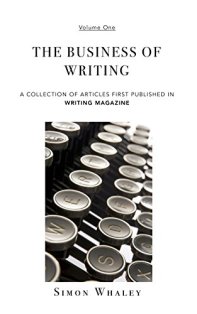
Simon Whaley is on a mission to make us all become more businesslike about our writing. If we treat our writing seriously and as a source of income, then our family and friends will adopt that attitude too – essential if you want to turn that ‘nice little hobby’ into a publishing empire! Simon’s blog about The Business of Writing is full of useful tips and many of you will recognise Simon’s name from his regular (and wise) column in Writing Magazine. He’s gathered together many of those articles into a handy e-book, also called The Business of Writing. It covers things like tax, record keeping, legalities, pseudonyms and much more, plus there are lots of tips and advice from writers across the genres.
 Teaching writing is one way that many authors top up their income but the thought of getting a class up and running can be daunting. Helen Yendall has years of experience as a writing tutor and she’s just published an e-book sharing the knowledge that she’s built up – Start a Creative Writing Class: How to set up, run and teach a successful class. The book focuses on the nuts and bolts of setting up a writing class for adults, covering everything from finding a venue and arranging insurance, to marketing the class and giving feedback. There’s also plenty of advice on dealing with students and ideas of what (and how) to teach. It contains 100 x 5 minute writing exercises plus icebreaker ideas to get the class warmed-up and ready to learn.
So let 2017 be the year you fulfill your ambitions and take your writing more seriously – with the help of Simon and Helen.
 Sally Jenkins