Archive for category Authors
The One Plus One by JoJo Moyes
Posted by Sally Jenkins in Authors, Books on August 19, 2014
Here’s an interesting fact for you – Tanzie (one of the main characters in The One Plus One) was named after the daughter of the highest bidder in a charity auction in aid of the Stepping Stones Down’s Syndrome Support Group. 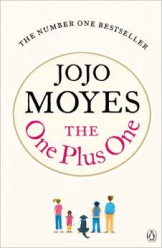
It’s a wonderful name and absolutely suits the young girl in the story. It makes me wonder if the book would have been different if someone named Hilda had been successful in the auction …
Anyway, I digress. I received this book to review for Mumsnet Bloggers. So here we go:
Tanzie is a young Maths genius. Her elder half-brother Nicky is being badly bullied. Jess, their mum, is struggling to keep them financially afloat with cleaning and bar jobs. They own a gigantic, drooling dog.
Ed Nicholls is wealthy, having made his money writing computer software. Then he makes a mistake and his world comes tumbling down.
This set of characters ends up on a car journey from the south coast to Aberdeen. Tanzie’s car sickness limits them to 40 mph. The dog’s digestive system pollutes the car. They live on sandwiches and food stolen from a hotel breakfast buffet. Relationships develop and are tested during the days and nights they spend cooped up together.
This is great light-reading and perfect escapism if you want to think about someone else’s problems instead of your own. I totally believed in this band of people and was rooting for each of them.
What more can I say – for me the characters make a book and these characters were brilliant.
Bits and Pieces
Posted by Sally Jenkins in Authors, Books, Competitions, Non-fiction, Promotion, Self-publishing on August 8, 2014
Today I was going to post about the Telegraph/Saga Travel Writing Competition but my writing buddy, Helen, got there before me. Read all about it on her blog. I’ll be joining her at Swanwick tomorrow – and hopefully partaking of some of that wine which she also mentions on her blog …
Not sure if I’ll get much free time at Swanwick but I’m taking with me JoJo Moyes‘ latest book The One Plus One. I received a copy for review via the Mumsnet Bloggers’ Network. So watch this space for my opinion in a couple of weeks (just noticed the book has 654 reviews on Amazon UK – does it actually need anymore?!).
Next, a shout out for Janice Preston. I know Janice through the Birmingham Chapter of the Romantic Novelists’ Association and she recently had her debut novel, Mary and the Marquis, published by Mills and Boon. How great is that! It’s a steamy Regency romance and well worth a look.
Finally, if you’re one of the few readers of this blog who haven’t already got the short story collection One Day for Me, you’ve only got until the end of Saturday 9th August (i.e. tomorrow) to download it for the bargain price of 99p/99c (UK/US only). Then Amazon will stick the price back up.
Death in Elysium by Judith Cutler
Posted by Sally Jenkins in Authors, Books on July 5, 2014
Have you ever fancied creating your own cosy crime ‘detective’ to star in a series of books? 
If so, take a look at Judith Cutler‘s latest novel, Death in Elysium, published by Severn House.
Judith is an old hand at creating strong female leads to solve a variety of crimes. She’s written series featuring lecturers, caterers, antique dealers and resting actresses. Death in Elysium is her first novel to feature vicar’s wife, Jodie Welsh.
But Jodie isn’t your typical vicar’s wife. She accumulated her fortune working in the City and has been made redundant. She falls in love and marries Theo, a widower and parish priest with a small town lifestyle completely different to the London life that Jodie is used to. Adjusting to the role of vicar’s wife is not easy and the parishioners give her a mixed reception.
Jodie employs a local teenage ne’er do well, Burble, as her gardener. But Burble goes missing and Jodie discovers strange building work going on in a nearby valley. The mystery deepens as someone tries to mow Jodie down with a car and a church warden is knocked unconscious.
Jodie needs all her contacts and skills from her past life to work out what is going on …
I asked Judith to explain how Jodie Welsh came into being.
“My experience as a village-dweller and as a practising member of the C of E came together in Jodie. Brash new-comers aren’t always the most welcome people in Kentish villages, and clergy wives are under particular scrutiny, since they’re often supposed to conform to an unwritten set of rules – rules poor Jodie never even knew existed since her relationship with her husband is so new.”
Judith planted a few characteristics within Jodie that will ensure she can stay the course for a series of books.
“Jodie needed a quirk, in this case her love of running, which has the advantage of her being able to spot things others wouldn’t and to take to her heels when necessary. Since clergy aren’t bound to stay in the same parish forever, Jodie and Theo can move to other parts of the country and her private wealth can free Theo to work in areas which will bring new challenges for them both.”
Another aspect of Jodie’s life which I found intriguing was her tendency to compare herself unfavourably to Theo’s deceased wife. I wonder if her insecurities in this area will subside or grow as the series continues.
So, if you fancy getting to know Jodie (and seeing how an experienced author handles the first book in a new series) take a look at Death in Elysium. It’s available now in hardback and will be out as an e-book in October – or why not ask your local library if they can get hold of it for you?
The Death of Lucy Kyte by Nicola Upson
Posted by Sally Jenkins in Authors, Books on May 29, 2014
I’ve just read The Death of Lucy Kyte by Nicola Upson and attended my first ever Reading Group meeting. 
The book is a cleverly structured and utterly absorbing work of fiction based on the real Suffolk Red Barn Murder of working class Maria Marten by her upper class lover, William Corder in 1827.
The book is set in the 1930s and the main character is Josephine Tey, who inherits a cottage from her godmother, close to the site of where the murder took place. Josephine Tey is based on a real person of that name, a playwright and novelist from the inter-war years.
The story revolves around the cottage and its previous occupants. One of whom is Josephine’s godmother and the other a young woman, who was Maria’s fictional best friend.
I loved the twists and turns, the evocative descriptions of 1930s England and the concept of a story within a story. It’s spooky, atmospheric and highly readable!
The Reading Group has just been formed at a local library and I have volunteered to help with it, along with another lady. Neither of us has experience of any other reading group and everyone around the table just put forward their general feelings about the book (and it was interesting to hear the views of those who weren’t as impressed as me).
But I’d like to hear from all you experienced book group members out there. Do you have a structure to your meetings? Do you go through a list of points for discussion? Does someone lead the meeting or is it a free for all?
It would be good to know how to get the best out of these meetings so that everyone goes away satisfied that they’ve had their say and maybe learned something from what others have said.
Lights, Camera, Action!
Posted by Sally Jenkins in Authors, Events, Successes on March 13, 2014
Remember I told you here about being shortlisted as Disney Winnie the Pooh Laureate for the Midlands and having to read my story over the telephone? Well, I won! 
Last week I went along to the Disney Store in Birmingham to receive my certificate and read the story to a group of children. It was exciting – TV and newspaper cameras turned up along with a professional photographer organised by the PR company. The Lord Mayor of Birmingham and the Lady Mayoress attended in their chains of office and last, but by no means least, Birmingham crime novelist Judith Cutler presented my certificate and kept me company through the afternoon. As an added bonus she introduced me to her husband Edward Marston, who writes historical crime fiction.
The media coverage of the event opened my eyes to the small budgets these people work on and how difficult it is to get publicity for anything that’s not hard news.
I’d been told the previous day that ITV Central News would be coming and had agonised over what to wear. Am I the only one who thinks there’s some rule about not wearing stripes, checks or loud patterns in front of TV cameras? Anyway, in the end I went for plain navy blue.
When the camera crew arrived, the ‘crew’ turned out to be a single cameraman (who’d arrived by motorbike) and that was it. I’d been expecting a reporter as well and possibly a sound man. But the cameraman did have one of those big furry microphones. So, Lina, the Disney PR lady, became the interviewer and stood just out of camera shot whilst she asked questions of Judith and myself. It’s very hard to talk naturally or sensibly when a camera is pointed towards you but you’ve been told not to look at it and when there’s that microphone, which looks like a cute animal, being held out to catch every word. Judith and I did our best. 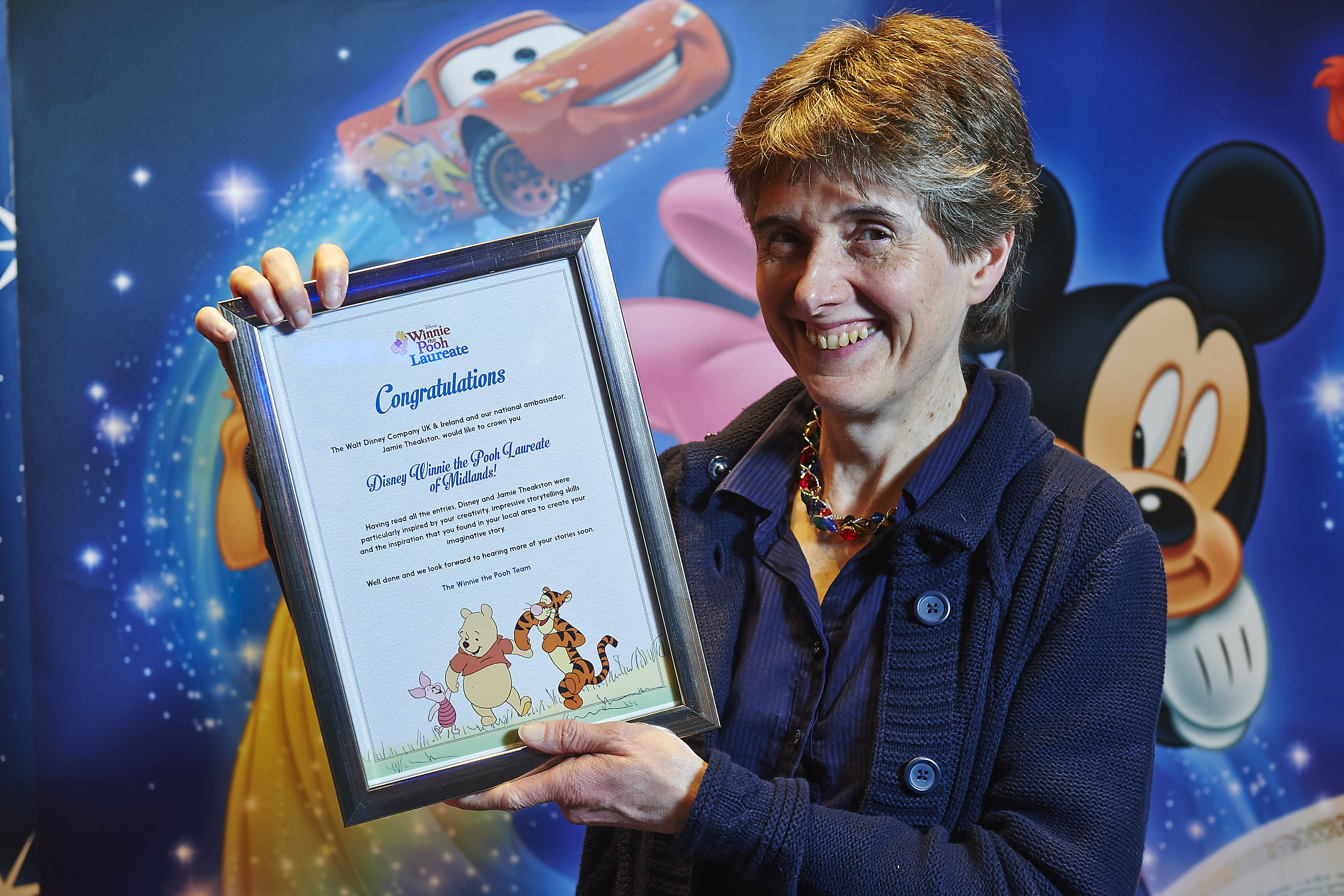
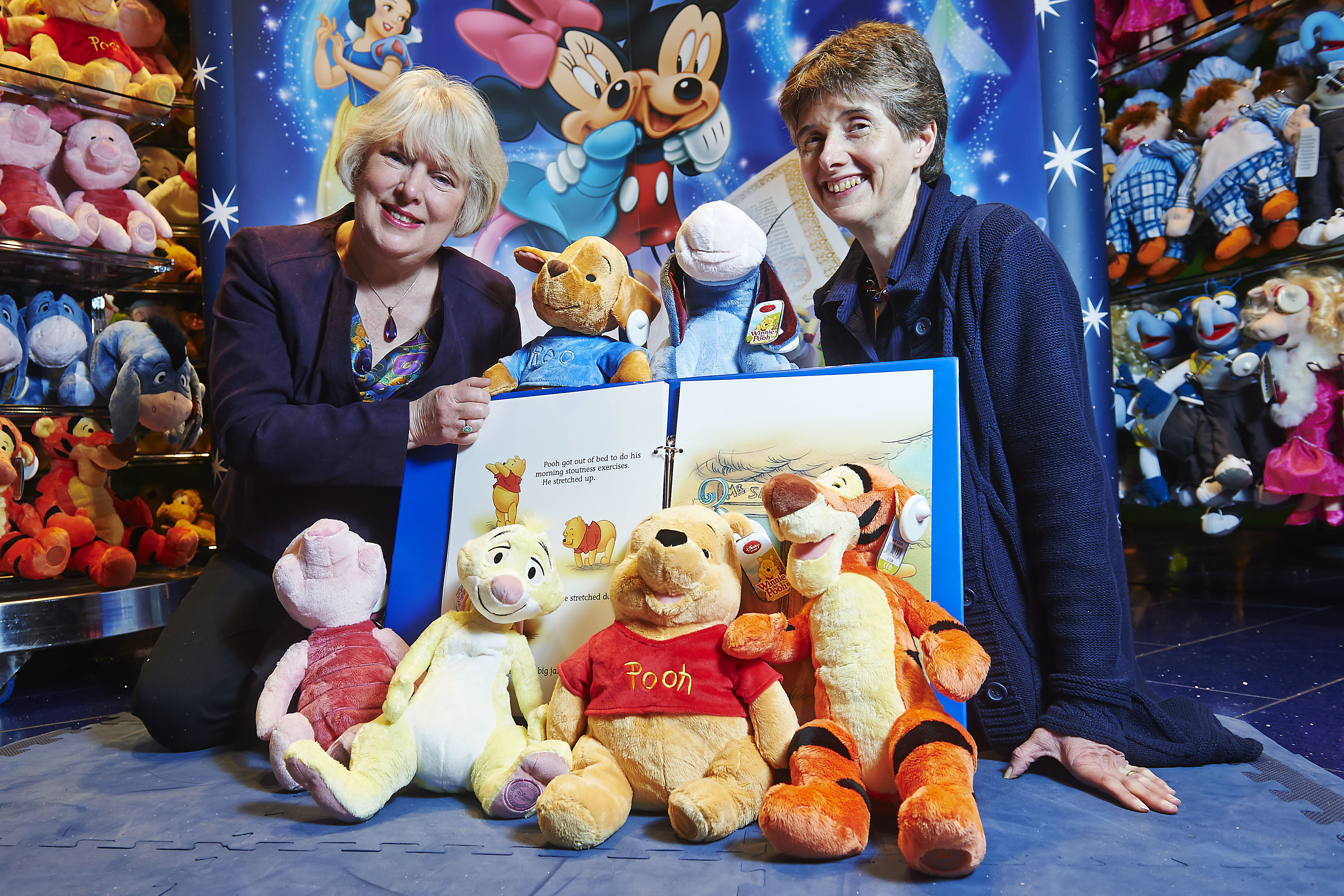
The two photographers had their turn with us next and spent ages posing Judith and I alongside various Disney cuddly toys in the shape of Winnie the Pooh, Tigger, Piglet and the rest of their friends from Hundred Acre Wood. They took pictures of us with the Mayor and some children (parents had to sign permission forms) and a giant story book.
After all this, I finally read my story to a group of children who were shopping in the store.
I went home clutching a goody bag of soft toys and a fistful of Disney Store vouchers. I felt quite a celebrity and couldn’t wait to watch my recording of Central News.
But my TV appearance was short, very short. Either my fears that I was spouting rubbish during the interview were true or everything else going on in the Central TV area that day was much more interesting! They showed a shot of Judith presenting my certificate and then a close up of the certificate and that was it. Neither of us was shown speaking – which in my case was probably just as well …
As for the press, there’s been nothing in the local paper yet despite the length of time the photographer spent with us.
BUT I have been sent some of the pictures taken by the PR company’s photographer AND I have got the platform of this blog to display them. So forgive me for indulging in a little celebrity showing off!
Networking Advice from Lin Treadgold
Posted by Sally Jenkins in Authors, Books, Promotion on March 7, 2014
I first met Lin Treadgold on the forum My Writers’ Circle.
Lin is a ‘Hero Member’ with thousands of helpful posts whilst I am a comparative newbie. Today Lin has agreed to answer some of my ‘writer networking’ questions.
What are the benefits that you get out of chatting to other writers on My Writers’ Circle?
I’ve been a member of My Writers’ Circle for the last nine years, since the forum opened. I received an invitation to become a moderator on the site and spent three years in that role. I stay on the forum because I understand the needs of new writers and how difficult it is, especially if you don’t know the ropes. As a published author I enjoy using my experience to support like-minded people.
You have a blog, It’s Lin Here. Do you use any other forms of social media?
I have a Facebook page and I also use Twitter but that’s about all I do. I am a great believer in face-to-face promotions. I love doing book signings.
Tell us about your real life networking?
It is important to go out there and meet the public, the new writers, and the authors. The internet can be a hostile place and words are very powerful, too powerful, and can cause a lot of pain. It is far better to meet your fellow authors. A face says a thousand words more that an ‘internet friend’. You need this if you are to be a writer. They will help you survive. I am a member of the Romantic Novelists’ Association and the Society of Authors. The RNA is the friendliest Association you could wish for. The support is amazing and without them I don’t think I could have got this far.
Your romantic novel, ‘Goodbye, Henrietta Street’ was published in summer 2013 by Safkhet Publishing in both paperback and digital format.
Even with the backing of a traditional publisher like Safkhet, authors are required to promote their books. How did you do this?
I enjoyed doing my own promotions on this novel. I know the locations well that I used for scenes in the book and I know the people who are best to approach, hence I sold 150 books in less than three weeks. I had a book launch on The Isles of Scilly, at The Mermaid pub on St Mary’s. About 40 islanders were there with the Sea Shanty group Bone Idol. Their songs made the whole event seem both surreal and wonderful. I am returning in July to do some more events to help keep the book rolling around on the islands and in Cornwall. Then I went to Yorkshire as there are also some scenes in Whitby.
Both paperback and e-books are selling well and Goodbye Henrietta Street is No.10 on Goodreads, Best of British Chic-Lit. I think my successes are down to the fact I am not afraid to be known. If you don’t tell people about yourself they won’t know you exist. I also do radio shows where possible.
Finally, please use the ‘networking opportunity’ of this blog post to tell us a little about your current writing activities?
It’s important to have another book on the boil, as the last one is ready for publication. I am presently writing The Tanglewood Affair, a romantic saga set in 1976, which tells the story of attractive 29-year-old, Jess Stamp. She is seeking a lifestyle change after losing her father. Jess moves to Dorset and rents a room at Tanglewood Farm, from divorcee farm owner, Connie Dijkman.
The farm is inhabited by Connie and her daughter Rosie, fiancée Ewan, Hans, and the handsome Jonni Holbrook, herdsman at the farm. It seems Connie is in the habit of taking in life’s waifs and strays, both animals and humans and this leads to conflict within the house.
Jess is aware of Jonni’s caring nature as he helps her with her luggage. However, life on the farm is not what she envisaged. The swearing, brash talk, and drug taking are shocking, but despite this and with the helpful Jonni, she becomes drawn into a family relationship with everyone, but something isn’t quite right with their family life and Jonni warns her not to get involved. What is it about Jonni that makes him so reluctant to allow his friendship with Jess to go any further?
The story is finished and I’m now working on it with my editor. I also have another two books planned; one is a novella, the other a wartime story. If you want to become a writer, you should be one step ahead of yourself.
Thank you so much for your time today, Lin and very best wishes with ‘Goodbye, Henrietta Street’ and your future plans.
It’s a pleasure Sally and I would be happy to answer further questions from the good folk out there.
Using Regional Speech in Dialogue
Posted by Sally Jenkins in Authors, Books, Writing on February 23, 2014
I love writing dialogue but never make my characters’ voices reflect their region of origin – because I  don’t know how to do it effectively! Then I got chatting to womag writer Maddie Purslow who loves accents and likes to slip them into her stories for Yours and Take a Break Fiction Feast whenever possible. Today Maddie has kindly agreed to give us all a few tips:
I have a Brummie accent and some would say I would do well to lose it, but I love accents. I love using them when I write. A lot of creative writing courses advise against using dialects but I think not only does it make your work more interesting, it also makes it easier for your reader to distinguish one character from another.
However, it can be a problem if it’s overdone. Nobody wants to wade through pages of unintelligible dialogue. The key is to concentrate more on the structure of the dialect rather than reproducing it phonetically which, let’s face it, can be a bit subjective. What sounds like a Geordie accent to you might not to someone else. So I suggest a light touch. Just add the odd phrase here and there that suggests the accent.
Using an American accent seems like an easy option because we hear so much of it on television but remember that Americans often use entirely different words from us and these can trip you up, leading to a lack of authenticity. Using an example from a story I had published recently, “You make sure and tell them to work hard at school, I figure that’s the best advice you can give them right now.” We would never say figure but it is part of American everyday speech.
If your character is Scottish, don’t go down the route of having them talk in clichés like the old, “Braw brit moonlit nicht” stuff. Instead look out for the things that are peculiar to the accent. Scots would add “right enough” at the end of the sentence by way of affirmation. “She’s a good looking girl, right enough.” It just gives the flavour of an accent without over egging the pudding.
And talking of puddings, the proof is in the eating of course, and the majority of the stories I have sold have featured at least one character with an accent.
My final tip would be, once you have written your dialogue, always speak it aloud. Even if you can’t do the accent, speak it anyway. It’s amazing how different it sounds and how many faults can be spotted that way.
But most of all enjoy it. Using an accent can be fun, just don’t overdo it. Or as we would say here in Birmingham, “Take it easy, Bab.”
And read more of Maddie’s great regional dialogue in her first novel, Fred The Red’s Dottir. 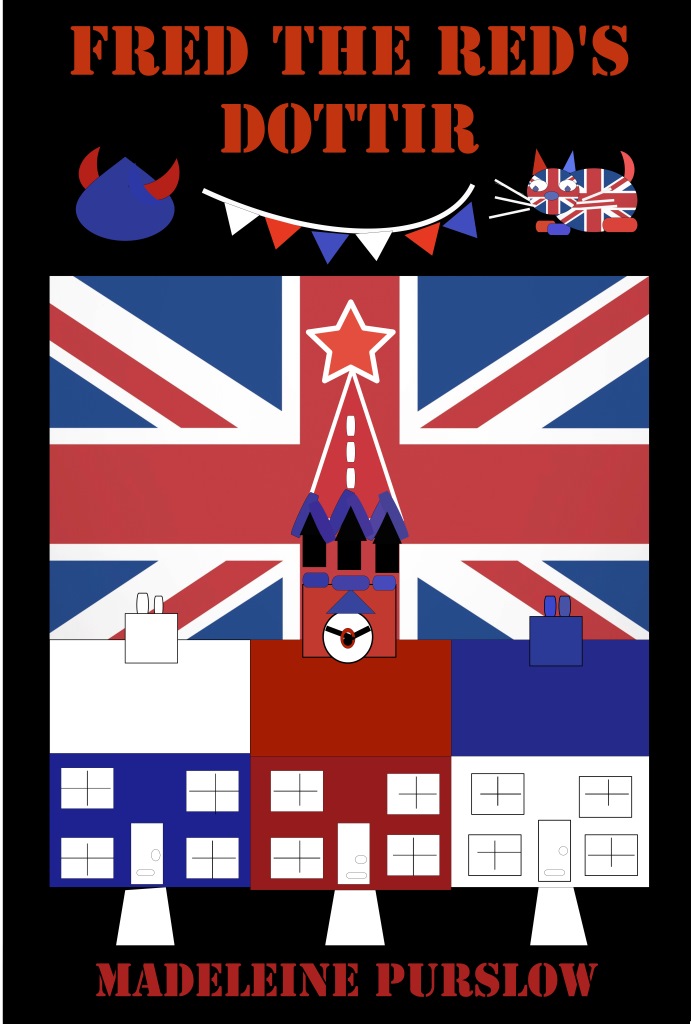
It’s currently only 99p on Amazon Kindle – going back up to the full price £2.49 next Sunday (2nd March).
The story sounds intriguing:
“It’s 1981 and the recession is biting hard. The summer of riots, a Royal wedding and things have turned sour for Julie Reynolds in London. She is forced to return to Birmingham where she has no choice but to live with her ailing, irascible communist father, Fred in ‘The Little Kremlin’. On her return to the working class Kingsbury Estate where she grew up, she is quickly drawn into the lives of her old neighbours, people she had tried to leave behind. But sometimes it is impossible to leave things behind….like secrets for instance.”
I was 18 in 1981 and remember it well so I’m going over to Amazon now, whilst the book’s still half the price of a takeaway coffee, and perhaps I’ll learn how to make the heroine of my next story talk like a Brummie!
Reading as a Writer
Posted by Sally Jenkins in Authors, Books, Events, Markets, Short Story on December 15, 2013
Last week I went to an event at Birmingham University where the novelist Helen Cross was speaking.

Cover of Charlotte’s Web (paper-over-board)
Helen was explaining how becoming a writer had taken away a lot of the ‘magic’ she previously experienced when reading. She told us that the first book she remembers getting utterly enthralled in as a child was Charlotte’s Web by E. B. White. The book made her cry. Even after she’d finished it Helen spent a lot of time musing over the book and wondering what the characters could have done to make things turn out differently and more happily.
But as she’s got older Helen has found such connections with books becoming increasingly rare. She puts this down to the fact that she now ‘reads like a writer’, for example she is looking to see how the book is constructed and what sort of tricks the author has used to withhold information from the reader. Helen finds herself mentally ‘editing’ the book and deciding which passages she would cut or how the dialogue might be changed.
I found this rather sad. To me the joy of reading is escaping into another world – something that can’t be done if you find yourself constantly critiquing the novel. I do admit to being more aware of the difference between good and bad writing since I started to write myself but I can also take off my ‘writer’s hat’ and just enjoy a book for what it is.
But maybe one of the secrets of becoming a good novelist is to analyse everything you read, and thus learn what works and what doesn’t.
What about you? Do you read as a writer or as a reader? Can you still get emotionally involved in a book?
Finally, thanks to Sharon Boothroyd for alerting me to this opportunity at the BBC. The next window for sending in material to Opening Lines – BBC Radio 4’s showcase for short stories is January 6th – February 14th 2014. They are looking for short stories that work well when read aloud i.e. with the emphasis on the narrative and not too much dialogue or character description. Stories should be between 1,900 and 2,000 words and only one submission per writer will be accepted.
Morley Literature Festival Prize Giving and Public Speaking
Posted by Sally Jenkins in Authors, Books, Competitions, Events, Short Story, Successes on October 20, 2013
I mentioned a few weeks back that I won first prize in the Friends’ of Morley Literature Festival Short Story Competition 2013.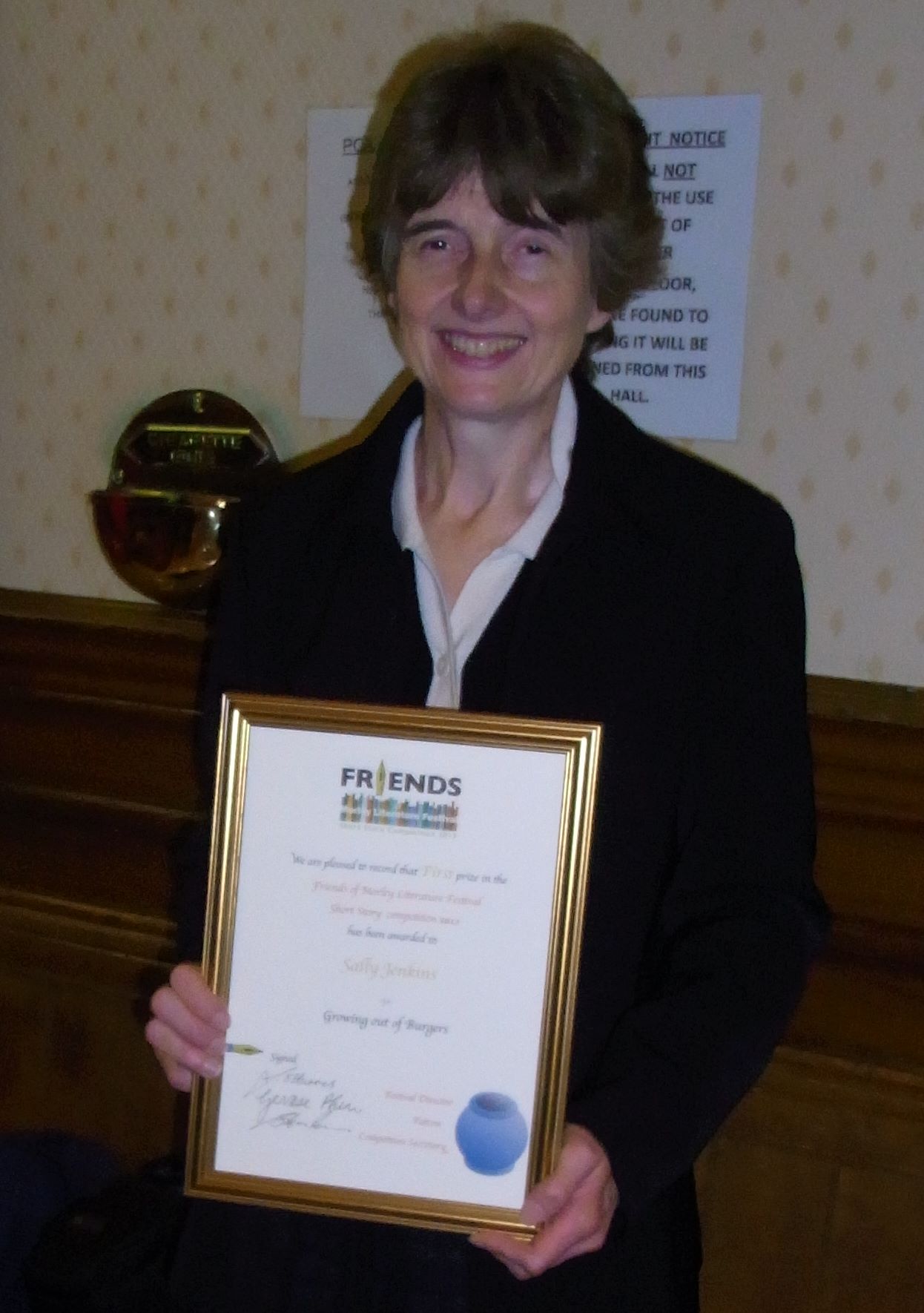 Last Sunday was the prize giving and I travelled up to Morley in West Yorkshire to receive my certificate and a cheque for £50. The certificate came nicely framed and it’s gone straight on my mantelpiece.
Gervase Phinn is the patron of the festival and he rounded off this year’s festival with an entertaining talk before making the presentation. As well as telling us about his experiences as a country school inspector (think James Herriot in a school inspector’s clothing) he was full of funny examples of mistakes we make with the English language, from his new book Mangled English – A Humorous Anthology of the Misuses of the English Language. I wish I’d written them all down now but if the book is half as enjoyable as the talk it will be a good read – and might make a good Christmas present for someone interested in words.
If you’d like to enter the Morley 2014 short story competition contact the organiser, Stuart Pereira, by emailing fmlitfest@yahoo.com for full details and an entry form. Entry is free and it’s an open theme – so what have you got to lose?
Gervase Phinn is an accomplished public speaker who knows how to hold an audience and keep them interested. I think it’s a skill that today’s writers need to master – whether it’s for promoting their work or teaching and running workshops. It’s also something that I’m useless at – so I’ve joined my local Speakers’ Club, whose strapline is ‘Speaking with Greater Confidence’.
If you’d like to find out how my first meeting went have a look at my guest post on the Sutton Coldfield Speakers’ Club Blog.
Many thanks to those of you who’ve taken the time to review Karen’s Story – The Museum of Fractured Lives. I do appreciate your honesty and I’ve learned a lot from the comments. There’s still time to enter the draw to win a Book Journal by leaving an Amazon review. Full details are here.
Finally, if you’d like some tips on plotting your novel, Nick Daw’s Three Great Techniques for Plotting Your Novel or Screenplay is going to be free on Amazon over the next few days. If you want some ‘straight to the point’ advice it’s worth a read (and, as with any free book, please consider leaving a review if you enjoy it).
Short Story Competition Advice by Iain Pattison
Posted by Sally Jenkins in Authors, Books, Competitions, Short Story on July 2, 2013
Iain Pattison is a successful short story writer, frequent competition judge and a writing tutor.
He has kindly agreed to share some of his wisdom with us today. He is pleading for more humour and less heartbreak in your competition entries:
You know, sometimes I think judging short story competitions should come with a health warning. Not that it’s dangerous – well, not if you can run fast enough from those who haven’t won – but more because of the awful things it can do to your state of mind.
It’s always the same. Each time a big envelope of entries drops through my letter box I grin insanely knowing I’m in for a reading feast. But then, moments later, I remember that 95% of them will be stories of angst, despair, betrayal, abuse, regret, anger and disappointment and I gulp and wonder if my poor ragged nerves will stand the trauma.
It’s not that I’m a delicate flower or have a soulful, artistic disposition (I make Frankie Boyle look like Pollyanna on a particularly upbeat day), it’s just that no one can take hour after hour, page after page, tale after tale of gloom, doom, depravity and darkness without it leaving them so down in the dumps it would take a JCB to effect a rescue.
In some larger comps the pile of entries stand four feet high – that’s a tower of tears, a soaring spire of sorrow, a mountain with pique at the top! And the only thing that gets me through the relentless emotional pounding is the rare treasured tale that provides a chuckle.
For a few precious smile-filled minutes I escape the plight of characters being diagnosed with cancer, discovering their spouses are having affairs, fretting over putting elderly relatives into care homes or dealing with their drug/alcohol/Facebook addictions , and just have a good laugh. Bliss. Sheer bliss.
So it won’t come as a surprise that I always urge writers to go for humour if they want to stand out in comps. Funny stories don’t have to be trite, lacking in compassion or silly. They can make the same telling points about how people behave, about the madness of modern life, and reveal real truths about the human condition – but do it with a few welcome giggles along the way.
Nor do they need to gag-packed or slapstick. Some of the funniest stories I’ve ever judged have been deadpan all the way through until springing an unexpected and ironic twist.
 Other adjudicators feel the same – we all call for comedy. And if you take a look at my eBook Is That A Pun In Your Pocket? 21 Short Stories To Tickle Your Fancy you’ll see that many of my satirical tales did indeed catch the eye of jaded judges.
So please – more funnies. It’ll boost your chances, make judges love you, and mean that The Samaritans can lift the bar they’ve put on my overwrought phone calls!
Many thanks to Iain for his advice! And if you want to see how Iain injects humour into his own stories do take a look at Is That A Pun In Your Pocket? 21 Short Stories To Tickle Your Fancy. I particularly liked Iain’s modernised version of A Christmas Carol and his take on Willy Wonka’s Chocolate Factory.
-
You are currently browsing the archives for the Authors category.
 Sally Jenkins