Archive for category Writing
Writing Serials for Women’s Magazines (Episode 1)
Posted by Sally Jenkins in Events, Resources, Writing on April 14, 2011
Last week I enjoyed an immensely informative day in Derby taking part in Joanna Barnden’s course on writing serials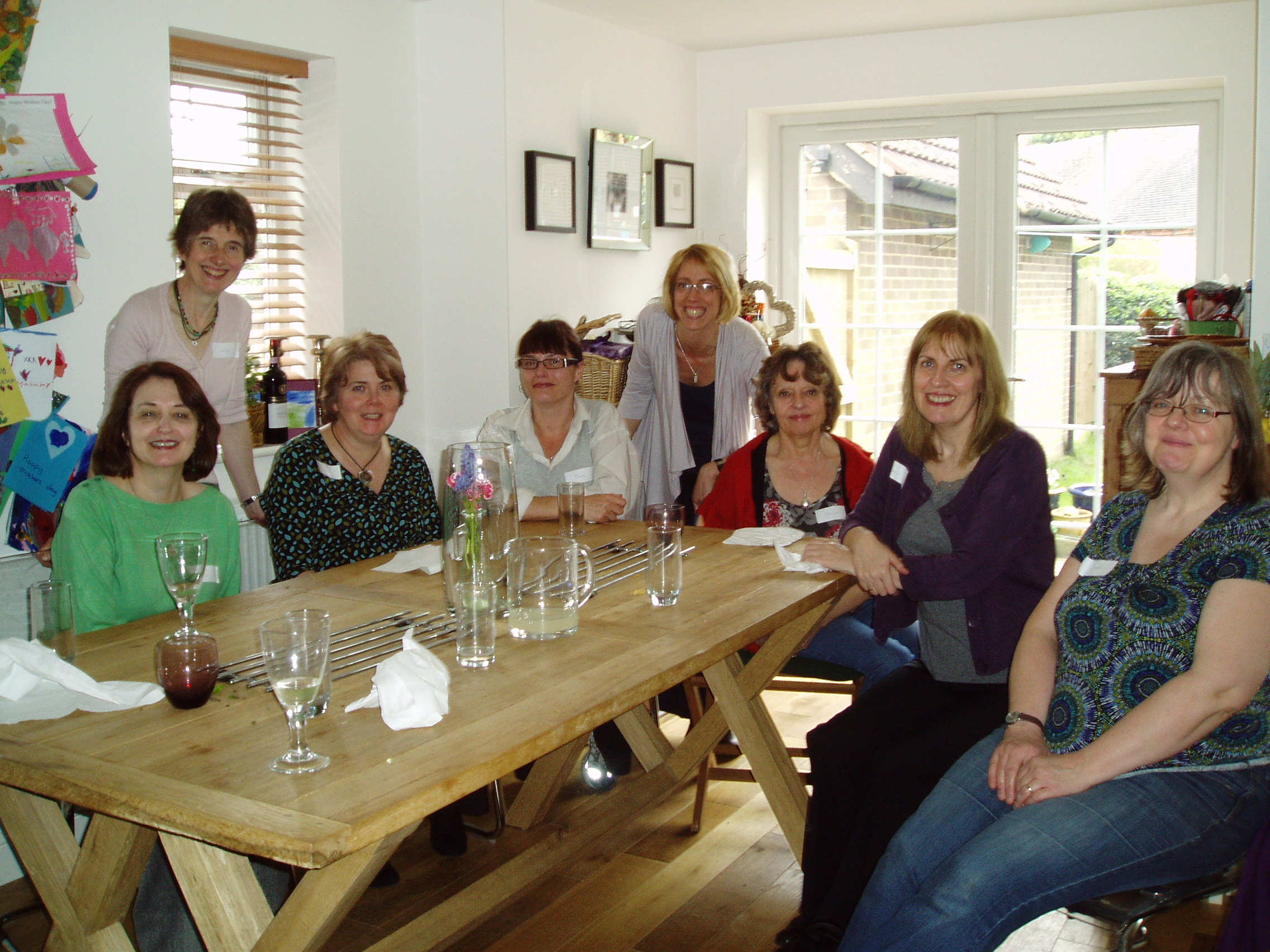 for women’s magazines. Joanna’s aim was for all of us to go home with a cast of characters and a basic outline for a serial that we could further develop ourselves. I thought it was a tall order but she succeeded!
There were 7 of us around the table (the picture shows us half way through a home-cooked lunch and waiting for pudding!) and as the day progressed so did our serials. From nowhere we produced story settings ranging from a Greek island, a solicitor’s office and a belfry. An equally disparate list of characters came to life and then we had to work on the bit I found really hard – a main plot plus a couple of sub plots…
Later it was down to planning that crucial first episode which has to grip the reader and make her buy the magazine again next week. But, most importantly, along with an episode by episode summary, it also has to sell the whole serial to the editor.
As we went through the day Joanna gave us a few rules to work with:
- Have lots of characters – all with their own problems. These people should be part of a linked group – perhaps they work together, belong to the same sports club or live around the same village green.
- The timeframe can be as long as you like
- Keep to a linear story
- Use several settings – think how often the camera moves to a different view in a TV drama
- Tease the reader by revealing things gradually
- Each episode needs to be satisfying read in itself – this is so that readers who have bought the magazine for the first time can still enjoy the story.
Most of these ‘rules’ are the exact opposite of short story writing where only a few characters play out the story in one setting within a tight time frame – so as someone who loves writing very short ‘coffee break’ fiction, this went totally against the grain for me.
One of the most important elements of a serial is the cliffhanger – and just to keep you on tenterhooks I’m going to save that plus how to submit your story to an editor for the next post !
In the meantime if you want to find out more about Joanna, her courses or her reasonably priced critiques – her website is here.
Character Names
Posted by Sally Jenkins in Resources, Writing on March 31, 2011
Wouldn’t it be great to have an ‘age appropriate’ list of character names to choose from?
The pool of names at my disposal is quite limited. If the heroine is about my age then I run through the names of the girls that I was at school with – this means that you’ll often find a Karen, Alison (we had 4 of those) or Tracy starring in my tales about women in the prime of their life (!). When I am writing about a teenager then I pick the name of one of my daughters’ friends and Holly, Amy or Megan will take centre stage. My mum’s contemporaries come in useful when I’m writing about the older woman and the names that I’ve grown up with are Shirley, Audrey and Dorothy.
Anything in between these generations and I just have to guess or try to think of someone I know of the appropriate age.
Men’s names are much harder because I went to a girls’ school, had no brothers and I have no sons. I work mostly with men but their average age is just over 40 so choosing names for young men can cause me a problem.
If I were to set a story 100 years ago it would be much tougher still to work out an age appropriate name for my cast of characters.
However, Katey Nixon has solved this problem for me. She has produced a resource for writers comprising the most popular names for both sexes over the last 100 years. So whether you want to invent a cast of characters for a story set in war-torn London in the 1940s, or a tale of saucy goings on in the 1960s or even about a baby born as the world entered the new millennium, there should be something suitably inspiring to bring your story to life.
Specifically, Katey’s spreadsheet contains the top 100 girls and boys names for ten-year intervals from 1904 to 1994, and every year from 1994 to 2008. Plus there are Irish and Scottish names over the last century and this. The character’s age as of 2010 is preprogrammed into the spreadsheet. But it has a facility whereby you can enter the date your book or short story is set and it will recalculate.
But the best thing about this list of names is that it raises money for the charity Hamlin Fistula UK, which supports the Addis Ababa Fistula Hospital in Addis Ababa, Ethiopia – a hospital caring for women with horrendous injuries sustained in childbirth.
You can get hold of Katey’s fabulous resource by donating just £2 by clicking here. After you’ve donated you’ll receive a link enabling you to download the spreadsheet and get inspired by all those names just crying out to be brought to life!
Fiction Addiction – An Online Womag Writers’ Circle
Posted by Sally Jenkins in Resources, Writing on March 21, 2011
Fiction Addiction is an online writing circle for Womag (women’s magazine fiction) writers. It was founded in January 2011 by Sharon Boothroyd because she (like the rest of us!) was fed up of getting rejections but not knowing where she was going wrong.
Since Fiction Addiction was mentioned on womagwriter’s blog, Sharon has received loads of emails and the writing circle is growing.
The circle has no strict rules to follow. Members send their work out for feedback whenever they wish. All stories and feedback are sent on a ’round robin’ basis so that everyone can read everything and no-one is left out. However, if individual members want to then start corresponding separately then that is OK too. Most of the stories submitted so far have been under 2,000 words but Sharon thinks that 6,000 would be the absolute limit. Serials and My Weekly/People’s Friend pocket novels are also welcome and can be sent out for feedback chapter by chapter or part by part.
The members of Fiction Addiction are asked to abide by certain guidelines to ensure that criticism is given in a constructive away and that email addresses are kept confidential. There is no need to fear having a story ‘stolen’ by someone else in the group – the ’round robin’ method of communication means that everyone else will know where a particular story originated from.
Membership of the Fiction Addiction writers’ circle is free and Sharon runs it as a hobby not a money-making enterprise. Some members of the group have already been published professionally and others are just starting out but they are all feeling the benefit of being part of a group rather than floundering alone. Here are some of their comments:
“Thank you all for the warm welcomes I have received already! It really is an active group and I am so excited about being part of it.”
“I love sitting down with a coffee to read a good story and it’s also really interesting to read everyone’s comments.” “Congrats to you for setting this all up, I think its going to be a real bonus for everyone involved and it feels great to be a part of something.”
I write women’s magazine fiction and find the feedback that I get from Helen, my writing buddy, invaluable. So I would urge anyone who would like someone else to cast an eye over their work (and who is willing to do the same for other people) to have a look at the Fiction Addiction website for more details.
Emerald Writing Workshops – Flash Fiction Competitions
Posted by Sally Jenkins in Competitions, Successes, Writing on March 17, 2011
It was my birthday on Sunday and the day was made even more special by receiving an email from Eddie Walsh of Emerald Writing Workshops to let me know that I was a runner-up in his Airport themed 500 word short story competition. A book of crime short stories is on its way to me – an unexpected ‘extra’ birthday present!
The winner was Tracy Fells from West Sussex. Her story was set around the baggage reclaim carousel and you can read it here. Congratulations Tracy!
Eddie Walsh is an Irishman living in Nottingham. He mainly writes fillers and letters but has recently become interested in fiction writing. In his competitions he is aiming to encourage the hobby writer and believes even getting on a shortlist stops a writer from giving up. He provides critiques of entries whenever he can, as writers rarely receive independent feedback.
Eddie runs a 500 word story competition every three months with a £75 prize fund for each one (£50 first prize, £15 second prize, £10 third prize plus books for 3 runners-up). There are 3 competitions currently open to submissions:
- First 500 words of a novel – closes May 31 2011
- 500 words on an open theme – closes August 31 2011
- 500 word ‘Riches to Rags’ story – closes November 30 2011
The entry fee is 5 second class stamps (or a cheque to that value). There are discounts for multiple entries into the same competition. Entries are acknowledged on receipt and periodically the site is updated with the number of stories received for each of the competitions.
Eddie is also currently running a 4-sentence competition which is free to enter and has a £75 prize fund to be divided equally between the 3 best entries. However, entries will only be accepted from people who have previously entered one of the 500 word competitions.
So if you’re looking for a competition with a friendly feel try Emerald Writing Workshops . And remember that the cost of second class stamps will be going up in April, so buy them now to use for your entry fee or if you intend paying by cheque, get your entries in before the price increase takes effect.
Creative Writing Courses to be Won
Posted by Sally Jenkins in Competitions, Events, Writing on March 10, 2011
Can creative writing be taught? It’s a topic that’s often debated but I don’t think anyone has come up with a definitive answer.
Obviously, we can learn the rules of grammar, spelling and punctuation. We can also be told how to present a manuscript (double spacing, wide margins etc) and make sure we include a self-addressed envelope. But can anyone tell us how to grab an idea and turn into in a story?
I think it is possible to teach someone to write a competent short story. Most people can grasp the basic rules, such as:
- Keep the number of characters to a minimum
- Keep the time frame short
- Use just one ‘scene’
- The main character must resolve some sort conflict (internal or external)
But to rise above the ‘competent’ and produce a tale that really sparkles (and will attract the attention of editors and competition judges) requires some sort of talent or creative leaning. It may be a hidden talent that we don’t know we possess until it is honed by the production of several stories, each a little better than the last – so practice is just as important as anything that can be taught.
So, is it worth going on a creative writing course? The answer is most definitely yes!
The benefits of courses often far outweighs the number of ‘writing rules’ that might be taught. Being with like-minded people, even if only for half a day, will fill you with enthusiasm, give you the opportunity to meet new friends and make you more determined to continue down the rocky writing road.
But unfortunately writing courses tend to be expensive – unless you can find a subsidised one taking place in a library or similar place. However, all is not lost because it is possible to win your way on to a course with the following competitions:
- The Arvon Postcard Competition is offering a first prize of a one week Arvon course. Send in a piece of flash fiction or poetry that describes your favourite writing place (seems like a big prize for few words!) Closing date 21 May 2011.
- The Swanwick Writers’ Summer School is running three competitions, two of which offer a free week at the 2011 Summer School as their first prize. The first is a short story on the theme ‘New Beginnings’ and the second is 1,000 words of a children’s story. Closing date is 30 April 2011.
- Leaf books is running a travel writing competition with a first prize of a beginners’ travel writing course (in London). Send a 300 word piece of travel writing before the closing date 30 April 2011.
- Nature of Wales is offering a place on the nature writing course at Tŷ Newydd as the second prize in their competition (first prize is £500 cash). They require a thousand word article on a subject of topical environmental or wildlife interest in Wales. Closing date 31 March 2011.
Women Only Writing Competitions
Posted by Sally Jenkins in Competitions, Writing on February 24, 2011
Where are all the male writers hiding?
The writers’ events I’ve been to recently seem to be dominated by the fairer sex. At the Martin Davies Novel Writing Day there were around a dozen participants but only one of them was male. At the writers group I attend, women outnumber men by nearly 3 to 1 and in the Birmingham Chapter of the Romantic Novelists Association we have just one man (but maybe that is to be expected!).
And judging by the email addresses of the subscribers to this blog, 95 % of them are women and most of the comments left are from ladies too.
I pointed out this imbalance in the sexes to my husband and he suggested that maybe all the male writers are actually writing and producing best-sellers, rather than sitting around talking about writing or surfing the blogosphere.
He could have a point. We women get caught up in the social aspects of writing whereas our male counterparts actually knuckle down and get on with it.
So as we seem to be all girls together, here are some suggestions for women only competitions to get you inspired and writing:
- The Glass Woman is a fiction competition for stories of between 50 and 5,000 words. The theme is open but the subject must be of significance to women. No entry fee and the closing date is March 21st. First prize is $500 plus there are runners-up prizes. Previous winning entries plus full details are here.
- The Baptist Times are running a women’s writing competition for non-fiction. There are 3 categories each with a prize of £100; Spirituality, Cultural Comment and Faith & Life. The judges are looking for writing that’s stylish, insightful and powerful. No entry fee, word limit is 1,000 and closing date is 4th April. Full details here.
- The Grey Hen Poetry competition is open only to women over 60. Closing date is 30th April 2011, £3 entry fee and £100 first prize. Full details here.
If you’re already a published novelist then there’s always the Orange Prize for Fiction.
Oh, and if you’re a man reading this – please leave a comment and make yourself known (or use the box on the right to sign-up to receive my blog posts by email – that way you’ll never miss one!)
Writing Serials for Women’s Magazines Course
Posted by Sally Jenkins in Events, Writing on February 14, 2011
Joanna Barnden is running a one-day course on writing serials for the women’s magazine market on April 7th in Derby. Joanna has had many stories and serials published and is a member of the Romantic Novelists Association.
I have attended 2 of her previous courses and as well as being extremely informative, they are stimulating and enjoyable. Joanna provides a friendly atmosphere and high quality refreshments throughout the day plus a home-cooked lunch (with pudding!).
Here is the course content (in Joanna’s own words):
Derby – Thursday April 7th 2011, 9.30 am – 4.30 pm
Editors love a good serial – one rich with interesting characters, bursting with tensions, rustling with mystery, and written with pace and flair. One, in short, that will keep their readers coming back for more. They are always on the lookout for new writers and, indeed, Women’s Weekly say that their serial slot receives the fewest submissions, so your odds of getting published are higher – if you get it right!
Now here is a one-day workshop that can help you do just that, covering:
What makes a good serial – To start off, we will look at the core attributes of all serials, at popular genres and at what the market is looking for right now.
Creating a cast list – This is a vital and much overlooked element of a successful serial. It’s your characters that give your story colour, detail, life and, very importantly in a longer work – variety. We’ll look at how to create a believable and exciting set of people for your serial.
Plotting – The strength and depth of your plot will determine the success of your serial. It’s the single biggest shift from short pieces and a serious challenge over stories of up to 60,000 words. We’ll look at how to create plots and subplots and how to intertwine them effectively.
Viewpoint – Longer serials are usually told from more than one viewpoint but this can be tricky to balance. We’ll look at how to successfully get into the heads of multiple characters.
Writing the submission – Your first episode and plot summary are your tools for selling your serial to an editor. We’ll look at how to get them right and get you into print week after week…
Cost: £90 including full home-cooked lunch (about half what you’ll make on just one episode).
Joanna points out on her website that much of the teaching will also be applicable to the sister craft of writing a novel.
For those who don’t live within reach of Derby, Joanna hopes to roll the course out across the country later in the year.
To request more information or to reserve a place – go to Joanna’s website www.joannabarnden.co.uk.
I’ve booked my place (as a birthday present from my husband) and am looking forward to picking up some useful tips. Hope to see some of you there!
Ideas for Writers Available Here!
Posted by Sally Jenkins in Resources, Writing on February 10, 2011
Where do you get your ideas from?
That must be the question most often asked of writers and the most difficult to answer. We all know that story and character ideas are all around in us our daily life – overheard conversations, a couple arguing in the street or 2 teenagers in hoodies following an old lady.
But ideas tend to be like buses – 3 come along in a row or, no matter how long you wait, not one puts in an appearance.
If you’re suffering an ideas drought here are a few ‘ideas factories’ to kick-start your imagination:
- Sally & Cally’s Short Story Ideas Generator – this will give you a random character, setting and conflict/situation
- The Brainstormer – this is a little bit like an on-line roulette wheel. Click on the ‘Random’ button to spin the wheel and generate a conflict, adjective and person/place/thing.
- The Writers’ Idea Store in Writers’ Forum magazine – this monthly feature by Paula Williams discusses where to find ideas and also incorporates a Fiction Square. The square includes 6 each of characters, conflicts, weather, setting and objects. Roll a dice once for each of these categories in order to determine which should be in your next story.
- The Writer’s Block – this is a block-shaped book that contains ideas and story prompts on every page. It’s well worth dipping into if you’re scratching your head for something to write about.
- Sign up for the free e-newsletter produced by www.ideasforwriters.co.uk – you will receive story prompts and ideas for historical anniversaries to write about.
- Creative Writing Prompts has 346 prompts to get your pen moving.
There is no copyright on ideas. This means that it’s acceptable to re-write a well-known story such as a fairy-tale or legend. Try writing The Frog Prince from the point of view of the frog rather than the princess or modernise Snow White and the Seven Dwarfs by giving the heroine a job as a housekeeper to a group of brothers living in a large house inherited from their parents.
So now you’ve no excuse for not writing. Don’t wait for inspiration to strike – use the suggestions above to create your own!
Remember – Writers Write! (they don’t just sit around and think about it).
How to Write a Novel
Posted by Sally Jenkins in Events, Writing on February 3, 2011
As you may have gathered from reading this blog, short stories and articles are my ‘thing’. I find the prospect of writing anything longer than about 3,000 words terrifying! I succeeded in NaNoWriMo 2009 but my 50,000 words were rambling and certainly nowhere near a coherent story.
Hence my decision to sign-up for Martin Davies’ Novel Writing Starter Kit.
Last Saturday was the big day and I came away thinking that writing a novel might actually be possible. Martin was very generous with his advice and here are the most important bits :
- Writing is a habit that gets easier the more you write. Decide when and where you are going to write. Don’t be too ambitious because that makes failure more likely. Sticking to 10 minutes, twice a week before bed is easier to maintain than trying to write for the whole of every Saturday afternoon. Remember that little bits, done regularly, will add up.
- Set a time limit for each writing session and don’t use that time to re-read or revise what has gone before. Don’t worry about the standard of your writing – just keep going.
- Write what you enjoy reading. You will have to live with this novel and its characters for months, maybe years, so it’s no good trying commercial chick-lit if you hate reading that genre.
- Don’t wait for a fantastic, original idea to drop into your lap. Most plots have been done many times over and it’s perfectly acceptable to re-tell an old tale or legend. Maybe set it in a different time period or tell it from a different point of view.
- People + Events = Change. This is the formula for a novel. Drop an event on your characters and watch as they react to the ripples and changes around them.
- Create a structure for your story. Include the main events plus the milestones that must happen to lead up to these events. This is your map for the journey ahead but remember, you can change this as you write and get to know your characters better.
- Only include subplots if they have a reason within the overall plot. For example they may give an insight into the character of your main protagonist or give necessary information to the reader.
- Know your setting but don’t go into reams of descriptions about the landscape. Feed small details to the reader and they will build their own images.
- Similarly with character descriptions, less can be more. Show your hero’s characteristics through action where possible.
- Don’t get bogged down by research. If you’re unsure of something when writing don’t stop the flow to find out, put a question mark and look it up later.
- Keep your first novel simple. You will gain confidence from finishing it, whether or not it is published, then you can move on to a more complex story/structure.
Sounds simple doesn’t it? Just stick to Martin’s mantra of ‘Writers Write!’ and you can’t go far wrong in turning yourself from ‘someone who likes the idea of writing a novel’ into ‘someone who has a completed novel under their belt’.
So, fired up with enthusiasm, I am now publicly setting myself the goal of writing a 30,000 word My Weekly pocket novel and I’m going to start by brainstorming some ideas…
My writing buddy, Helen Yendall, also attended Martin’s workshop – you can read her take on the day here.
P.S. Only one day left to enter my free prize draw!
Improve Your Reader’s Mood
Posted by Sally Jenkins in Books, Competitions, Markets, Writing on January 17, 2011
As you write do you consider how your words will affect your reader’s mood? Will he be uplifted to a better place or left wondering whether or not to slit his throat? 
The Reading Agency and BBC Headroom have worked with reading groups to identify a selection of ‘Mood-busting Books’ that should leave you with a smile. The list includes The Uncommon Reader by Alan Bennett, Cold Comfort Farm by Stella Gibbons, My Family and Other Animals by Gerald Durrell and The No.1 Ladies’ Detective Agency by Alexander McCall Smith.
I think it’s hard to write something that makes a reader a happy. It’s so much easier to make a story out of tragedy or misfortune – after all if everything is going swimmingly for your characters, where’s the conflict that we are told is an essential element of every piece of fiction? A death, divorce or double-dealing fraudster immediately threw up dozens of plot lines but it’s harder to make a compelling piece of fiction out of happy family life. Making your reader feel good is much more of a challenge than making them feel sad.
Judges of short story competitions often complain that there are too few entries that make them smile. Imagine wading through a couple of hundred stories dwelling on the harsher side of life – the one story that can make you laugh and raise your mood must make it to the short list.
So why not read one of the mood-busting books above and then practise some ‘feel-good’ writing – January is dismal enough without making it worse with massive amounts of melodrama.
To get the creative juices flowing, here are a few places to target with your smiley stories and pick-me-up poems:
- The Marple Short Story and Poetry competition is offering a special prize for the best humourous poem submitted
- East of the Web publishes short stories online and has a humour section – unfortunately there is no payment other than a page to publicise yourself, including links to your own blog/website.
- Chicken Soup for the Soul publishes inspirational books, comprising a selection of short pieces on a particular theme designed to encourage, comfort or amuse. They are currently looking for submissions around themes such as weddings, Canada and marriage. The full list is here.
And if you just want something to cheer yourself up during these grey weeks – enter my free prize draw.
-
You are currently browsing the archives for the Writing category.
 Sally Jenkins