Posts Tagged Womag Serials
Writing Serials for Women’s Magazines (Episode 2)
Posted by Sally Jenkins in Events, Resources, Writing on April 18, 2011
More tips picked up at Joanna Barnden’s highly informative course on writing serials for women’s magazines:
Each episode of a serial needs a cliffhanger to make the reader buy the next edition of the magazine. The cliffhanger has to leave the reader wondering about what has just happened or desperate to find out what is going to happen next. It should open up the story for lots of possibilities in the next episode rather than answering any questions or tying up any loose ends.
Try to do this by revealing something that suddenly changes the reader’s assumptions about the story line, such as a dead body, a person who is not what he seemed or dropping in a face from the past. Alternatively leave your character in a perilous situation, for example in charge of a runaway horse or at the mercy of a gun man in a post office hold-up.
I mentioned in my previous post that it is the opening episode plus further episode by episode summaries that sell a serial to an editor. Joanna referred to this first episode as the ‘pilot’ that really has to ‘wow’ a very critical audience. This episode should try to include all your main characters. There are 2 obvious ways of doing this:
- Have everyone get together at a big important event such as a party, funeral or on a coach journey. Show how they react to each other and the event they are attending.
- Have a crisis (such as a road accident, outbreak of war) and show how the different characters react to it.
Following on from this, the episode summaries need to be concise and easy to read. Around 500 words per episode is sufficient. Also include a cast list with your submission listing a very brief sentence about each character. Finally, write a short summary of the whole story. This should be similar to the blurb found on a novel or DVD.
Three magazines currently use serials:
- People’s Friend – around 10 episodes with a total word count of 60,000
- Women’s Weekly – serials of either 3 or 4 parts of 3800 words each, they want ‘serials that reflect life but in a way that is utterly compelling’
- My Weekly – they don’t always run one but prefer 3 episodes of 2,500 words each
Once a magazine has accepted the first episode and summaries you will usually be asked to submit each episode in turn to the editor. She may request changes to get things just right before you move on to write the next episode. There is no need to write the whole serial ‘on spec’.
So there you have it – serial writing in a nutshell!
Writing Serials for Women’s Magazines (Episode 1)
Posted by Sally Jenkins in Events, Resources, Writing on April 14, 2011
Last week I enjoyed an immensely informative day in Derby taking part in Joanna Barnden’s course on writing serials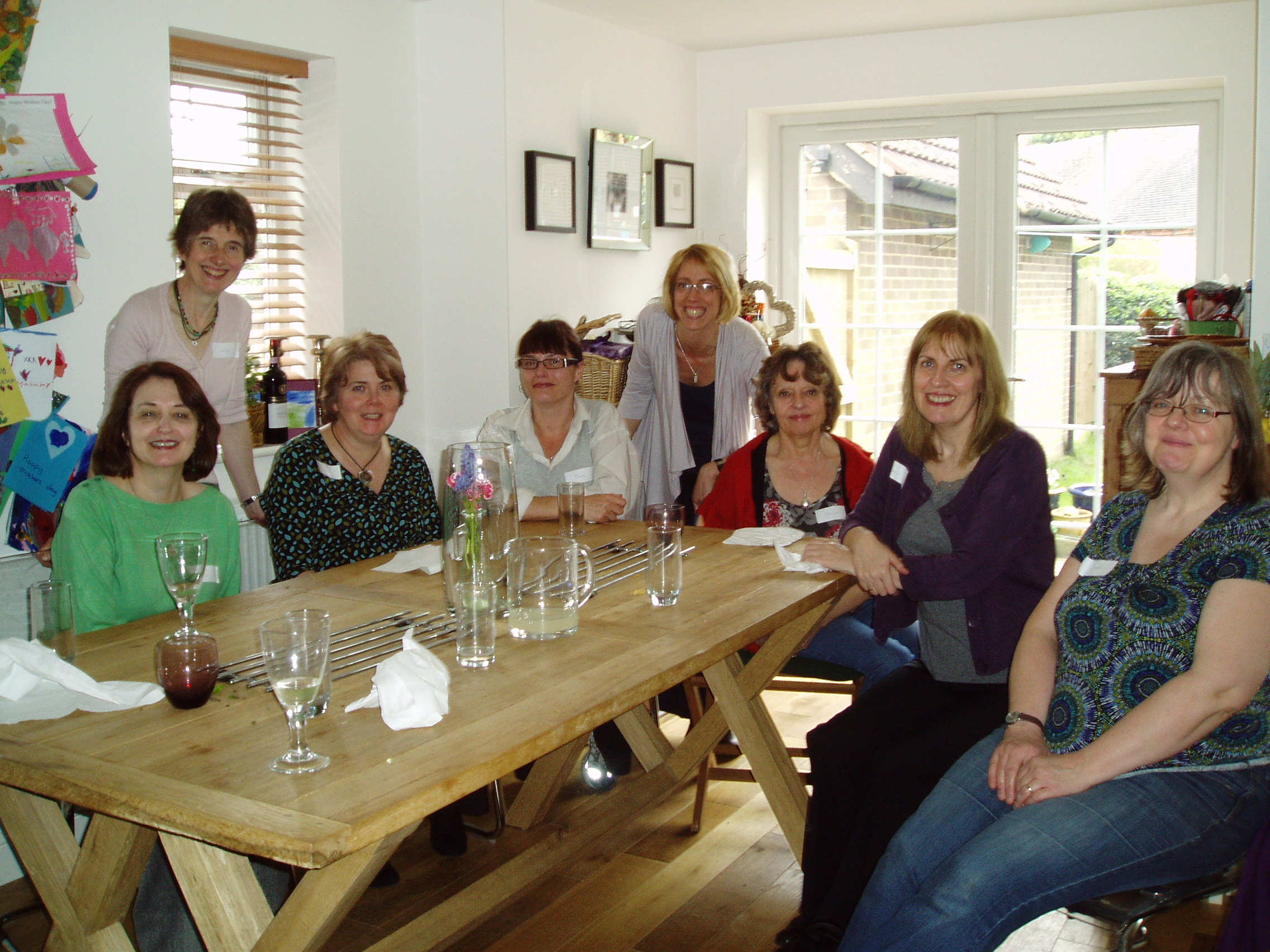 for women’s magazines. Joanna’s aim was for all of us to go home with a cast of characters and a basic outline for a serial that we could further develop ourselves. I thought it was a tall order but she succeeded!
There were 7 of us around the table (the picture shows us half way through a home-cooked lunch and waiting for pudding!) and as the day progressed so did our serials. From nowhere we produced story settings ranging from a Greek island, a solicitor’s office and a belfry. An equally disparate list of characters came to life and then we had to work on the bit I found really hard – a main plot plus a couple of sub plots…
Later it was down to planning that crucial first episode which has to grip the reader and make her buy the magazine again next week. But, most importantly, along with an episode by episode summary, it also has to sell the whole serial to the editor.
As we went through the day Joanna gave us a few rules to work with:
- Have lots of characters – all with their own problems. These people should be part of a linked group – perhaps they work together, belong to the same sports club or live around the same village green.
- The timeframe can be as long as you like
- Keep to a linear story
- Use several settings – think how often the camera moves to a different view in a TV drama
- Tease the reader by revealing things gradually
- Each episode needs to be satisfying read in itself – this is so that readers who have bought the magazine for the first time can still enjoy the story.
Most of these ‘rules’ are the exact opposite of short story writing where only a few characters play out the story in one setting within a tight time frame – so as someone who loves writing very short ‘coffee break’ fiction, this went totally against the grain for me.
One of the most important elements of a serial is the cliffhanger – and just to keep you on tenterhooks I’m going to save that plus how to submit your story to an editor for the next post !
In the meantime if you want to find out more about Joanna, her courses or her reasonably priced critiques – her website is here.
 Sally Jenkins