Poetry, Pictures and Andrew McMillan
Posted by Sally Jenkins in Competitions, Events, Poetry, Successes, Uncategorized on October 10, 2011
On Saturday I went to Morley in Yorkshire to collect my certificate for the Friends of Morley Literature Festival Short Story Competition. It was a lovely evening which featured Andrew McMillan (not sure if he’s any relation to Ian) reading poetry that had been written for a special project undertaken in conjunction with the Literature Festival.
Four families in the area chose paintings from Leeds Art Gallery to hang in their homes for 3 months. Andrew went out to visit these families and talk to them about how they felt about the art works. He then used these conversations as triggers for poems. Three local schools also chose pictures to hang in their classrooms for a similar project but this time the children wrote the poems with Andrew acting as their mentor.
Andrew has a wonderful way of performing poetry and he brought the children’s colourful language & unusual ideas to life with his gestures, timing and strong regional accent. Similarly, hearing him read his own poems made them so much more vivid (for a non-poet like me) than simply reading words on a page.
So, to be a successful poet do you have to be able to perform with panache and carry the audience with your words? Or can you succeed as a shrinking violet? I imagine that few people buy books of poetry these days and therefore a confident performance is essential to build a following.
The evening continued with a gig by the comedian Arthur Smith (of Grumpy Old Men). He was brilliant but surprised me by including poems (which he knew off by heart) in his act. My favourite was The Mower by Philip Larkin, which is a rather sad tale about a hedgehog.
Also – until midnight on Friday (14th October 2011) I am donating £1 to the RNIB for each new subscriber to this blog. Simply enter your email address in the box on the right – it’s free and you can unsubscribe at any time. More information is here.
Guardian Travel Writing Competition 2011
Posted by Sally Jenkins in Competitions on October 6, 2011
A quick glance at the newsagent’s shelves will tell you that there are hundreds more markets for articles than there are short stories. But with competitions it’s the other way around – there are plenty of opportunities to win with fiction but very few contests asking for non-fiction. I’m not sure why this should be but it does mean that if you want to sharpen your article writing skills you should grab every opportunity to submit your work for judging – especially if entry is free as it is in the Guardian Travel Writing Competition 2011.
The competition has six categories and the prize for each is a fantastic holiday. They are as follows:
- The Big Adventure – wins a place on the 20-day Spirit of Shackleton trip to Antarctica
- The UK Trip – wins a stay in a contemporary, glass-fronted cabin (with an outdoor hot tub) in Sherwood Forest
- The Summer Holiday – wins a seven-night summer break in Cancún in Mexico
- The Short Break – wins a trip to the beautiful city of Aosta in the Italian Alps
- The Family Holiday – wins a snowboarding trip to California for a family of four
- Unusual Accommodation – trip for two to Zambia with Wildestate Africa
All the categories require just 500 words about a holiday that you’ve taken in the past year – I’m sure most of us can manage that and then, who knows, next year’s holiday could be all expenses paid! Closing date is 23rd October 2011 and entry is via email.
For full details plus terms and conditions see here.
And don’t forget I am currently donating £1 to the RNIB for every new subscriber to this blog – details here.
Read for RNIB Day 2011
Posted by Sally Jenkins in Non-writing on October 3, 2011

Image via Wikipedia
Friday 14th October is Read for RNIB Day 2011 – the aim is to raise funds for the RNIB. Participants can do anything reading related – from organising a book sale or literary lunch to getting the office to dress up as their favourite book characters.
As my contribution to Read for RNIB Day, I will donate £1* to the RNIB for each new subscriber to this blog between now and midnight on Friday October 14th. To sign-up simply put your email address in the box on the right of this page. You will then receive each new post as an email instead of having to visit this website. It is completely free and you can unsubscribe at any time.
I do have a special interest in this charity because I am virtually blind in one eye. It doesn’t affect my life – I can still drive, work, read etc. but it does mean I try not to take my sight for granted and have regular checks at the opticians.
Blind and partially sighted people can’t enjoy the simple luxury of reading a book without expensive technology.
So here are some of the things that the money raised by the RNIB will be spent on to help blind people read and write:
- £50 will pay for a birthday book, so we can send every child their favourite book in the format they want on their birthday.
- £100 pays for a full day’s recording of Talking Newspapers – audio versions of the daily papers people with sight loss know and love.
- £125 helps run classes that prepare parents to teach braille to their children.
- £250 can help buy a braillenote machine, so someone with sight loss can read and write on their own again, rather than relying on others.
So please, stick your email address in the box and help me raise money for the RNIB.
*My donation will be capped at £20 – in case I get spammed or I’m just more popular than I anticipated!
The British Haiku and Haibun Awards 2011
Posted by Sally Jenkins in Competitions, Poetry on September 29, 2011

Image via Wikipedia
Most of us a probably familiar with the Haiku poetic form (even if, like me, you can never remember exactly how many syllables there should be) but have you heard of the Haibun?
According to the leaflet for the British Haiku Awards 2011, a Haibun must contain at least 100 words of prose plus at least one haiku, and must not exceed 2,500 words in length. The haibun should be given a title. Examples of Haibun can be found here.
It looks a pretty challenging form of poetry (and prose).
There is £125 first prize in both the Haiku and Haibun sections of the awards. The Haiku section also has two runners-up prizes of £50 and the leaflet states ‘as the number of entries for the haibun category increases it is hoped eventually to bring this into line with the haiku category and award runner-up prizes as well’. I take it that this means there are fewer entries for the haibun – so it may well be worth having a go! Closing date is 31 January 2012 and full details are on the website.
In case you’re wondering, the picture is the grave stone of Yosa Buson, a Japanese Haiku poet.
A Successful Week!
Posted by Sally Jenkins in Competitions, Successes on September 26, 2011
After a dearth of acceptances over the summer months I’ve had four bits of good news in three days:
- Writers’ Forum have accepted an article that I first pitched to them back in July.
- I have a short story in this week’s Weekly News (dated 24th September). Thanks to Julia for letting me know it had been published and to Helen Yendall, my writing buddy, for giving the story the once-over before I sent it.
- I have won the Friends of Morley Literature Festival short story competition. This was a free to enter competition (which we like!) with a £50 first prize. There is also a prize-giving in Morley, near Leeds – I’m still working on the logistics of attending that. The 2012 short story competition is now open and entry forms are available via email from the organisers. Details are here.
- I have been asked to write for the Work Your Way magazine website. I mentioned this magazine on my blog a couple of weeks ago. It’s a new publication aimed at entrepreneurial/self-employed mums.
So at the moment my head’s buzzing and I feel great! But now I need to get some more work out there in the hope of getting this ‘high’ feeling again in the future. So I’m trying to learn from these acceptances.
Writers’ Forum taught me not to be afraid to chase an editor if he doesn’t reply to a pitch within a reasonable time – the summer holidays meant time was short and things were overlooked.
The Weekly News story was written from a male point of view and involved sport. This may have increased its chances of success in a publication read by both sexes.
My competition win shows that there’s nothing to lose and everything to be gained by sending off an entry to a free competition. For more free competitions check out Patsy Collins’ blog.
The offer from Work Your Way came about because once I’d had one article accepted by the magazine, I went back to the editor with another idea before she had time to forget who I was! Now I have to get my thinking cap on and come up with several more ideas – it feels quite scary to be put on the spot!
Writing Competitions – the way to win
Posted by Sally Jenkins in Books, Competitions, Resources on September 19, 2011
In my quest for success I’ve started reading ‘Writing Competitions – the way to win’ by Iain Pattison and Alison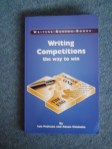 Chisholm. It covers short story, poetry and article writing contests.
Chapter 2 deals with targeting the right sort of competitions to increase your chances of success. Iain and Alison advise a few ways of doing this:
- Forget the big internationals and concentrate on small competitions that will attract fewer entrants. Not many of us are likely to get anywhere in something like the Bridport but we might stand a chance of being placed in a local writing competition. I would much rather win a book token in a small competition than see my entry disappear into the black hole of well-publicised literary contest.
- Choose a competition with a difficult theme – this will put many entrants off because it’s too much of a challenge and a previously written story can’t be recycled to fit the subject. Competitions with an open theme attract the most entrants.
- Try competitions where entry is limited by the rules – for example competitions restricted to unpublished writers or to writers of a certain age or to those living in a specified area
Iain and Alison also advise targeting contests where the entry fee is high compared to the prize fund. This is because we are all naturally mean and therefore the number of entrants will be low. I’m afraid my own natural meanness won’t let me endorse this advice but I can see that there is logic in this method of choosing where to send your work. So if you’re not as tight with money as me, you might want to try it.
And speaking of relatively small competitions (& I don’t mean that in a derogatory way), Bev Morley is running a short story competition on the theme of ‘Christmas’ via her blog. First, second and third prizes are £50, £25 and £10 respectively plus publication in a Kindle anthology, up to 12 further stories will also be included in the anthology. The word limit is 3,000 and closing date 30th September. Entry by email only and the fee is £3. Full details are here.
‘Writing Competitions – the way to win’ is worth a read if you want to increase your chances of success in competitions.
Work Your Way Magazine
Posted by Sally Jenkins in Markets, Resources on September 12, 2011
The launch issue of Work Your Way Magazine dropped through my letter box recently. It’s a quarterly magazine aimed at freelance, self-employed and entrepreneurial mums – categories that lots of us writers fall into.
In her first ‘Letter from the Editor’, Mary Cummings describes the magazine as a ‘celebration of all you fabulous mums who have split the nine to five office scene and are now working from home’.
Mary has used a variety of freelance contributors (I know because I am one!) to source the wide range of features in the magazine. The areas covered include:
- Family – features on Raising Confident Kids, Parenting a Child with Special Needs and A Day in the Life of a Freelance Mum
- Work – features on Coaching To Help You Move Forward, Good Customer Care and an interview with Carol Savage of mydish.co.uk, who secured a £100,000 investment from Deborah Meaden on Dragon’s Den
- Top Tips – features on How Much Should I Charge?, Blog for Business (that’s me!) and Cash in Your Bookcase
- Health and Well-being – features on A Good Night’s Sleep, What to Avoid When Working from Home and Yoga
The magazine also has a flourishing website which is currently asking for online contributions. Click here for details.
Work Your Way features in Writing Magazine this month (October 2011 issue) as a case study for Elaine Everest’s article How to Set Up a Start-up. In it Mary describes how she got the magazine off the ground.
If you fancy getting your hands on a copy of Work Your Way and picking up some useful information about the freelance life, visit the website for details of how to subscribe.
San Francisco and Writer’s Digest
Posted by Sally Jenkins in Competitions, Non-writing, Resources on September 5, 2011
I’m back!
I had my bike ride – it was across the Golden Gate Bridge & I had my icecream – in the heart of San Francisco. (Apologies for the white lie about my holiday but I’m currently wrangling with my car insurance over the theft of my car a few weeks ago and it made me feel vulnerable about announcing to the world that the house would be empty.)
Amongst many other things we visited the San Francisco Museum of Modern Art. It contains a video installation that explores the art of story telling ‘without a beginning or an end and with no character or plot development’. I’m sure if we tried this as writers our work would be swiftly rejected. Maybe it’s different in the art world…
I also bought a copy of the US writing magazine ‘Writer’s Digest’. It seemed quite thin compared to our own Writing Magazine and Writers’ Forum but there are a few things of interest on its website:
- A series of writing prompts – responses of up to 500 words can be posted on the site or you could just use them to kick-start your own writing
- Various competitions such as one here for a 1500 word story.
- Writing Tips
- Writing articles cargorised by genre such as Romance, Horror, Memoir etc.
So, if you fancy an insight into the US writing scene, take a look at the site.
Summer Break
Posted by Sally Jenkins in Books on August 25, 2011

Image by Jo Peattie via Flickr
Apologies to those of you who were looking out for my regular Monday lunchtime post this week. I’ve decided that since so many people are on holiday at the moment, I’m going to take a short break from blogging. Normal service will be resumed in September.
Over the next couple of weeks, amongst other things, I’ll be reading and reviewing The Barbarian Nurseries by Hector Tobar for the Waterstones website. If you fancy reviewing books for Waterstones (no payment but you get to keep the book) grab yourself a Waterstone’s loyalty card and click here to see the current book prize draws, each has around 25 copies of a forthcoming title up for grabs in return for providing a review.
I also hope to find time to read Sally Quilford’s My Weekly pocket novel ‘Sunlit Secrets’. I recently won a signed copy via Sally’s blog and am hoping that it will point me in the right direction with my own pocket novel. I have a 50,000 word first draft sitting in a corner waiting to be edited…
If you would like to be notified when I start posting again, please put your email address in the box on the right and you’ll receive my next (and subsequent) posts via email. It’s free and you can unsubscribe at any time.
By the way, the beach photo is just wishful thinking – although I do hope to manage a cycle ride in the local park plus an icream (everyone deserves a treat!).
See you soon!
Emerald Writing Workshops Competitions 2012
Posted by Sally Jenkins in Competitions on August 18, 2011
Emerald Writing Workshops 2012 Competition Calendar is out now!
These competitions are entering their third year with an increased prize pot of £100 per competition – First £65, second £20, third £15 plus three runners-up each receive a book of short stories. Entry is only £1.80 (overseas entrants can pay via PayPal) and I think that’s really good value!
All the competitions are for a 500 word piece of flash fiction and the 2012 themes are as follows:
- Story set on a train – closes 28/02/12
- Story including the words ‘Nobody will ever know’ – closes 31/5/12
- Story about anything you like – closes 31/8/12
- Story on the theme ‘Trapped’ – closes 30/11/12
Plus, if you enter any of the above (or have entered any of the 2010/2011 comps) then you can submit a Four Sentence Story. This is free to enter and 5 winners will each receive £20.
Entries are by post only but entries from different people or for more than one competition can all go in the same envelope.
Full details of how to enter are here along with winning entries from previous competitions.
Good Luck!
 Sally Jenkins