Archive for category Resources
Icebreakers for Creative Writing Adult Education Classes
Posted by Sally Jenkins in Non-writing, Preparing to Teach in the Lifelong Learning Sector, Resources on January 13, 2015
I’m currently doing the ‘Preparing to Teach in the Lifelong Learning Sector’ course (PTLLS). It’s one day a week for nine weeks and today was Session 2.
We’ve been taught that icebreakers are an important part of all adult education classes, whatever the subject. All the early sessions in a course should start with an icebreaker activity, so that participants can get to know each other and feel comfortable with their classmates.
Each of the eleven participants on my course has to run an icebreaker activity sometime over the next few weeks. I put my name down to go first because I hate things like that hanging over me. If it’s got to be done, do it sooner rather than later, is my motto.
So today I split the class into two groups and gave each group an envelope containing six cards. On the cards were written the details of two characters, two objects, a location and either the words ‘Happy Ending’ or ‘Sad Ending’. I asked the groups to create a very short story using the details on the cards. I stipulated that everyone in the group should contribute at least one sentence and each group should nominate a scribe and a spokesperson to read the story aloud. Then they had five minutes to get creative.
I was anxious as they opened the envelopes and got started. No one else on the course is a writer, their chosen subjects include Punjabi, parenting skills and dressmaking, so I wasn’t sure how they’d take to a writing activity. One group was slightly slower getting started until they got the idea of what had to be done, so I did have to give some extra time.
The two stories were read aloud and then I got feedback on the activity. Everyone enjoyed it and liked the fact that it was subject-related rather than just an arbitrary activity. And the tutor thought it went well. He added that if I used it again it might be worth having an extra card or two up my sleeve to throw at a group who finished early, to avoid them getting bored.
So far, as a class, we’ve done two other icebreakers:
- People Bingo, organised by the tutor. Every one has a ‘bingo card’ but instead of numbers it has requirements such as ‘someone who does extreme sports’, ‘someone who has a pet’ etc. The task is to find fellow course participants who fit the requirement and write their name in the space on the ‘bingo card’.
- Questions, organised by another participant at the session today. Everyone is given a sheet with a question on it, such as ‘What is your favourite food?’, ‘If money was no object, where would you like to be right now?’ We took it in turns to stand up and answer our question.
Anyone know any other icebreakers?
The Art of Receiving Criticism
Posted by Sally Jenkins in Authors, Resources, Writing on November 11, 2014
A couple of weeks ago my writing buddy, Helen Yendall, wrote a blog post about The Art of Giving Feedback. Today, I’m going to come at it from the other side and talk about the The Art of Receiving Criticism.
I am working on a novel, in fact I thought I’d done a reasonable job on it. But I know how hard it can be to look at one’s own writing objectively so I decided to seek the opinion of an expert. I chose published romantic novelist Patricia Fawcett. I have met her a couple of times at writing events and she is also a reader for the Romantic Novelists’ Association New Writers’ Scheme. Also, Patricia’s critiques are great value for money.
I received a comprehensive report on my novel suggesting several ways that it could be improved, starting with the first chapter where the pace is a ‘domestic crawl’. On the positive side, Patricia said that she liked my female main character who is ‘vulnerable and interesting’ but, on the negative side, my male main character comes across badly and I need to put in more of his back story so the reader gets to know him. Patricia also pointed out that part of the plot depends on a couple of unlikely coincidences that would ‘get up an editor’s nose’ – so they need taking out and/or re-working. She also suggested a different ending to the novel, which I think will probably be more plausible than the one I had in mind. There was much more in the report but I won’t bore you with it all.
So I’ve still got a lot more work ahead of me.
If I’d received this report a few years ago I would probably have stuffed it in a drawer and given up all hope of ever being able to write anything longer than a 1200 word short story. But as the years go by (and I get older and wiser) I realise that very few people get it right first time and there’s no reason why I should be any different. So it’s time to submerge myself in the plot again and learn from everything that Patricia has highlighted.
Patricia ended her report positively, she said, “If I have gauged you right, you will dust yourself down, shake this one up, and carry on to prove to me and to yourself that you can do it.”
Fingers crossed that I can!
Write an Epitaph for your Character
Posted by Sally Jenkins in Resources, Writing, Writing Exercises on November 4, 2014
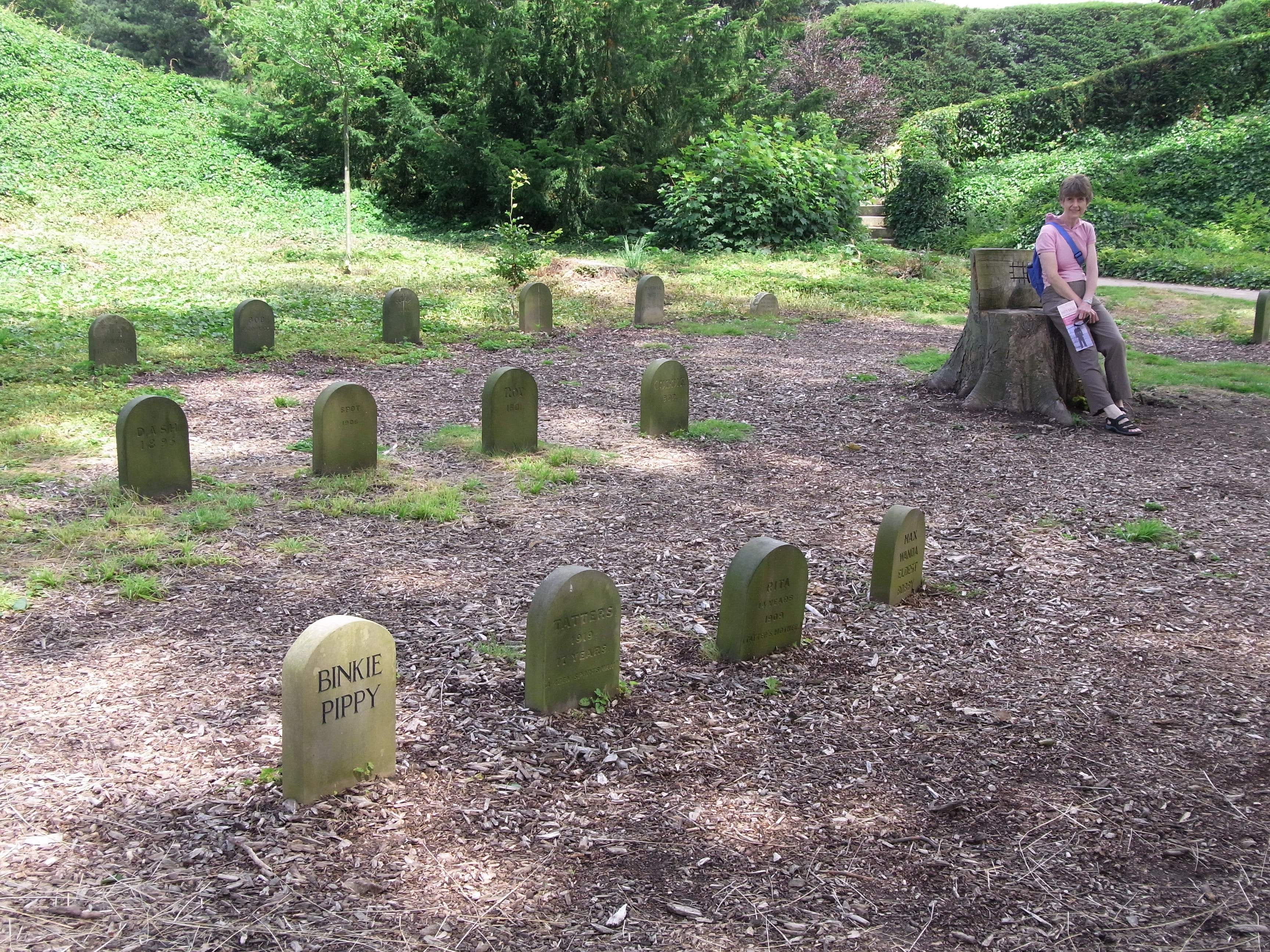
Pets’ Graveyard at Brodsworth Hall
On Sunday, Andrew Marr was asking Scottish politician Alex Salmond what he would like on his epitaph.
Epitaphs were discussed again on the Today program yesterday and it got me thinking.
An epitaph is a couple of sentences epitomising the dead person i.e. summing up how they lived their life.
It struck me that writing an epitaph might be a good way to get to the heart of a character’s psyche.
I’m sure we’ve all come across those character-creation questionnaires which demand that you fill in everything about your protagonists such as date of birth, hair colour, favourite food, best subject at school and secret fear. I’ve tried doing this but find that I get distracted by stuff that isn’t relevant such as my heroine’s shoe size and what she carries in her handbag.
I feel that what I should be doing is getting to the heart of what my character wants from life, what is stopping him or her from getting it and how they are going to overcome this hurdle by their own efforts. It should be possible to do this in two or three short sentences to fit on a gravestone and then, from these few words, it should be possible to work out what else I need to know about the character’s background.
So I’ve had a quick go at doing this for the hero in my current WIP:
‘A devoted father removed from his son by divorce. He endured unemployment and poverty in order to fulfill his paternal drive.’
Alright, it probably needs polishing and editing before the stone mason gets out his chisel but it helps to focus my mind on what this character wants. Knowing this desire will help to shape his actions through the story and keep him on target to get what he wants.
What about you? Does the twenty (or one hundred) questions method suit your way of working or do you do something completely different to create believable characters?
For those of you who do like the questionnaires as a starting point, there’s a whole array of them here.
Going Viral
Posted by Sally Jenkins in Books, Promotion, Resources, Self-publishing on September 28, 2014
This week I’m trying to go viral. The Omnibus Edition of The Museum of Fractured Lives is reduced to only 99p/99c until Saturday 4th October. 
And I need the world to know!
Have you ever loved and lost? Have you kept something to remind you of that relationship? Do you think it might be easier to move on with life if you let go of that object? That’s what The Museum of Fractured Lives is all about. It displays objects donated by people who have suffered a trauma in their lives. Each of the three stories in this book tells the emotional tale of that object and its donor. And this omnibus edition also includes a prologue telling how the museum came into being.
The individual stories (each around 9,000 words) have been well reviewed:
“I thought this was a truly excellent novella. The central character, Maxine, is vividly portrayed, and her story is touching and powerful, with some surprising twists and turns.” Mr N. Daws on Maxine’s Story
“The story drew me in very quickly as I needed to know how Karen would go about putting her plan into place … and the erotic episode between Karen and John was an added bonus!” Lesley on Karen’s Story
“Another good story in the Museum of Fractured Lives. It was good to have a story from the male perspective with a good twist at the end. Thought provoking.” Mrs J A Williams on Pete’s Story
So, how to tell the world?
I’m going to try a range of Facebook groups:
The Kindle Publishing Bible
Debbie Young’s Kindle-loving friends
Kindle Publishers
The Review
Short eBook Reviews
I’ve already contacted Indie Book Bargains who send out a daily e-newsletter. They kindly featured One Day for Me a couple of months ago but I think they select according to number of Amazon reviews and, being fairly recent, I fear the Museum Omnibus hasn’t yet generated enough.
I’m also going to investigate The EasyChair Bookshop which I heard about via Helen Laycock on the Writing Magazine Talkback Forum.
If anyone knows any other promotional places please let me know. Maybe together we can build up a list of useful sites.
(And if anyone downloads and enjoys the Museum Omnibus, I’d be over the moon if you could leave a review!)
Authors’ Licensing and Collecting Society
Posted by Sally Jenkins in Resources, Writing on July 27, 2014
I’ve finally got around to joining the Authors’ Licensing and Collecting Society and registering my short stories and articles that have been published over the last three years.
Being a member of ALCS ensures that you get paid any secondary royalties earned by your works, for example if an article is photocopied by an organisation like a school.
Life membership of ALCS costs £25 but this is deducted from the writer’s first royalty payment – so there is no upfront charge and therefore no risk of being out of pocket by joining ALCS.
I have to admit to not totally understanding how ALCS knows what has been photocopied and how payments to writers are calculated. And I don’t imagine that at this very moment zillions of people are photocopying my work and handing it out to all and sundry. So will I actually ever see any money from ALCS? I have absolutely no idea, but you’ve got to be in it to win it, as they say.
Registering work published in magazines (newspaper articles are not accepted) is easy and can be done on-line. But only things published in the last three years are eligible – so it’s better to do this sooner rather than later and then keep it up to date.
The only problem that I encountered was finding the ISSN (International Standard Serial Number) for some publications. The ISSN is an identification number for periodicals but not all magazines have them. I’ve had several articles published in Freelance Market News which I discovered had no ISSN. However, when I contacted the magazine’s lovely editor, Angela Cox, she went to the trouble of obtaining an ISSN for Freelance Market News (thank you, Angela!) So I’ve now been able to register those articles, although I’m not sure of the implications if the ISSN wasn’t in existence when the article was first published.
Has anyone else got any experience/knowledge of ALCS?
Children’s Writing Course & Horror Short Story Competition
Posted by Sally Jenkins in Competitions, Resources, Short Story on June 14, 2014
Here are two things I’ve come across recently that might be of interest.
Firstly, Groupon are offering a massive discount on a course entitled ‘Learn to Write Children’s Stories’. It is advertised as being reduced from £349 to £14!
The course consists of 14 modules (those of you who are good at Maths will have worked out that this is the equivalent £1 per module) and guides “beginners through the process of writing great children’s stories, from plot to story structure to voice and style, this course aims to free imaginations and let the inner child create tales of adventure”.
However, this offer is only valid for five more days (which, by my calculations, is until 19th June 2014).
Full details are here.
Secondly, Joe Mynhardt of Crystal Lake Publishing is running a FREE to enter Horror Short Story Competition.
The organisation of this competition is different to most competitions. Initially Joe only wants to see 150 words. These words must be split (in any ratio) over the synopsis and opening of the story. For example the synopsis might be 30 words and the opening 120 words or vice versa.
Those that get through this first round of the competition will then be invited to submit their full story, which must be between 3000 and 7000 words and it must be horror, weird or suspenseful.
The prizes are as follows:
1st: Your story in Tales From the Lake Vol.2; $40; one contributor’s copy; bragging rights; a 30,000 word edit by Joe Mynhardt; all Crystal publish eBooks published at the time of announcing the winners.
2nd: Your story in Tales From the Lake Vol.2; one contributor’s copy; $30; a 20,000 word edit by Joe Mynhardt; any two Crystal publish eBooks published at the time of announcing the winners.
3rd: Your story in Tales From the Lake Vol.2; one contributor’s copy; $20; a 10,000 word edit by Joe Mynhardt; any one Crystal publish eBook published at the time of announcing the winners.
Full details of the competition are here and the first round closes on June 30th 2014 – so there’s still time to write those initial 150 words.
Regular readers of this blog may remember that Joe did an informative guest post for us on fiction writing. It’s still available here and might be worth a read if you’re thinking of entering the competition.
Proofreading and How to Send Documents to the Kindle
Posted by Sally Jenkins in Computers & Technical, Resources, Self-publishing, Writing on April 24, 2014
Does anyone else use their Kindle for proofreading?
I find this very helpful if I’m writing something longer than just an ordinary short story. It means I don’t have to sit staring at my computer screen for ages whilst I work my way through the whole manuscript and nor do I use large amounts of paper and ink printing the thing off time and time again (although I do use this method when I think I’m almost there).
Proofreading on the Kindle means I can curl up in an armchair with a mug of coffee and pretend I’m reading a ‘proper’ book. I find it lets me judge my writing in a different way and I’m less likely to skip over words.
The disadvantage is that I can’t edit as I go along and I can’t scribble and cross things out either. But depending on what stage you’re at, this can be a good thing because it forces you to read the whole manuscript from beginning to end without wasting time trying to perfect a single sentence. This makes it easier to see the whole story arc and judge whether or not it works.
But in order to be able to proofread in this way, the manuscript needs to be sent from PC to Kindle. There are a couple of ways this can be done. You can either email the document to the Kindle (yes, every Kindle has its own email address!) or plug the Kindle into the PC and ‘drag and drop’ the file across.
There are detailed instructions on how to use both of these methods over on Molly Greene’s Blog so I won’t repeat it all again here. In her post Molly doesn’t specifically mention that Word documents can be sent in this way but I know from experience that they can and there are comments at the end of the post which confirm this. Molly also gives some instructions for the iPad too (I’m not lucky enough to own one of those).
This method of sending stuff to the Kindle can also be used for PDF documents – but I’ve never worked out how to increase the font size of a PDF when it’s on the Kindle and so end up having to use my reading glasses.
And it’s useful to be able to transfer files in this way if you’re ever asked to beta read someone’s work before publication or if you get sent an early review copy.
Please do let me know if you’ve got any proofreading tips or experience of sending stuff to the Kindle.
GeoRiot
Posted by Sally Jenkins in Computers & Technical, Promotion, Resources, Self-publishing on April 17, 2014
GeoRiot is a free tool that may be useful to those of you who are marketing Amazon Kindle e-books.
I’m going to explain it simply because not everyone will be familiar with the basic concepts.
Amazon stores are country specific i.e. those of us living in Britain shop through Amazon.co.uk, those in the US buy through Amazon.com and there are also geographic specific sites for France, India, Germany and many more.
Most e-book marketing is global via the internet, using blog posts, Facebook, newsletters, paid-for adverts etc. Authors using these methods will endeavour to provide readers with a direct link to the Amazon page for the e-book being promoted.
However, unless the author provides the individual link for each geographical Amazon site, there will be users somewhere in the world who don’t reach their ‘home’ Amazon site and, if they want to buy the book, will have to navigate there by themselves. Many of them won’t bother. When the link provided doesn’t take them where they want to go, they’ll click on to something else instead.
But it looks clumsy and messy to list around a dozen Amazon links every time you mention your book on the web.
GeoRiot creates a single web address for an Amazon product. This address will always take the user directly to his ‘home’ Amazon site. If the link is clicked in the UK then it will route the user to Amazon.co.uk, if the link is clicked in the US then it will route the user to Amazon.com and so on.
Here’s an example. When advertising Kindle Direct Publishing for Absolute Beginners I could list each geographical link:
For buyers in the UK: http://www.amazon.co.uk/Kindle-Direct-Publishing-Absolute-Beginners-ebook/dp/B00IJFG1W4/
For buyers in the US: http://www.amazon.com/Kindle-Direct-Publishing-Absolute-Beginners-ebook/dp/B00IJFG1W4/
For buyers in Australia: http://www.amazon.com.au/Kindle-Direct-Publishing-Absolute-Beginners-ebook/dp/B00IJFG1W4/
etc. etc.
Or I can use just one global link provided by GeoRiot: http://georiot.co/40oj
I think it looks much more professional to provide a single link.
GeoRiot provide this service for free unless you are an Amazon affiliate and then they take a small percentage of your affiliate earnings. For more details on how this payment system works see the GeoRiot website and Nick Daws’ comprehensive blog post where he goes into this and the mechanics of GeoRiot in much more detail than I have.
That’s it – I hope I haven’t blinded any of you with science!
Kindle Direct Publishing for Absolute Beginners
Posted by Sally Jenkins in Computers & Technical, Non-fiction, Promotion, Resources, Self-publishing, Successes on February 28, 2014
As most of you will be aware by now, I am very interested in e-publishing and have been building my own 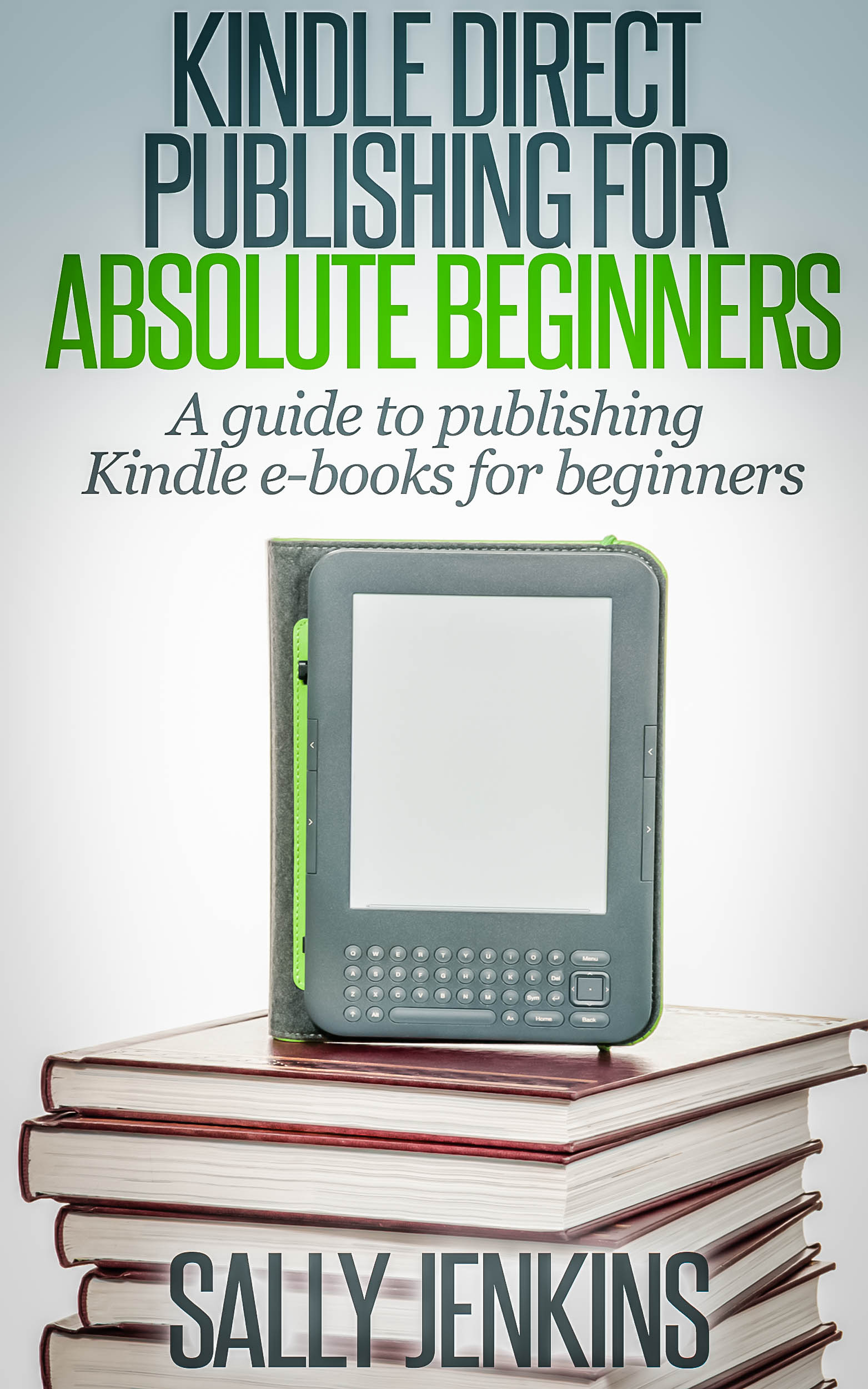 e-publishing empire(!) for the last twelve months. I’ve picked up a lot of knowledge along the way and have also had many people say to me that they wished they were ‘technical’ enough to do the same.
A couple of months ago Helen Yendall asked if I would talk about e-books and e-publishing to the writing class that she tutors at Moreton-in-Marsh. Whilst sorting out what I might say, quaking in my boots and being glad that I made the effort to join Sutton Coldfield Speakers’ Club, I realised that I had enough material to write a short e-book for beginners who want to publish their first e-book via Amazon KDP.
And so Kindle Direct Publishing for Absolute Beginners was born.
It starts with the definition of an e-book and moves on through topics such as choosing what to write (if you don’t have a manuscript ‘ready to go’), how to get your book cover, basic marketing and much much more.
Once I’d finished, I followed my own advice and found a beta reader who matched my target audience i.e. a writer who is contemplating e-publishing for the first time. Peter Hinchliffe is an ex-journalist and news editor who has also completed a novel. He gave my manuscript a big thumbs up and said in his review, “This book shares the skills needed in a detailed, easy-to-follow way. It could be the most rewarding book you ever buy.”
The launch of Kindle Direct Publishing for Absolute Beginners took place yesterday, following my talk to the lovely writers of Moreton-in-Marsh. There was Bucks Fizz, chocolate cake, coffee and one of the writers celebrated her new grandchild by providing cream cakes for the class – so no one went home hungry! It was really nice to be able to involve other people in the launch instead of doing everything virtually.
So, if you’ve ever fancied seeing your work for sale on Amazon, go and take a look at Kindle Direct Publishing for Absolute Beginners – it might help you on your way!

Choosing a Book Title for KDP
Posted by Sally Jenkins in Promotion, Resources, Self-publishing on February 2, 2014
Most of us have a working-title whilst we’re writing, whether it be a short story, novel or a work of non-fiction. Usually it’s the first word or phrase that came to mind as we sat down to begin our masterpiece.
And that’s the way it should be. Too many writers waste time trying to find the perfect title before starting to write – and then never get anything down on paper. A scrappy working-title is fine but take some time to refine it before sending the manuscript out into the big wide world.
If you’re intending to go through Kindle Direct Publishing (KDP), it’s worth bearing the following points in mind:
- For non-fiction don’t be too clever, simply focus on the benefits the book will bring to the reader – for example, Fast Weight Loss or How to Grow Cacti.
- The title should give an indication of what the book is about. In 1925 ‘Fleece of Gold’ by Gautier sold 6,000 copies. It was then re-titled ‘The Quest for a Blonde Mistress’ (which is a much better description of the story) and in 1926 it sold 50,000 copies. (I know this was way before KDP but it illustrates the importance of choosing the right title)
- Try a brainstorming session with a couple of friends and note down all the ideas that come out. Review them a week later and see which still seem good.
- If possible, try to include in the title any keywords that a reader might use on Amazon to search for books, for example if your work is similar to Fifty Shades of Grey you might want to include ‘Billionaire’ in the title
When you’ve dreamt up something plausible, put your title to the test using a clever tool provided free by Lulu.com. Go to lulu.com/titlescorer/index.php and simply fill in the boxes. The tool will give your title a score of between 9% and 83% chance of bestseller success. Obviously there are no guarantees but it’s worth a try if you can’t decide between two or three different titles.
Anyone else have any tips on how to create a great title that will respond well in Amazon searches?
Finally, a writing prompt for you based on something I saw this week. On a visit to the supermarket, I used the ladies’ toilets. In the cubicle was an empty pregnancy test packet – someone obviously couldn’t wait until they got home to find out if she was expecting. Who was she? What was the result of the test? Was it the result she wanted? What happened next?
-
You are currently browsing the archives for the Resources category.
 Sally Jenkins