Archive for category Writing Handicaps
5 Questions About Writing With . . . Lee Benson
Posted by Sally Jenkins in 5 Questions About Writing, Poetry, Writing for Children, Writing Handicaps on May 6, 2025
Lee Benson was the owner of successful Birmingham art gallery ‘Number Nine’ for 14 years and the sales director of a commercial gallery prior to that.  He is a fine watercolourist with two sell out solo exhibitions and many group shows. Lee has published 11 children’s illustrated books, six of which were recorded for TV. He has visited over 100 schools performing the stories and has been a guest author for World Book Day as far afield as Dubai and Stourbridge. Lee has also had nine books of poetry published, with two new collections due for release early this summer. He has produced three novels, a ghost story and seven complete discographies in collaboration with A. Sparke. Under the pen name of Lee Hemingway he released an alien crime novella in the USA.
Lee can be contacted through his website: https://thecreativeleebenson.com/
All of his books can be viewed on his Amazon page.
How do you discipline/motivate yourself to write and do you set daily targets?
Great question. My mind is always busy and so is my life. I put myself into writing mode by walking in the fresh air and absorbing the atmosphere. This applies to both my children’s stories and my poems. When my mind is in the right gear, I write. I write from within the story. I see it, then write it.
What are the most important qualities required by a writer? Do you have them?
Self-belief.
I do not believe in writing to order or being formulaic. If I’m not feeling it myself, it gets binned. I hate rewriting chapters so I edit in my head first before committing to paper. My wife is a great listener, she tells me if it flows or if it doesn’t make sense. We all love reassurance that what we have created is good. Children are the best critics for my children’s tales.
How do you market yourself and your books?
I use all social media badly. I find performing at schools is the best way to sell my children’s books. After a lockdown drought, schools are letting us indie authors in again but the receptionist frontline can be a tight fortress to get through, plus teachers have to follow protocols now.
Which writing resources have you found useful, e.g., books, courses, organisations, websites etc.?
Because I am dyslexic writing courses are difficult and frustrating. Searching for help is even more challenging. You have to ask the right logical questions to get to the right logical answers and I have a problem with thinking logically. So I rely on my brain and my life experiences to help me.
A top tip for other writers?
Write away selflessly without editing. Don’t think you have to write a certain amount of words per day. If it flows, then go for it. About Random Hopefulness – published October 2024
Random Hopefulness is a collection of observations on humour, love and loss, with a little tongue in cheek included for good measure. It is the first of a new series of poetic oddities. Lee focuses on what is all around us. He says, “Sometimes I don’t realise I am writing at mad unholy hours and voila in the morning, there it is, Random Hopefulness is the answer.”
5 Questions About Writing With . . . Claire Sheldon
Posted by Sally Jenkins in 5 Questions About Writing, Authors, Books, Writing Handicaps on October 24, 2024
Crime author, Claire Sheldon lives in Nottingham with her family, and a dog called Podrick. She suffers from Multiple Sclerosis but that doesn’t stop her writing. Perfect Lie was released in 2020 followed by A Silent Child and A Burning Lie. Her latest book A Dead Lie was published on October 24th 2024. Claire’s inspiration comes from hours spent watching The Bill with her grandparents and then later, Spooks.
How do you discipline/motivate yourself to write and do you set daily targets?
I use Scrivener so I input how many words I need to write and when I need to get them done by. Scrivener then tells me how many words I need to write each day. I try to stick to that and if I write more than that in a day, it just means I’ll get to the magic number quicker.
What are the most important qualities required by a writer? Do you have them?
If you’re writing for fun, then I don’t think there are any important qualities because you’re doing something you enjoy with no major goal in mind.
If you’re looking to get published then you’ll need patience (I have zero of that!) and perseverance, because it’s unlikely you’ll become the next best seller overnight. And even when you’ve written “The End”, there is still so much more work needed to get the book out there.
How do you market yourself and your books?
Social media is a great tool. I’ve joined several Facebook groups in my genre, such as UK Crime Book Club and Crime Fiction Addict. And also, a group called The Fiction Café Book Club, who are always happy to support authors.
In the real world, I’m part of a group that meets every month and we have different authors that come in and talk to us about their work. So, I occasionally run an event there.
It’s about getting your books out there and being “seen”. And, of course, supporting others, who will then go on to shout about your books in return.
Which writing resources have you found useful, e.g., books, courses, organisations, websites etc.?
I’ve got all of Stuart Gibbon’s “straightforward guides to” books, which have been really helpful for everything to do with police procedure. I also use Forensics for Dummies. And I’ve got The Emotion Thesaurus by Angela Ackerman and Becca Puglisi, which details character traits for each emotion – great for those show don’t tell moments.
A top tip for other writers?
Never give up! Keep chipping away because you will eventually get there. It might be hard work but it will be worth it 😊
About A Dead Lie – published 24th October 2024
 A DEVOTED WIFE. THE PERFECT MOTHER. A DARK PAST SHE’LL DO ANYTHING TO OUTRUN. MEET DETECTIVE JEN GARNER.
Jen’s life is a balancing act between her past as an undercover police officer and her present as a mother. Until a woman claiming to be her best friend, Chloe Seaward, shows up on her doorstep.
But Chloe died years ago during an undercover operation.
Caught in a deadly game of cat and mouse with no one she can trust, can Jen uncover the truth . . . and keep her family safe?
Keeping On, Keeping On
Posted by Sally Jenkins in Lifestyle, Writing, Writing Handicaps on June 17, 2022
“Keeping On, Keeping On,” said Alan Bennett. But I’m wondering whether that is always the right thing to do? Should there come a point when it’s best to draw a line in the sand, say, “I tried my best”, and then move onto something else?
I’m going through a dry patch in my writing. You may remember me telling you that I had a second book on submission with my agent and was keeping my fingers crossed. As with the earlier novel, this one also failed to find a home with one of the big publishers. I suggested trying both books with the smaller, digital first publishers. My agent felt unable to add much to this process and therefore we agreed that I would proceed down this route un-agented. I have submitted to several places but, as of this moment, nothing has come of it.
I’ve put a lot of work into getting so near, but yet so far. People tell me that I did well to get taken on by one of the best agents in the country. I understand that and I learned a lot from the process. But it’s still very difficult to get re-enthused about starting all over again on another novel that might also never see the light of day.
I’ve considered returning to short stories and have managed to write two. One’s gone off to a competition and the other one is waiting for a final edit before I try it with The People’s Friend. However, the short story market has shrunk and shrunk and shrunk, so I’m not feeling optimistic.
And, at the moment, the article pitches seem to be landing on deaf ears after a good run of successes.
On a more positive note, I am two weeks into a free Zoom novel-writing course run by Jacci Turner. She’s running the course in the US at 10 am, which is a convenient 6 pm BST but there is an Australian in the cohort joining from a darkened house at 2:30 am! I’m hoping this course might re-ignite my passion and enthusiasm.
But in the meantime I’d love to hear your opinion/advice:
Should I continue ‘keeping on, keeping on’ as a writer or call it a day and find something else? How do you cope with dry patches like this?
If Goethe had had to prepare supper
Posted by Sally Jenkins in Authors, Travel, Writing Handicaps on June 20, 2019
I’m just back from a cycling holiday along the banks of the Danube from Passau, near the German/Austrian border, to Vienna, in Austria. The weather was excellent. I didn’t get saddle-sore, thanks to several pairs of padded shorts. And although my leg muscles were exhausted by the end of day two, I got a second-wind and finished the trip without too many aches.
However, the point of this blog post is to highlight a memorial to the authoress, Emerenz Meier, on the river bank in Passau. The written work of this lady suffered due to the pressures on her to earn a living and keep house. She laments this in a poem reproduced on the memorial. It reads:
If Goethe had had to prepare supper, salt the dumplings;
If Schiller had had to wash the dishes;
If Heine had had to mend what he had torn, to clean the rooms, kill the bugs –
Oh, the menfolk, none of them would have become great poets.
Most of us have moaned, at some time or another, about the way chores and working for a living take up too much time. Time which could otherwise be used for productive writing. Today, equality of the sexes means fitting in the housework is no longer a uniquely female problem. But Emerenz Meier was born in 1874, died in 1928 and was married twice, so I’m guessing neither husband was particularly domesticated.
So next time domestic drudgery is getting in the way of creativity, be glad that we have washing machines, vacuum cleaners and many other labour saving devices: Emerenz would have been doing everything the hard way. And we don’t usually have to kill too many bugs!
The memorial was erected by Soroptimist International Club Passau, an organisation of professional women.
Focus on Your Own Path and Goal
Posted by Sally Jenkins in Lifestyle, Non-writing, Writing Handicaps on June 8, 2018
I recently walked the West Highland Way. This is a 96 mile path from Milngavie (a suburb of Glasgow) to Fort William, at the foot of Ben Nevis. The walk took seven days and on the eighth day we climbed Ben Nevis and walked in snow on a blazing hot day. All along the route the scenery was terrific: mountains, hills and lochs. We heard cuckoos and saw feral goats.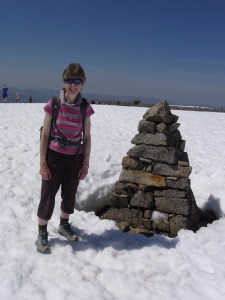
We chose to go in the middle of May, which is supposed to be the best time for both weather and minimum midges. We had sunshine and few insect bites but there was a lot of people. On the more open stretches of path they could be seen snaking in front of and behind us like a colourful bendy reptile. When the path was narrow and terrain difficult, there was a constant tapping of walking poles and a search for passing places to let those walking faster than us overtake. At first this unnerved me; I felt as though I was in a race and being overtaken by everyone else. I worried we were going to be last to finish the day’s walk and my competitive spirit kept trying to kick in and make us go faster. Eventually I relaxed and realised everyone has their own pace and there are merits to going slower and enjoying the views.
What has this got to do with writing?
Social media makes us all very aware of what other writers are doing. We know when they get an agent, when they sign the publishing deal and when the book hits the shelves. Or we know who’s on a winning streak in the womag short story world. Or competition winners are shouted from the roof tops. Celebration is good and, after the toil of writing, well deserved. But as a result we are constantly measuring ourselves against the success of others, just as I was measuring my walking speed and ability against the other boot clad walkers on the West Highland Way. This is not a good thing. Everyone’s path to success is different. We have different talents, different starting points and face different obstacles along the way.
Instead of comparing yourself to others, focus on your own route to your goal. You may find it beneficial to take a detour into article writing or to pause and clear your mind. Domestic issues might slow you down or a surge of ideas might push you forward. Take the journey at your own pace without comparing it to others (but do give them a little cheer when they succeed!) and you’ll enjoy it all the more.
And when you stand on that mountain top we’ll all be cheering you and your achievement – however long it might have taken to get there.
Too Much Time?
Posted by Sally Jenkins in Lifestyle, Writing Handicaps on August 10, 2017
Is it possible to have too much writing time?
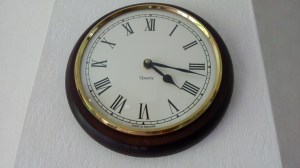
Tempus fugit in my living room
One of my constant gripes is that I don’t have enough time to write. If the day job, the housework and general ‘stuff’ all disappeared, I would be prolific. The words for that bestselling novel would tumble from my brain through my fingers and onto the page. My success would be guaranteed. Or would it?
Those of you who are my Facebook friends will know that a nasty foot infection had me in hospital for four nights. The foot is going to take several weeks to fully heal and until it does my activities are severely restricted. This means I have more time to write. But I’ve found it very difficult to motivate myself. When the day stretches emptily in front of me, the urgency to do anything disappears. I’ve been getting up later, lying on the settee reading magazines and checking Twitter and Facebook ten times more often than usual. My excuse is that I’m convalescing, catching up on the sleep I lost in a noisy hospital ward and recovering from the stress of fighting with an NHS which wouldn’t give me a treatment plan. I’ve been told to sit with my foot up as much as possible – and the most comfortable place to do this is on the settee not behind a desk. I could write longhand as I lounge around but that seems like too much effort and what’s the hurry, at the moment I don’t have to cook, wash up, iron etc. (thank you, husband!) so I have all the time in the world.
Result: I have time handed to me on a plate and I waste it.
Lesson learned: My dream of giving up the day job and becoming a full-time writer may not work for me. When time is limited I make much better use of it.
Coffee Shop Writing
Posted by Sally Jenkins in Writing, Writing Handicaps on March 15, 2012
Have you ever tried writing in a coffee shop?

Image via Wikipedia
I fancied myself as a J.K. Rowling sort of writer – scribbling away in the corner of a cafe, far from all the domestic distractions and guilt trips (like ironing, kitchen cleaning etc). So when my daughter bought me a Costa Coffee gift card I decided to indulge my fantasy.
11am on a Friday morning and the cafe was busy but I managed to find a nice little table hidden away at the back – just right for me, my latte and my notebook. I had a few sips of coffee, found my pen and started to write and that’s when I noticed the noise level. All around me were groups of women yakking at the tops of their voices (or so it seemed). I’d never noticed this decibel assault before (probably because I’m usually one of those yakking women when I go out for coffee!) It was impossible to stop myself tuning into what they had to say:
“That’s Mark’s ex. Now he’s with the one with the crooked eye.”
“They stitched her up so the baby couldn’t come out and now she’s nearly 2 weeks overdue.”
“She was sick at the altar whilst she made her wedding vows.”
At home I write in silence with not even the radio on for company so all this was hard to take but I did eventually manage to tune out and write.
The next problem was – how long can you sit with an empty latte glass in front of you without feeling obliged to buy another or leave? It was a situation made worse when the waitress whisked my glass away leaving me with nothing – but she completely ignored the tables of women who’d been there much longer than me. So I gave up and went home.
Would I try coffee shop writing again? Yes – I’ve still got £7.65 left on my gift card and it was good to get away from the PC and back to pen and paper. But I’ll try to go when it’s not so busy next time and have a pot of tea – so it’s not so obvious when I’ve finished & the waitress won’t whisk it away!
Where do you prefer to write?
Writing with Dyslexia
Posted by Sally Jenkins in Authors, Writing Handicaps on June 30, 2011

Image via Wikipedia
Most of us misspell words, punctuate incorrectly or get our grammar in a twist from time to time. Usually a quick read through the story or article will throw up the errors made in our haste to get the words down on paper. Then it’s a simple job to correct them and send the manuscript on its merry way to the editor.
But imagine if it wasn’t so easy. What if you couldn’t spot your own errors and continually made the same basic mistakes over and over again – despite having read The Penguin Guide to Punctuation six times? What if you’d been labelled ‘educationally subnormal’ at the age of 15 ? What if there were stories and poems buzzing around inside your head but no one would take your writing seriously because of the spelling and punctuation errors?
That was the experience of a friend of mine until finally, at the age of 60, she was diagnosed with dyslexia.
“I cried tears of such relief when I was told by an educational psychologist at the University of Birmingham that my IQ is above average and it is not my fault that I am a slow learner,” she said. “He discovered that I am seriously dyslexic and have problems writing paragraph sequences. I am very slow at reading print and need to read something up to 6 times before I fully understand it.”
The computer, with its spell-check facility has been my friend’s saving grace. It doesn’t flag all her errors but at least enables her to get her stories on to paper. Since her diagnosis she has successfully completed a BA Hons. in Creative Writing – demonstrating that she has the imagination and creativity to become a writer when armed with the right tools.
My friend isn’t the only writer to have battled dyslexia. Novelist, Natasha Solomons told the Evening Standard, “No one explained to me that the written shapes on the page were related to the words we spoke. I thought there were two separate languages: one sounds and one squiggles.”
The author and women’s campaigner Erin Pizzey is dyslexic, as is the actress and writer, Susan Hampshire.
So next time you’re struggling to find the right word or trying to decide whether an apostrophe is required, be thankful that you can easily browse the thesaurus or check in your grammar textbook. Some people aren’t so lucky but still battle through to make a success of writing.
By the way, the illustration to this post is called ‘Dyslexic Vision’. If any of you suffer from dyslexia, maybe you could let me know if this is how the printed page appears to you?
-
You are currently browsing the archives for the Writing Handicaps category.
 Sally Jenkins