Posts Tagged Book Group
Book Club Day UK 2025
Posted by Sally Jenkins in Books, Events, Lifestyle, Resources on September 11, 2025
 September 11th is Book Club Day in the UK.
It’s a time to share and highlight the joy of being part of a book club and to encourage new clubs to form, so that more people will discover the social connections that discussing a book can bring.
I led a library-based book club for eleven years, stepping down only recently due to time pressures. But I’m remaining a member of the group because I love hearing all the different opinions generated by just one book. Invariably, we have someone who loves it and someone who thought it was so bad that they couldn’t finish it, plus all shades in between. And as an author, the experience helps me to accept that, without a doubt, some readers will hate my books while others (fingers crossed!) will like them.
There are a multitude of different types of book club: some concentrate on a particular genre such as crime, in others members take it in turn to choose the books, in my group the leader chooses our monthly book from the book group stock held within the Birmingham library system, in some groups the wine is more important than the literature and others bring together neighbours in a particular street.
If you’re looking for recommendations for your group, here are a few that my group has read and discussed with gusto:
The Uncommon Reader by Alan Bennett – the late Queen visits a mobile library.
Mr. Two Bomb by William Cole – a man witnesses the atomic bombs in Hiroshima and Nagasaki.
Mrs. Palfrey at the Claremont by Elizabeth Taylor – an elderly lady in the late 1960s joins several other older people as a permanent resident in a hotel.
Daisy Jones and the Six by Taylor Jenkins Reid – a 1970s pop band and their lead singer.
Elevation by Stephen King – a man is mysteriously losing weight.
As a group leader, I always found it helpful when a book had a list of ‘Discussion Questions’ included at the end. We didn’t work prescriptively through the list but it was good to have a jumping off point to get the conversation buzzing. During the final edits for Out of Control I drew up a list of discussion questions and was delighted when my publisher, Choc Lit, agreed to include them at the back of the book. 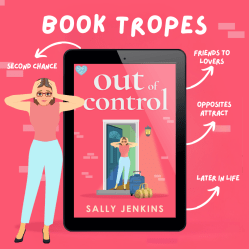
I’m too nervous to try out the book and the questions with my own group (and I think my presence would sugarcoat their comments!) but if anyone tries Out of Control with their group, I’d love to know how you get on, whether the questions help and whether there are any other topics that the book leads you on to?
Island Song by Pepsi Demacque-Crockett
Posted by Sally Jenkins in Authors, Books, Resources on January 30, 2025
I’ve just finished reading Island Song, the debut novel by Pepsi Demacque-Crockett – published today, 30th January 2025 (No, I didn’t speed read 300+ pages! I received an advance review copy).  If the name of the author seems familiar to you, you are right. Pepsi enjoyed a career in the pop industry in the 1980s and 1990s as part of Wham! and later in the singing duo Pepsi & Shirlie. Pepsi’s parents came to the UK in the 1950s from Saint Lucia and Island Song is inspired by their experience. I enjoyed this book in two different ways, as a reader and as a writer:
The blurb: When their father dies, Agnes Deterville and her sister Ella must forge their own paths in life. Headstrong Agnes dreams of a new life far away. Cautious Ella fears the world beyond their small village in St Lucia. When Agnes departs for a new life in 1950s London, they are both confronted by heartbreak, loneliness, and tragedy. Separated by an ocean, but bound by love, can the sisters keep their island song singing in their hearts?
My reader review: Island Song is a book of contrasts. The reader travels from the bright and colourful island of St. Lucia to grey and dismal London. We experience the friendly, inclusive Caribbean culture and then witness the hostility and suspicion of people in 1950s UK. We get to know Agnes and her adventurous, determined spirit compared with her older, much more cautious sister, who is very much a home bird.
Pepsi Demacque-Crockett weaves all of these threads together to create an absorbing, timely, thought-provoking but easy-to-read novel. It is reminiscent of ‘A Small Island’ by Andrea Levy and would make a great book club read.
With thanks to HarperCollins and The Reading Agency for my Advance Review Copy.
My writer review: The word ‘contrast’ sums up what I learned as a writer from Island Song. We are always told the importance of differentiating our characters to avoid them homogenising into one voice. However, this can be difficult if our protagonists are similar ages, from similar backgrounds and have similar lifestyles. Pepsi got around this difficulty by giving the two sisters, Agnes and Ella, very different personalities: Agnes wants to conquer the world but Ella fears even leaving their village. But they still share the same basic philosophy that family is all important. For me, the lesson to take away is that I should concentrate on what makes my characters different to one another, especially when they are conversing or otherwise interacting with each other.
Book Group Recommendation: Mrs. Palfrey at the Claremont by Elizabeth Taylor
Posted by Sally Jenkins in Authors, Books, Lifestyle on July 30, 2024
I run a monthly book group. There are 12 of us in the group and I choose our books from the numerous book group sets available from Birmingham Libraries. We always get a cross-section of opinions on each book; some members will rave about the book and others will detest it so much that they can’t finish it.![20240707_151310[1]](https://sally-jenkins.com/wp-content/uploads/2024/07/20240707_1513101.jpg)
Recently we read Mrs. Palfrey at the Claremont by Elizabeth Taylor (no, not the actress) and it provoked one of the best discussions we’ve ever had. It’s about an elderly lady in the late 1960s who joins several other older people as a permanent resident in a hotel. She longs for her grandson to visit so that she can show him off to the other residents. He doesn’t appear but Mrs. Palfrey strikes up an unlikely friendship with an impoverished young writer.
I found it an easy, gentle read but the novel has a lot to say about the issues and indignities of growing old, much of which is still relevant today, for example, loneliness, infirmity, abandonment by family and fear.
The ladies in my group are all retired and were open about their opinions on the treatment of older people, their fear of needing care, the advantages and disadvantages of ‘retirement villages’ and how we encourage our children to fly the nest and go away to university, but often they never return. We came to the conclusion that there has been no improvement in how we treat older people over the last 50+ years.
But the book is not all doom and gloom. The residents have eccentricities and there are lovely comic cameos plus a marriage proposal! I’d never heard of Elizabeth Taylor but she is a wonderful writer and creator of characters. Read her books!
On the subject of book group discussions, it was lovely to hear from a group who have read and discussed Waiting for a Bright New Future. They all enjoyed the book and found it uplifting (which was my aim!), the group favoured the character of Florence (she’s a colourful, middle-aged, tribute band singer and I loved writing her!), one member guessed the ending but the others were taken by surprise and there was general consensus that a sequel would be good in order to find out what happens to Stuart. I’m also aware of two other book groups borrowing the five copies of Little Museum of Hope in Birmingham Libraries. I have no idea what their verdict was! And I’ve just noticed that Amazon have reduced the price of the paperback to £4.65 (for how long, I don’t know), if you fancy a bargain.
If your book group has read a book that created a good discussion please share it in the comments!
Yellowface by Rebecca F. Kuang
Posted by Sally Jenkins in Authors, Books on June 7, 2024
As an author I found the premise to Yellowface by Rebecca F. Kuang intriguing: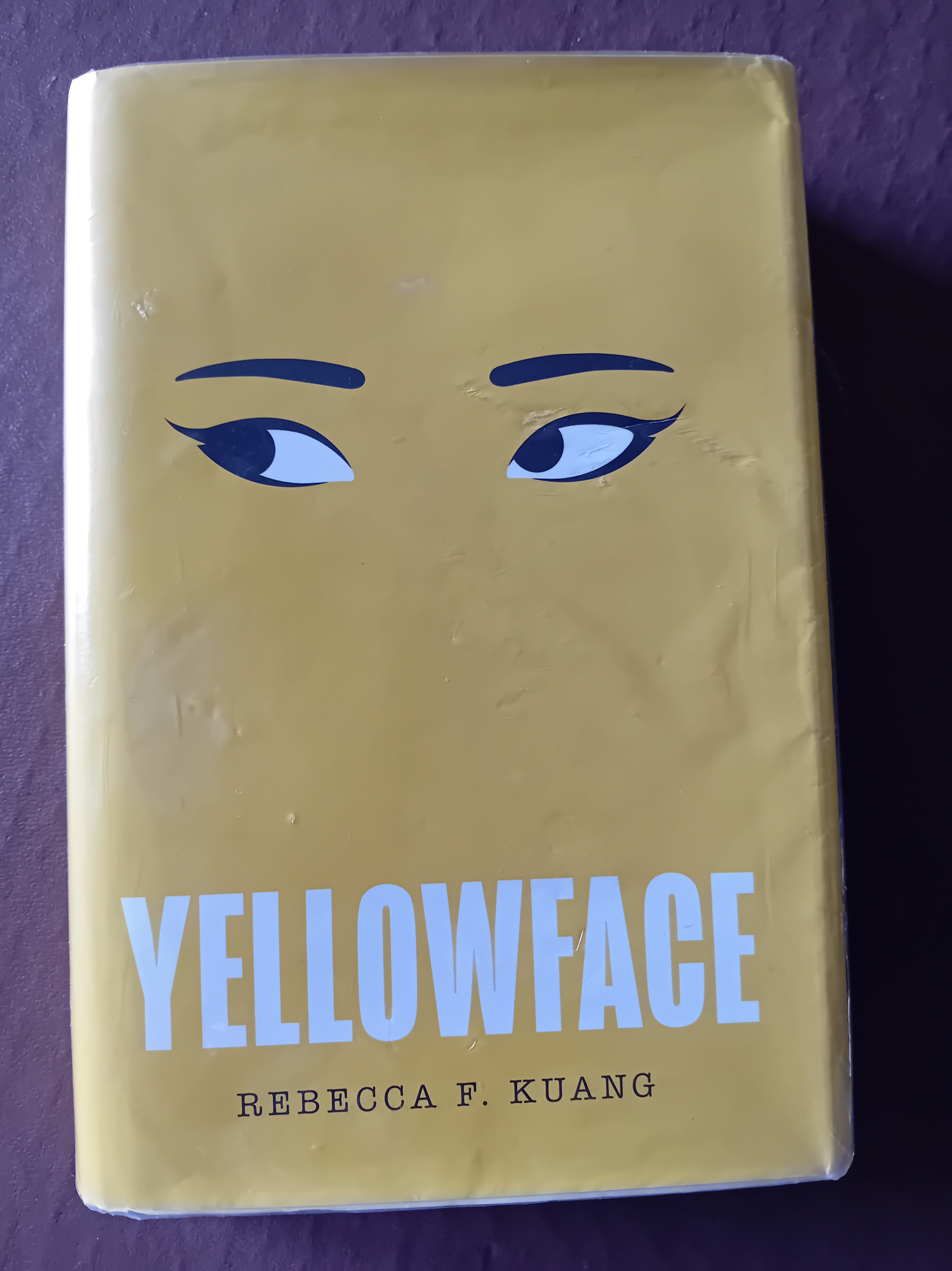
A struggling writer, June Hayward, is friends with a bestselling author, Athena Liu. Athena dies in a freak accident while June and Athena are alone in Athena’s apartment. June spots Athena’s just-completed, latest manuscript and steals it. This paper copy is the only one in existence – despite this being the age of the internet, Athena works on an old typewriter.
June edits and tweaks the manuscript and then passes it off as completely her own work. Publication of the book causes social media uproar but not, at least initially, for the reasons you might expect.
Most of us writers have, at one time or another, felt some degree of envy at another’s success. But how many of us would be prepared to take the same action as June? Hardly any of us, I imagine (and hope!). That is what makes this book so compulsive – it tips us into somewhere we dare not tread.
Yellowface would make a great book club read (or it might be something you discuss within a writers’ group) because it encompasses so many issues. The following discussion prompts popped into my head as I was reading:
- Can/should an author create a character from a background of which they themselves have no experience, e.g. a different race, sexual orientation etc. ?
- What makes someone keep working towards their ambition despite numerous knockbacks?
- Does it matter if your family are ambivalent/disinterested in that ambition?
- Would there ever be a circumstance in which the stealing of a manuscript was acceptable?
- Was Athena also a thief? Did she deserve to have her novel stolen?
- How would you feel if someone used part of your life story in a novel without asking permission?
- Social media plays a large part in the book. Has it become too powerful?
If you’ve read Yellowface and would like to add to the list of issues it raises, please leave a comment in the box below.
On the subject of book clubs, a reader has told me that they have suggested Waiting for a Bright New Future as a possible read for their book group. If it gets through, I’ll be both intrigued and apprehensive to find out what they discuss and the verdict on the book!
Shared Reading
Posted by Sally Jenkins in Lifestyle, Non-writing on November 5, 2019
I’ve run a book group for several years and hearing several different opinions of the same book is always a fascinating experience. A book’s themes often lead to interesting conversations and we usually have a laugh too.
However, recently I’ve discovered an alternative type of group; Shared Reading.
Shared Reading is championed and supported by the charitable organisation The Reader. The charity “builds warm and lively communities by bringing people together and books to life”.
The groups are free to join and open to all. However many of the groups are located in places to help those living with conditions such as dementia, complex mental health issues and chronic pain, as well as those recovering from addiction or feeling lonely.
The groups meet on a weekly basis and all the reading is done out loud during the session, with both the group leader and the participants doing the reading. At appropriate points in the poem, short story or prose extract there will be a pause and the leader will start a conversation about the text. Group members might talk about the impact the words have on them, their interpretation of the text or simply whether they are enjoying it or not. No one is forced to contribute or to read aloud but it’s hoped that the groups’ inclusive atmosphere gives everyone’s voice and opinion a chance to be heard and appreciated.
This week I had the chance to shadow the leader of two Shared Reading groups in north Birmingham; one in a care home for the elderly and another in a community centre. I had a thoroughly enjoyable time.
The older people looked at two poems: New Every Morning by Susan Coolidge and Moon Compasses by Robert Frost. It was a lovely to hear the positive message they took from the first poem about each new day offering a new beginning. The second poem took more concentration but the description of love at the end pleased them all.
The community centre group were looking at the chapter, ‘Mother’, in Cider with Rosie by Laurie Lee. They had looked at the first half of the chapter the previous week but I was soon brought up to speed. We talked about the chaotic home over which Laurie’s mum presided and her constant hope that one day the husband who’d walked on her would return. The session finished with the poem My Heart Leaps Up by William Wordsworth and us agreeing that even though we are no longer children, it’s still lovely to see things in nature that bring us joy.
These groups are a million miles away from a school English Literature lesson. They are all about personal interpretations of the texts and how they make us feel.
All the Shared Reading group leaders are volunteers and have been specially trained for the task. I’m contemplating putting myself forward.
The Ragged Trousered Philanthropists by Robert Tressell
Posted by Sally Jenkins in Books on October 5, 2017
The brilliant thing about book clubs is the encouragement and opportunity to read books outside your comfort zone – that’s how I found myself reading The Ragged Trousered Philanthropists by Robert Tressell. 
It’s a thick book written over 100 years ago and viewed by some as a classic. It has much to say in favour of socialism and the edition I read had an introduction by Tony Benn. However it is possible to push the politics to one side and read it as a piece of social history.
The story centres around a group of painters and decorators living in poverty. They are in and out of work depending on the season and very badly treated by their rich, fat cat employers. Health and safety is non-existent and this is long before the safety net of the welfare state and the NHS. The book follows these wretched men and their families over a twelve month period, contrasting their circumstances with those of their bosses.
I found the first chapter hard going – there were far too many characters introduced all at once. But I persevered and the subsequent chapters focused in on individuals which made the going easier. I became fond of Owen, the deep thinker of the group, and young Bert, who worked for nothing in an exchange for an ‘apprenticeship’ which taught him only the skills of being a dogsbody. I also felt for their wives, who often went without food so that their children and husband could eat.
Verdict: It took me three weeks to read the book and only 30% of the book club members stuck with it all the way through. It made me incredibly glad that I wasn’t born 100 years earlier into a society that had to live hand to mouth. The Ragged Trousered Philanthropists is not a ‘good’ read but I’m very glad I’ve read it – in the same way that I’m often very glad I’ve been to the gym even though pounding the treadmill or doing sit-ups was not a good experience.
Toby’s Room by Pat Barker
Posted by Sally Jenkins in Books on August 5, 2015
Toby’s Room
 It generated an interesting discussion on a range of topics.
Toby’s Room
Toby was a papyrus twin. This means his twin died in the womb and as Toby continued to grow he compressed and flattened the dead foetus. So we talked about the effect on a surviving twin when his sibling dies at or before birth. One of our group surprised us by revealing that she was a twin and her sister was stillborn. Throughout her life she has always felt something was missing and she’s also felt guilty that she may have caused the death of her sister by ‘stealing all the goodness’ in the womb. She remembers in her childhood this being said aloud in her presence.
Many of the characters in Toby’s Room
We also talked about a scene in the book where Toby’s uniform is sent home in a parcel. When it is opened the smell of the battlefield fills the nostrils. It’s difficult to imagine the terrible emotions this would evoke in a family.
In our group the book got a mostly positive response. We thought the first half was particularly good and enthralling. The second half seemed to be dragged out a little and some thought the ending was too sudden. The reader does find out what happened to Toby – but I won’t spoil it by telling you!
We all agreed that we had learned something new about World War I from the book and that it had definitely been worth reading. If you’re in a book group, Toby’s Room
And if you’re thinking of writing rather than reading a novel, you might be interested in this Online Novel Writing Master Class with Bonus Manuscript Critique for £29 from Amazon Local.
The Death of Lucy Kyte by Nicola Upson
Posted by Sally Jenkins in Authors, Books on May 29, 2014
I’ve just read The Death of Lucy Kyte by Nicola Upson and attended my first ever Reading Group meeting. 
The book is a cleverly structured and utterly absorbing work of fiction based on the real Suffolk Red Barn Murder of working class Maria Marten by her upper class lover, William Corder in 1827.
The book is set in the 1930s and the main character is Josephine Tey, who inherits a cottage from her godmother, close to the site of where the murder took place. Josephine Tey is based on a real person of that name, a playwright and novelist from the inter-war years.
The story revolves around the cottage and its previous occupants. One of whom is Josephine’s godmother and the other a young woman, who was Maria’s fictional best friend.
I loved the twists and turns, the evocative descriptions of 1930s England and the concept of a story within a story. It’s spooky, atmospheric and highly readable!
The Reading Group has just been formed at a local library and I have volunteered to help with it, along with another lady. Neither of us has experience of any other reading group and everyone around the table just put forward their general feelings about the book (and it was interesting to hear the views of those who weren’t as impressed as me).
But I’d like to hear from all you experienced book group members out there. Do you have a structure to your meetings? Do you go through a list of points for discussion? Does someone lead the meeting or is it a free for all?
It would be good to know how to get the best out of these meetings so that everyone goes away satisfied that they’ve had their say and maybe learned something from what others have said.
 Sally Jenkins