Improvements to KDP Paperback Offering
Posted by Sally Jenkins in Self-publishing on February 5, 2018
In 2017 Kindle Direct Publishing introduced the facility for authors to self publish in paperback as well as on Kindle. This meant it was no longer necessary to use Createspace to produce paperbacks for sale on Amazon. However, there was a downside to moving away from Createspace towards KDP paperback publishing – unlike Createspace, KDP paperback publishing didn’t allow authors to order proof copies or author copies (i.e. books for the author to sell direct to the public). I blogged about this previously.
However, that has now changed!
It is now possible to order proof and author copies of paperback books via the KDP Author Bookshelf. According to Amazon, authors will pay just the printing costs plus delivery and any taxes. And the really good news? Copies for the UK and Europe will be printed and shipped from within Europe – an improvement on CreateSpace, which ships from America.
Chris McMullen has written a detailed blog post comparing Createspace and KDP paperback publishing, which is well worth a read if you’re wondering which path to take or whether to switch from Createspace to KDP. He concludes that for most authors KDP is now the better option.
On a personal note, I’m now glad I tried KDP paperback publishing for A Coffee Break Story Collection and will consider switching from Createspace when I need more author copies of Bedsit Three.
Publication of The Promise
Posted by Sally Jenkins in Books, Promotion, Successes on January 28, 2018
Today The Promise goes out into the big wide world! 
It’s been a long time coming. I signed with The Book Guild last June and since then there’s been cover designs (back and front), proof reading, a marketing meeting, sorting out a blog tour etc. etc. Lots of people have been involved in bringing The Promise to publication. As well as the lovely people at The Book Guild, there’s my writing friends who have cheered me through the whole process of blank page to finished manuscript, my husband who puts up with a wife hiding herself away with a computer (at least I’m not hiding myself away with another man!), my mum who totally believes in me, everyone who bought Bedsit Three and made me think it was worthwhile trying to write another, all the followers of this blog who let me know I am not alone in my endeavours plus everyone in my non-writing life who has asked when the next book is coming out. The dedication at the front of The Promise is to you all with very many thanks:
For all those who have helped along the way – your support continues to be invaluable.
The Promise is dark fiction and the back cover blurb reads:
Olivia has recurring nightmares about the murder of a man which took place when she was a teenager. She refuses to explain the dreams to her worried fiancé, Mark.
Petty criminal Tina is diagnosed with a terminal illness and becomes concerned for the future welfare of her younger brother, Wayne.
When Tina finds a forgotten letter from her ex-cellmate, Audrey, a promise made decades before links the two families.
But the letter also contains a sinister secret…
 The book is available in paperback from all major online book retailers and in high street bookshops. It’s also available on Kindle, iBooks, GooglePlay and Nook.
In the coming week I’ve got wonderful bloggers helping me get publicity for The Promise off to a flying start:
Monday 29th January – Helen Yendall’s Blog About Writing. Helen is my longtime writing buddy and fantastic womag writer.
Tuesday 30th January – Lou’s Book Blog. The lovely Lou will be shining the spotlight on The Promise.
Wednesday 31st January – Anne Harvey’s Passionate About The Past. I met Anne through my contact with the Birmingham Chapter of the RNA and we’ve helped each other along the way.
Friday 2nd February – Julia Thorley’s Life, Yoga and Other Adventures. Julia is a woman of many talents. She and I are virtual friends.
And week commencing February 5th there’ll be a 21 stop blog tour organised by Rachel’s Random Resources.
Jelly Working
Posted by Sally Jenkins in Lifestyle, Resources, Writing on January 16, 2018
The concept of writers and other home-workers pulling out laptops and working in coffee shops is familiar. It lets us escape those same boring four walls of home and all the domestic distractions. And it makes us feel part of society, even if the only person we speak to is the barista.
UK Jelly takes this a step further. Their aim is to ‘to bring home workers, freelancers, small business owners and entrepreneurs together in a relaxed, informal, working environment to maximise creativity and minimise the isolation that being your own boss can bring.’ It is not networking to sell yourself or your business. It’s about having some company whilst you work and maybe exchanging help and advice. At Jelly events the venue, wi-fi and parking are free, the only charge is for refreshments.
I went along to my first Jelly event last week. There were only a few of us and we had introductions and a bit of a chat before getting our laptops out to work. I deliberately didn’t connect to the free wi-fi because I wanted to do some distraction free editing. By the end of the session I’d done two hours solid work and met some new people. It beat coffee shop working because I didn’t feel guilty about taking up space for a long time with only one drink and I liked that I was part of a group. My local Jelly only meets monthly but I’ll definitely be going back in February.
Why not find out if there’s a Jelly near you?
January is Hot Month for New Crime and Thriller Releases
Posted by Sally Jenkins in Books on January 7, 2018
If you’re a crime or thriller fan, January is your month. The first month of the year used to be the post-Christmas dead slot in the publishing world but not any more.
An article in today’s Sunday Times reports that January is the hot time to release new titles in these genres. The trend started with the January release of The Girl on the Train in 2015 and that book occupied the UK hardback number one spot for 20 weeks.
Nicholas Clee, joint editor of the book-trade newsletter, BookBrunch, says, “You’re making a statement putting your book out in January — you’re saying it could be the next Girl on the Train.” And there’s no sign of the popularity of this type of book diminishing. Alice O’Keeffe, books editor at the Bookseller magazine, puts it down to the “blurring of the psychological suspense thriller with the women’s fiction market. It pulls in two readerships.”
So what have fans got to look forward to in January?
Dark Pines by Will Dean is Nordic noir by a British author.
Need to Know by Karen Cleveland is about a CIA analyst who believes her husband could be a Russian sleeper agent.
Girl in Snow by Danya Kukafka investigates the death of a teenager in a small Colorado town.
It looks like The Promise by Sally Jenkins, about a vow made in prison 30 years ago, will be in good company when it’s released on January 28th!
Head Count by Judith Cutler
Posted by Sally Jenkins in Authors, Books on December 31, 2017
I’ve written before about Judith Cutler, known as Birmingham’s queen of cosy crime. She has a knack of creating feisty female lead characters and also a prolific output. Judith knows her fan base well and how to please them, which she does time and time again. Her books are very readable and so I was pleased to hear about her latest novel, Head Count. This is the second in a series of novels featuring Jane Cowan, a primary school head teacher. 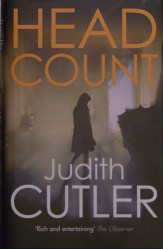
In Head Count, Jane Cowan gets mixed up in the horrors of people smuggling, in particular children arriving in the UK alone and having to fend for themselves. It is cosy crime with a realistic and very topical sharp edge. As a writer I found the structure of this book very interesting. Generally, crime fiction begins with a body on page one and then the hunt is on to find the killer. In Head Count, Judith Cutler takes a different tack. The story starts with Jane being knocked off her bike and into a hedge. She’s not badly hurt and an elderly couple help her back on her feet – but when Jane later goes to their house to thank them with flowers, the couple have disappeared into thin air. From that point on the mysterious happenings come thick and fast – no local builder will touch the renovations needed to Jane’s house, a village do-gooder constantly interferes with Jane’s school and two small boys with no English keep turning up at the school’s breakfast club.
If you want to find out how to create a layered mystery rather than a traditional whodunnit, Head Count is worth a read.
Head Count is authentic and well-researched. As well as being a head teacher, Jane Cowan is also a cricket umpire and match descriptions and after match socialising events in the novel feel real. Jane Cowan also has friends in the police and I’m guessing that Judith Cutler does as well – the police involvement in the book appears true to life, in particular there’s a clever piece of advice included in the narrative about how to make a 999 on a mobile phone when you are in the process of being kidnapped and can’t speak out loud to the operator. It’s worth reading the book just for this advice – it might save your life one day!
Judith Cutler is not afraid to tackle topical and controversial issues but she does so in an empathetic and accessible way. If you like your cosy crime to be relevant to today’s society, rather than 1930s golden age, Judith Cutler is an author to watch out for and Head Count is a good place to start.
Now I’m off to catch up with the first book in the Jane Cowan series, Head Start.
Avoid Being Scammed!
Posted by Sally Jenkins in Computers & Technical, Lifestyle, Non-writing on December 16, 2017
Three things prompted the writing of this post.
Firstly, I received a phone call from the Serious Fraud Office to tell me that my bank card had been used fraudulently. I’ve had cards misused in this way before but the informant has always been my bank or credit card company. So I queried why the Serious Fraud Office was involved.
“We have someone in custody with a cloned copy of your card.”
“Can you tell me which bank the card is for?” Like many people I have more than one payment card. Also, alarm bells were ringing – the Serious Fraud Office surely wouldn’t bother with my little bank card?
There was a long silence and then the SFO man named a bank. I don’t have an account there and so put the phone down. If he’d named my bank, I hope I would have had the sense to still put the phone down and then call the bank direct.
The second prompt came via an email from a follower of this blog. He told me how he’d been one click away from falling for a scam and transferring a large sum of money to an unknown bank account. Fred (not his real name) received a call from someone well-spoken, supposedly from his bank. This man was querying a large payment that had just been attempted via internet banking from Fred’s account. Fred said the payment was nothing to do with him. The well-spoken man said there had obviously been a security breach and that he would put Fred through to someone in the Security department who would sort things out. According to the security man this meant setting up a new account and transferring over the whole balance from old to new account. He gave Fred the ‘new’ sort code and account number and talked him through doing the internet transfer. Fred was just about to hit the ‘Confirm’ button when he began to feel suspicious, the ‘new’ sort code wasn’t like the ones usually used by his bank.
He didn’t press confirm and instead rang his bank direct. They confirmed it was a scam. Fred had been one click away from losing almost £2,000.
Finally, the company I work for is extremely hot on all security issues. It has a particular thing about phishing emails which, if a single employee clicks on a ‘bad’ link, can invite hackers into the whole of the company’s system. Last week we all got sent a warning about fake charity emails. Apparently charity scams are particularly prevalent in this season of goodwill. The email will appear to come from a well-known charity, it might even be one that you support. The email might ask you to click on a link to check the record of donations you’ve already made or it may be inviting you to make a donation. Don’t click on any links you are not absolutely sure of! Instead abandon the email and go direct via the charity’s main web page to donate or check your account.
Tip: By hovering the mouse over a link in an email, you can see where it will take you.
Be vigilant and stay safe!
Mick Arnold – A Man in a Woman’s World
Posted by Sally Jenkins in Authors, Books on December 7, 2017
The USP for Mick Arnold’s debut festive novel is his gender. The Season for Love is a Christmas romance and, unusually for a romance author, Mick is a man. I asked Mick how he came to be interested in writing love stories.
A mere four years ago, you could have described me as a typical male reader. I was (and always will be) a voracious reader of all things Terry Pratchett and general science-fiction. If you’d given me a romance novel to read, I’d probably have used it to prop open a door. Certainly, I’d never given thought to putting pen to paper or, nowadays, pop open my laptop. 
Then my lady wife persuaded me to read ‘The Christmas Factor’ by Annie Sanders. The next day, I opened my laptop and from who knows where, started to type, and type, and twelve hours later, I was finally persuaded to stop writing. So was born my first attempt at a novel and yes, it was a romance. ‘Flirty Something’ was born and remains unpublished. Not surprising really, as being my first attempt, the writing is poor, though I’d like to revisit it as the story is good (I like to think).
From somewhere, I heard about the Romantic Novelists’ Association New Writers’ Scheme and decided to join the multitudes clicking away at the ‘Send’ button at silly-o’clock in the morning, attempting to join. I got lucky when someone decided not to take up their position. Did I know what I was letting myself in for? Of course not, but it was the start of the most wonderful, unexpected ride of my life (apart from my marriage, of course)!
At no point I can remember, had I considered writing a book, let alone trying to get published. Yet, suddenly, I found I’d thrown myself into this new goal; and in a world dominated by the fairer sex. This latter was of no great surprise. What was, was the way in which I found myself welcomed into what can still be, a world every bit as alien as any created by Ridley Scott. I now know more about Jimmy Choos, Louboutin and Burberry than I would admit to any other red-blooded male. Such is the life I’ve chosen to enter.
I’ve never been happier to have made this accidental choice though and as I come towards the day each author dreams of, the release of their debut novel, I couldn’t have wished for a more supportive bunch of people to have shared this journey with. It’s still a little intimidating when I’m surrounded by all these talented ladies, not helped by being a naturally shy person, but I can’t imagine a more supportive group of people who make me welcome into what is and will always be perceived as a genre dominated by women.
Albeit, a little diluted by my good self now.
About The Season for Love
Believing she was responsible for the death of her husband, Chrissie Stewart retreats from all those who love her. A chance meeting with mysterious stranger, single-parent Josh Morgan and his bewitching young daughter Lizzy, breathe new life into her and gradually, she feels able to start to let go of the memory of her lost love. Unexpected links are revealed between the two families that strengthen the growing bonds she feels to this man and with the encouragement of her best friend Annie, herself hiding a hidden conflict from Chrissie, she battles with her demons to believe in her ability to trust and love again. Everything comes to a head on Christmas Day; which all goes to show that this is truly The Season for Love. 
The Season for Love is available from Amazon US , Amazon UK , Barnes & Noble, Bookstrand , Smashwords , Kobo US and Kobo UK
About Mick Arnold
Mick is a hopeless romantic who was born in England, and spent fifteen years roaming around the world in the pay of HM Queen Elizabeth II in the Royal Air Force, before putting down roots, and realising how much he missed the travel. This, he’s replaced somewhat with his writing, including reviewing books and writing a regular post at the http://www.NovelKicks.co.uk blog site.
He’s the proud keeper of a cat bent on world domination, is mad on the music of the Beach Boys and enjoys the theatre and humouring his Manchester United supporting wife. Finally, and most importantly, Mick’s a member of the Romantic Novelists’ Association.
Twitter – https://twitter.com/mick859
Facebook – https://www.facebook.com/MWArnoldAuthor/

Nottingham Writers’ Club National Short Story Competition 2018
Posted by Sally Jenkins in Competitions, Short Story on November 30, 2017
I’ve rather neglected the short story scene of late – my head has been stuck in the clouds, dreaming of becoming a bestselling novelist!
Last week Mars Hill from Nottingham Writers’ Club kindly sent me an email about the Club’s 2018 competition and I’m sure that some of you more down to earth people will be interested in having a go. My one dismal attempt at the RNA NWS came back with a comment indicating that it was easier to earn money with short stories than novels. So maybe I should get my head out of the clouds and have a go at this.
The prompt for the Nottingham Writers’ Competition is ‘Choose a Season’. It can be any kind of story in any genre, as long as your chosen season plays an important part. Maximum word count is 2,000.
The three main prizes are £200, £100 and £50. There will be five runners up prizes.
Entry fee is £6 online or £5 by post.
Entries can only be submitted between 1st February and 28th February 2018. But that means you need to start planning and writing now!
Visit the Nottingham Writers’ Club website to register your interest and get full details.
Creating an Author Facebook Page
Posted by Sally Jenkins in Computers & Technical, Promotion, Resources on November 20, 2017
Creating an author Facebook page is something I’ve been putting off for a very long time. For two reasons:
- I don’t understand what benefit it will bring me. If my fans (!) are searching for me on the internet, they will find this website/blog, which tells them about me and how to get in touch.
- All the author Facebook pages I’ve looked at have some wonderful header graphics across the top of the page. I’m not artistic and didn’t know how to create one of these.
Back in June, when I had my initial meeting with The Book Guild we briefly discussed how an author can help with book marketing and it was suggested that I create an author Facebook page. Since then it’s been on my ‘to do’ list like a hated piece of school homework. Next week I have another meeting with my publisher to discuss publicity and marketing. So, because I was a bit of a goody-two-shoes at school and always handed my homework in on time, I have finally created my author Facebook page.
A secondary reason for creating the page was that Facebook don’t like people ‘selling’ from personal profiles. Book promotion could possibly be classed as ‘selling’?
Was creating the page as bad as I expected? No!
I’d heard many people mention how great Canva is for creating graphics. So I signed up (it’s free!) and, fairly quickly, managed to create myself a banner (see below). It’s probably not the world’s best promotional graphic but hopefully it will do the job for now. As for creating the actual page, it’s as simple as filling in a form with Facebook holding your hand and making suggestions along the way.
But my sparkling new author page has given me two new problems:
- A page that’s not regularly updated isn’t very inspiring to anyone who stumbles across it. What shall I post on there?
- Is it worth annoying people by asking them to ‘like’ my page? More likes mean better page visibility?
I’d be grateful for any advice from you Facebook pros.
And if you have a page you’d like ‘liked’, please stick it in the comments and we’ll have a mutual ‘like-in’.

Public Speaking Tips for Authors
Posted by Sally Jenkins in Events, Lifestyle, Promotion on November 8, 2017
Those of you who’ve been following this blog for a while will know that a few years ago I joined Sutton Coldfield Speakers’ Club in order to gain the public speaking confidence necessary to promote myself and my books at author events. Last week I was part of a panel of three judges for a speech competition at a neighbouring club. The speeches were 6 to 8 minutes long and had a completely open theme.

Thank You Gift for Judging Speech Competition!
All the speakers were confident in front of an audience and all chose subjects with wide appeal. They all did well. After we’d decided on the winner and runner-up, we judges discussed the points the head judge should make in her summing up of the competition. The aim of the summing up was to give general advice for the contestants and members of the audience to take away. Listed below are some of these points plus other tips I picked up from my observation of the speakers. They maybe useful to those of you devising an author talk:
- Beware of meaningless gestures i.e. continually moving your arms as you speak
- Beware of keeping your arms rigidly still throughout – include a few meaningful gestures e.g. expanding your arms to describe the size of something or stamping a foot to jolt/surprise the audience
- Project your voice from the very first word you utter. Grab the audience’s attention!
- Don’t continually sway from side to side or move your weight from one foot to another. It’s disconcerting to watch a human pendulum!
- Inject a little humour. Not in the form of a joke but perhaps a throwaway observation on something the audience is familiar with.
- Make eye contact with all parts of the audience – this means shifting your eye gaze around the room as you speak.
- Speak with minimal reference to notes – this will free you up to make appropriate gestures and make lots of eye contact with your audience. Don’t read your talk!
From my own experience, I would add – don’t be put off if someone in the audience falls asleep. This has happened to me twice when speaking to groups of older ladies. The first time I put it down to the fact that we’d all just enjoyed a nice, big lunch. The second time, the organiser warned me in advance that one particular lady always went to sleep when they had a speaker and sure enough, I saw her head nod and her eyes close quite soon after I’d started.
However many times you do it, speaking in public is nerve-wracking – if you’d like to practise in front of a sympathetic audience, find a Speakers’ Club near you.
 Sally Jenkins