Equestrian Short Story Competition
Posted by Sally Jenkins in Competitions, Lifestyle, Short Story on May 21, 2014
Firstly, I must thank Nick Daws for bringing this competition to my attention in his regular newsletter. 
The Equestrian Short Story Competition 2014 is a good one to enter if you’re trying to get break into horse-based fiction. But be aware that the publicity and exposure will be worth more than the actual prize.
The competition is looking for, ” … stories that have an equestrian background rather than solely about just being a horse. Maybe a crime novel set in the horse world or perhaps a fantasy novel or an equestrian Harry Potter? How about an equestrian romance which is ideal for the Jilly Cooper addicts!”
The winner’s story will be published as an e-book with the profit from sales going to World Horse Welfare. The winner will also get a Haynet logo hoody.
Two runners up will get their stories published on Haynet and Lavender & White Equestrian Publishing websites.
Word limit is 6,000 words plus a 500 word synopsis. Entry is by email and the closing date is 11th August 2014.
Please check all the terms and conditions before entering.
And if you’re wondering what the photo has to do with the competition – absolutely nothing!
This is me after walking 26 miles, up and down dale (and steep hills!), in the Peak District on Sunday as part of the Leaden Boot Challenge. I look happy because I’ve finally finished (and just eaten a massive plate of pie and peas). But the pain kicked in on Monday morning and I’ve been hobbling around with sore muscles and blistered feet since then.
Any sort of physical challenge like this reminds me of writing, i.e. actually doing it is hard work and not always enjoyable. But that feeling of having completed a challenge or having written something, can’t be beaten!
Do you understand where I’m coming from?
E-Book News
Posted by Sally Jenkins in Books, Promotion, Self-publishing, Successes on May 13, 2014
A couple of bits of e-book news for you:
Just in case there’s anybody out there who hasn’t yet got A Writer on Writing – Advice to Make You a Success, I thought I’d let you know that it’s currently reduced to only 99p (99c in the US) until Sunday 18th May 2014. Grab it while you can!

Pete’s Story, the third in the Museum of Fractured Lives series is now available. Pete tells how he fell in love with Sarah almost thirty years ago when he was twenty-one. At the time he was singing in a band and living in a bedsit. Sarah was eighteen and had just left school. They planned their life together. Sarah would manage the band and it would become a worldwide success. But the couple’s future goes awry…

Finally I had some good news yesterday from Liz Smith at My Weekly – two stories accepted! So if you ask me this week how my writing’s going I’ll say, ‘Very well, thank you’.
By the way – thank you to everyone who took the time to comment on my previous post ‘How’s the Writing Going?’ It was really lovely to share all your experiences and know that none of us are alone!
I do hope that this week everyone’s writing is going tremendously – and if it’s not, remember we all often hit a dark spot. So pick yourself up and carry on! (or leave a comment on this post & I’ll commiserate with you).
How’s The Writing Going?
Posted by Sally Jenkins in Lifestyle, Writing on May 9, 2014
“How’s the writing going?”
Since I’ve started declaring myself to be a writer this is a question that family and friends often ask – and one that I find difficult to answer.
Perhaps if I was a ‘proper’ novelist it would be easy. I’d say that I was working on the edits requested by my publisher for one book and drafting a synopsis for the next bestseller with my agent – all quite simple and successful sounding.
But in reality I’m more likely to be still smarting from last week’s womag rejection, wondering why I didn’t make the shortlist of that competition I entered, trying to decide whether or not I can turn the anecdote I heard about someone’s long-lost cat into a short story for People’s Friend and toying with the idea of having a go at a serial – if only I could think of a strong enough idea.
None of that sounds very professional, so I could give them the sales spiel about my latest Kindle e-book (click here if you’re interested) but then they’d probably exclaim that they didn’t have a Kindle. And their eyes would glaze over if I tried to explain that anyone can read Kindle books on a PC or laptop if they download the free Kindle app.
So before I say anything I try and guess what they want to hear. Are they just asking out of politeness in the same way that acquintances you meet in the street ask ‘How are you?’ and expect no answer, other than ‘Fine, thank you. How are you?’ Or are they genuinely interested?
If it’s the former, I’ll be brief and positive, ‘I had a story published last month and have just submitted a couple more so, fingers-crossed, I might get some more good news.’
If it’s the latter, I’ll start slowly trying to explain how I’m trying to lengthen a ‘twist in the tale’ that Take a Break didn’t want in order to make it fit the bill at The Weekly News. But as soon as I sense I’ve lost them, I change the subject and remark on the weather.
Is it me, or is it very difficult to talk about writing to a non-writer?
What do you answer when people politely ask, ‘How’s the writing going?’
Proofreading and How to Send Documents to the Kindle
Posted by Sally Jenkins in Computers & Technical, Resources, Self-publishing, Writing on April 24, 2014
Does anyone else use their Kindle for proofreading?
I find this very helpful if I’m writing something longer than just an ordinary short story. It means I don’t have to sit staring at my computer screen for ages whilst I work my way through the whole manuscript and nor do I use large amounts of paper and ink printing the thing off time and time again (although I do use this method when I think I’m almost there).
Proofreading on the Kindle means I can curl up in an armchair with a mug of coffee and pretend I’m reading a ‘proper’ book. I find it lets me judge my writing in a different way and I’m less likely to skip over words.
The disadvantage is that I can’t edit as I go along and I can’t scribble and cross things out either. But depending on what stage you’re at, this can be a good thing because it forces you to read the whole manuscript from beginning to end without wasting time trying to perfect a single sentence. This makes it easier to see the whole story arc and judge whether or not it works.
But in order to be able to proofread in this way, the manuscript needs to be sent from PC to Kindle. There are a couple of ways this can be done. You can either email the document to the Kindle (yes, every Kindle has its own email address!) or plug the Kindle into the PC and ‘drag and drop’ the file across.
There are detailed instructions on how to use both of these methods over on Molly Greene’s Blog so I won’t repeat it all again here. In her post Molly doesn’t specifically mention that Word documents can be sent in this way but I know from experience that they can and there are comments at the end of the post which confirm this. Molly also gives some instructions for the iPad too (I’m not lucky enough to own one of those).
This method of sending stuff to the Kindle can also be used for PDF documents – but I’ve never worked out how to increase the font size of a PDF when it’s on the Kindle and so end up having to use my reading glasses.
And it’s useful to be able to transfer files in this way if you’re ever asked to beta read someone’s work before publication or if you get sent an early review copy.
Please do let me know if you’ve got any proofreading tips or experience of sending stuff to the Kindle.
GeoRiot
Posted by Sally Jenkins in Computers & Technical, Promotion, Resources, Self-publishing on April 17, 2014
GeoRiot is a free tool that may be useful to those of you who are marketing Amazon Kindle e-books.
I’m going to explain it simply because not everyone will be familiar with the basic concepts.
Amazon stores are country specific i.e. those of us living in Britain shop through Amazon.co.uk, those in the US buy through Amazon.com and there are also geographic specific sites for France, India, Germany and many more.
Most e-book marketing is global via the internet, using blog posts, Facebook, newsletters, paid-for adverts etc. Authors using these methods will endeavour to provide readers with a direct link to the Amazon page for the e-book being promoted.
However, unless the author provides the individual link for each geographical Amazon site, there will be users somewhere in the world who don’t reach their ‘home’ Amazon site and, if they want to buy the book, will have to navigate there by themselves. Many of them won’t bother. When the link provided doesn’t take them where they want to go, they’ll click on to something else instead.
But it looks clumsy and messy to list around a dozen Amazon links every time you mention your book on the web.
GeoRiot creates a single web address for an Amazon product. This address will always take the user directly to his ‘home’ Amazon site. If the link is clicked in the UK then it will route the user to Amazon.co.uk, if the link is clicked in the US then it will route the user to Amazon.com and so on.
Here’s an example. When advertising Kindle Direct Publishing for Absolute Beginners I could list each geographical link:
For buyers in the UK: http://www.amazon.co.uk/Kindle-Direct-Publishing-Absolute-Beginners-ebook/dp/B00IJFG1W4/
For buyers in the US: http://www.amazon.com/Kindle-Direct-Publishing-Absolute-Beginners-ebook/dp/B00IJFG1W4/
For buyers in Australia: http://www.amazon.com.au/Kindle-Direct-Publishing-Absolute-Beginners-ebook/dp/B00IJFG1W4/
etc. etc.
Or I can use just one global link provided by GeoRiot: http://georiot.co/40oj
I think it looks much more professional to provide a single link.
GeoRiot provide this service for free unless you are an Amazon affiliate and then they take a small percentage of your affiliate earnings. For more details on how this payment system works see the GeoRiot website and Nick Daws’ comprehensive blog post where he goes into this and the mechanics of GeoRiot in much more detail than I have.
That’s it – I hope I haven’t blinded any of you with science!
Writing Romantic Novels with Sue Moorcroft
Posted by Sally Jenkins in Events, Markets on April 10, 2014
Last Saturday I had a great time (and learned a lot) at a workshop organised by the Birmingham Chapter of the
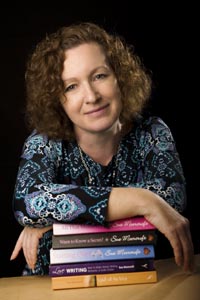
Sue Moorcroft
Romantic Novelists’ Association. It was held in the lovely surroundings of the new Library of Birmingham.
Sue Moorcroft came to talk to us about writing romantic novels. She gave us much good advice such as:
- Know the publisher/market you are aiming for before beginning the book and she told us that Harper Impulse are currently open to submissions.
- Have a one sentence synopsis to describe the book and also know what tone you are writing in i.e. light and frothy, grittty, tearjerker etc.
- When planning the story, avoid listing the scenes/ideas down the page. Instead use a spider diagram so that your brain is not chanelled into what happens when too soon – instead your mind can jump about and pick the most appropriate scene.
- What should you do when a story runs out of steam or you have a ‘saggy’ middle? Introduce something dramatic such as the revelation of a secret, a new character (maybe an ex-boyfriend or an illigitimate baby), a skeleton in the cupboard or anything else that will add drama to the situation.
- Keep the hero and heroine apart by giving them conflicting goals.
- The traits required of heros and heroines – they should both be decent, honest people but should have some flaws and vulnerability like the rest of us.
- A prologue (where the book lends itself to it) gives the author two chances to hook the reader (once in the prologue and once in chapter one)
- Chapter One should move the story forward. Do not clutter it with back story or scene setting.
- An epilogue can be used to prolong the reader’s feeling of happy satisfaction at the end of a book. It may be a wedding, new baby or other tieing up of loose ends.
- When writing, remember Act, React and Interact. This will make it easier to Show rather than Tell. For example the characters should react to their environment – such as squinting at the sun – rather than the author describing the sunny day.
We had a lovely buffet lunch and the whole day ran smoothly. Special mention should go to Marilyn Rodwell for her organisational skills and her doughnuts which gave us all a sugar kick first thing in the morning!
And if you’d like more of Sue’s invaluable advice take a look at her book Love Writing – How to Make Money Writing Romantic or Erotic Fiction – available in paperback or as an e-book.
E-Publishing with Kobo Writing Life
Posted by Sally Jenkins in Computers & Technical on April 4, 2014
This week I’ve done something I’ve been meaning to do for months – I’ve finally branched out to another e-book platform. 
Old Friends – 13 Coffee Break Stories is now available on Kobo as well as Amazon Kindle.
This collection is my Kindle ‘best seller’ and hasn’t been enrolled in KDP Select for a long time meaning I’m free to publish it elsewhere.
So, how did I find the Kobo publishing process?
The hardest part was creating a Kobo login ID to allow me to start the process.
If the email address entered into Kobo is registered to a Facebook account then Kobo requires you to login with your Facebook credentials. I didn’t want to do this and went round in circles until I discovered that the only way to keep my Kobo and Facebook accounts separate was to login to Kobo initially with my Facebook account and then, within the Kobo ‘My Account’ page, un-link Facebook from my Kobo account.
Complicated or what?!
Kobo accepts manuscripts in a variety of formats, including Microsoft Word .doc and .docx, and then converts them to .epub. Initially I uploaded my manuscript as .docx but when I checked the finished product using the Kobo previewer (which isn’t as good as the Kindle one) the line spacing seemed very wide.
So, I downloaded the free conversion software Calibre and converted my .docx file to e.pub. Then I uploaded the .epub file to Kobo and the result looked much better.
This all sounds very complicated and technical – but it’s not! There is a guide available on the Kobo website full of tips about how to format your Word document to ensure the best results. I used the same manuscript that I’d formatted for Kindle according to the instructions in Mark Coker’s Smashwords Style Guide and, once I’d discovered Calibre, had no further problems.
Having said that, if anyone downloads the Kobo version and finds the formatting isn’t up to scratch – please let me know!
Next, I have to work out how everything works on the Kobo site …
Two Free Writing Competitions
Posted by Sally Jenkins in Competitions, Short Story on March 27, 2014
Ian Skillicorn from Corazon Books has been in touch to tell me about two free to enter competitions that he’s involved with:
Historic House Short Story Competition
This competition is being run by Corazon Books and the Historic Houses Association to celebrate the publication of The Property of a Gentleman by Catherine Gaskin. This modern classic by the bestselling “Queen of Storytellers” has recently been reissued by Corazon Books in ebook format, in time to celebrate its 40th anniversary. The Property of a Gentleman is a tale of intrigue, mystery and romance, set in a fictional earl’s ancestral home, in the dramatic landscape of England’s Lake District.
Entrants to the competition must submit a short story of between 1,500 to 2,500 words. The story must take place in, or be inspired by, a historic house (real or fictional). The submissions deadline is Friday 26th September 2014 and the winner will be announced on Monday 17th November 2014.
The winning writer and a guest will be treated to a private tour and afternoon tea with the owners of Levens Hall in Cumbria. The winner will also receive a cash prize of £150, and a double Friends membership for the Historic Houses Association. Two runners up will each receive a double Friends membership to the Historic Houses Association. Corazon Books also plans to publish an e-book anthology of the best entries, with each writer receiving royalties for their published story.
Full details of the competition can be found here.
The Write Time competition
Corazon Books is running a writing competition for the over 50s, in partnership with Mature Times.
“The Write Time” competition offers the winner a two-year digital publishing contract, with full editorial and marketing support, and a generous royalty on all sales.
The organisers are looking for compelling fiction for adults from a previously unpublished author. For the purposes of the competition, “previously unpublished” is defined as a writer who has never had a publishing contract for a short story collection, novella or full-length novel, which offered royalties and did not require any payment from the writer. So, even if you have self-published your writing, you are still eligible to enter.
Work can be submitted in the genres of family saga, historical, medical, mystery and suspense, and romance (contemporary or historical).
For the first round of the competition, entrants should send a 200-500 word synopsis and the first three chapters of their novel/novella before 16th June 2014. Entrants who pass this first round of submissions will be asked to send the complete novel in September this year. The winner will be announced in November.
Entry to the competition is free, but writers must include an entry code which they can find (along with all the other details about the competition) on the Mature Times website.
eBookSoda and the AsparaWriting Festival
Posted by Sally Jenkins in Books, Competitions, Computers & Technical, Events, Promotion, Self-publishing, Short Story on March 20, 2014
This week I’ve got a couple of writing-related things that might interest you.
Firstly, eBookSoda is an e-book promotion newsletter sent daily, and free of charge, to readers’ inboxes. Until March 26th 2014 it is FREE to advertise your e-book in the newsletter. After this date there will be a $5 cost to have an e-book mentioned in the newsletter.
So why not get your skates on and click here to get a bit of free publicity for your book? The book doesn’t have to be on a discounted or free special offer (although many of them are) – it must just be $4.99 or less and have at least eight reviews with an average star rating of 3.5.
Alternatively, if you simply want to hear about the e-books available (many of which are on special offer) sign up for the eBookSoda free newsletter.
Secondly, crime novelist Judith Cutler has brought the AsparaWriting Festival to my attention. It is specifically designed for aspiring writers. During the event you can learn from the professionals about writing crime, history, comic or straight fiction and poetry. There are events scheduled from 23rd April 2014 to 21st June 2014 in the Evesham area.
There’s also a short story competition with a £100 first prize and a trophy. The story should be no more than 6,000 words (3,000 for junior entries), written in English, set in the Vale of Evesham or the Cotswolds, should fit into the crime genre and include asparagus. But you’ll have to start writing now – the closing date is March 29th 2014.
Happy Writing!
 Sally Jenkins