Bits and Pieces
Posted by Sally Jenkins in Competitions, Resources on January 5, 2013
I hope you’re all fully recovered from the festive season and ready to write again.
Here are a few bits and pieces that might be useful for the new year:
- ‘Don’t Break the Chain’ – nip over to Vikki Thompson’s blog to read about a great method of encouraging you to write every day. It involves using a chart to mark each day that you’ve written something. Hopefully, all these marks will form a long chain that you will do anything to avoid breaking. Follow the link on Vikki’s blog to down load the chart for free. And it doesn’t matter when you start because there are no dates on the chart. So no excuses – you can start any time of the year!
- Prima magazine have changed the word count for their monthly ‘Your Winning Story’ competition. It is now a maximum of 1000 words. The prize is still a Kobo eReader. Email your entries to yourwinningstory@hearst.co.uk and include your name, age, address, phone number and a recent photo. You’ll have to buy the mag. for the full rules plus the address for postal entries.
- Uniquely Dublin International Competition wants entries that ‘celebrate Dublin today’. There are categories for all the arts (music, animation etc) including the written word – and you only need to write 100 words about Dublin to be in with a chance of winning the category prize of 1,000 Euros or the overall prize of 10,000 Euros. Closing date is Jan 28th 2013 and entry is free. Full details are here.
And finally a couple of thank yous:
- I would like to thank Maria’s Book Blog and Jenny Schwartz for my prize of a Kindle copy of ‘Drawing Closer’ – Jenny’s contemporary romance. Maria regularly hosts author interviews and book giveaways, so if you want to win – pay her a visit.
- Last but certainly not least, I would like to thank Susan for nominating me for an Inspiring Blogger Award, which she did before Christmas. I’m supposed to tell you 7 things about me but I’m sure your eyes are glazing over by now so maybe I’ll leave that for another time. But do have a look at Susan’s blog – she’s a lovely lady.
The Bath Short Story Award & Erewash Flash Fiction Competition
Posted by Sally Jenkins in Competitions, Short Story on December 29, 2012
Here are a couple of competitions for you to mull over whilst you finish the Quality Streets and prepare for whatever 2013 might bring.

Help! I’m drowning in Quality Street! (Photo credit: nataliej)
- The Bath Short Story Award is a new international competition. The prizes are good – £500, £100 and £50 plus an additional £50 for a local winner. Stories can be on any theme and the maximum word count is 2,200. Entry fee is £5 and the closing date March 30th 2013. Enter by post or online but note that online entries must be in PDF format. Full rules are here.
- Erewash Writers’ Group are running a FREE flash fiction competition on the theme ‘Start’ – which seems appropriate as we approach the beginning of a new year. First Prize is publication on the Erewash Writers’ website, a copy of Dan Purdue’s book
‘Somewhere To Start From’ and one free entry to the Erewash Open Competition 2013. Second prize is one free entry to the Erewash Open Competition 2013. Word limit is 500 and the closing date is March 21st 2013.
The judge is author, Dan Purdue and he offers some advice on flash fiction on his blog.
Full competition details are here.
Free Kindle Book – Writing: The King Author Way
Posted by Sally Jenkins in Books, Resources on December 23, 2012
Writing: The King Author Way is free on Kindle from today (23rd December) to 26th December.
I haven’t had time to look at it yet but it’s described as:
“A collection of over fifty articles on how to be a writer. From tips on
marketing, self publishing and editing to how to submit to an agent and work
with a publisher. This book offers specific advise on writing short stories,
horror fiction, romance, erotica and articles. This easy to read digest
of useful writing advice is a must for anyone who has an interest in writing.”
It’s been put together by King Author – Author Advisory Service.
So if you’ve got a couple of minutes to spare, it might be worth downloading before Christmas inertia sets in.
The Museum of Broken Relationships
Posted by Sally Jenkins in Non-fiction, Resources, Successes, Travel, Writing on December 20, 2012
I was leafing through the Independent on Sunday and came across a travel article on Zagreb. It mentioned the Museum of Broken Relationships which immediately fired my writer’s imagination.
The museum contains exhibits that each recall the breakup of a relationship. Each object is accompanied by a narrative telling its story such as:
- A lover’s mobile phone, given to the girlfriend he’d just broken up with, so that she couldn’t call him anymore
- An axe that was used on the furniture of an unfaithful partner
- A garden dwarf that was thrown at an ex’s windscreen on divorce day
The place sounds like a building full of writing prompts with a whole wealth of relationship stories, just waiting to be written. There’s a cafe there too – so somewhere to sit and jot down notes whilst enjoying mulled wine and pepper cookies (the house specialities according to the website).
The museum also accepts new exhibits from people wishing to get rid of stuff that reminds them of a painful breakup. What would your hero or heroine donate?
Look out for the museum’s touring exhibitions, there was one in Lincolnshire earlier this year and one in London in 2011 – if only I’d known I could’ve collected enough ideas to last a lifetime! Instead I’ll have to save up for a flight to Zagreb …
P.S. I had an acceptance from People’s Friend this week – hurrah, a great way to end the year!
Pride and Prejudice
Posted by Sally Jenkins in Authors, Books, Competitions, Short Story on December 13, 2012
I’ve been reading Pride and Prejudice in preparation for entering the Writers’ News subscribers only January 2013 competition – the brief is ‘a story based on any of the characters or events in that famous novel – but set firmly in the 21st century’.

Detail of a C. E. Brock illustration for the 1895 edition of Jane Austen’s novel Pride and Prejudice (Chapter 3) (Photo credit: Wikipedia)
It’s the first time I’ve read the book and it’s taken me some time to get into it. I suppose it’s the old-fashioned language and often long paragraphs used to get a point across. But now that I know the characters I’m quite engrossed – although I’ve no idea how I’m going to capture its essence in just 1,700 words of a contemporary story.
In Jane Austen’s world people seem to marry barely knowing each other, with background and financial position counting far more than the compatibility of the couple. They get little time alone together and the height of a woman’s ambitions (and those of her parents) is to make a good marriage. Equally, the less well-off males are looking for a bride of independent means to make up for their own financial shortcomings.
Of course, today relationships are conducted quite differently so I think I’ve got quite a brainstorming session to think up a modern-day equivalent story! There is a wealth of Pride and Prejudice fan fiction on the web such as here – so I’m going to have a trawl through and see how it’s done.
In case you’d missed it, 2013 is the bicentenary of the publication of Pride and Prejudice – Austen held her first printed copy of the book on 29 January 1813. Today Pride and Prejudice is The British Library’s ‘most adopted’ title, in a fund-raising campaign where supporters are encouraged to sponsor a book of their choice.
I wonder which of today’s books will still be popular in 2213? Any suggestions?
By the way if you know any young writers (or are one yourself), there are details of a Jane Austen writing competition here, open to school years 7 to 11.
Christmas Round Robin Letters plus a Competition
Posted by Sally Jenkins in Competitions, Non-fiction, Writing on December 6, 2012
Christmas Round Robin Letters – do you love them or loathe them?

I don’t usually write one but this year I did and it’s currently winging its way to those I rarely see. The cost of postage drove me to include the letter with my cards. I begrudge paying 50p (second class postage) just to stick a card in an envelope so I decided that people were going to hear what my family did in 2012 – whether they wanted to or not. After all, I’m supposed to be a writer so it shouldn’t be difficult to make a round-up of the last 12 months sound interesting.
It was a lot harder than I expected!
I tried to be mindful of the fact that no-one wants to read a list of my daughters’ achievements and their plans for the future. I’ve received letters like that and they leave me feeling totally inadequate. So I skirted over that and moved onto how the recession has impacted the working lives of my husband and me. Then I decided that talk of redundancies was too depressing so I moved on to the interesting things we’ve done in our spare time – and came up with nothing!
Writing a round robin letter is like trying to have a one-sided conversation in the dark. It’s impossible to gauge whether you are boring people because there’s no facial expressions to read and no feedback in the way of comments. So I did my best and sent it out . It’s up to the recipients whether they read it or bin it and from now on I’ll be much less dismissive of the letters I receive because I know how difficult they are to write!
Competition
If you’ve had any letters printed in a newspaper or magazine during 2012 you might be interested in a competition run by the Association of Christian Writers. ACW’s UK letter writing competition is looking for the best letters published in any national, regional or local magazine or newspaper during 2012. There is a prize of £50 for the best single letter published and prizes of £100, £50 and £25 for collections of 6 letters published in 6 different publications. Closing date is 31/12/2012. Full details are here.
E-book Erotica – the way forward?
Posted by Sally Jenkins in Events, Markets, Self-publishing on November 29, 2012
On Saturday we had a really interesting meeting of the Birmingham Chapter of the Romantic Novelists’ Association. There were 8 of us around the table in the Edwardian Tea Rooms of the Birmingham Museum and Art Gallery and one of our member’s exploits took up most our discussions.

Birmingham Museum & Art Gallery – Edwardian Tea Room (Photo credit: ell brown)
She shall remain nameless, since for obvious reasons she writes under a pseudonym, but she is making around £800 a month selling her erotic e-books, mostly to the US markets. Bear in mind that she fits this around a full-time day job and a family -it makes me wonder why I am slogging away trying to get the odd story accepted by a women’s magazine or shortlisted in a competition!
Our successful author currently has 67 stories for sale, ranging in length from 3,000 to 10,000 words. Apparently the secret of her success is to keep up with the latest trends in erotica – for example monsters are the ‘in thing’ at the moment (the mind boggles!).
She self-publishes the e-books, formatting them and designing the covers herself. As you can imagine, we were all agog to learn her secrets and she has promised us a workshop in January…
Talking about the mind boggling, I caught the tail end of a Radio 4 program – ‘When Harry Potter Met Frodo’ – about Fan Fiction this week. The presenter was talking about Slash Fiction. This is a sub-genre of Fan Fiction and involves choosing 2 of your favourite male characters from existing works of fiction, bringing them together and letting them have an affair (at least that’s my polite way of putting it!).
So, if you want to write what the market wants – now you know!
A Bit of Bronte Luck
Posted by Sally Jenkins in Authors, Travel on November 19, 2012
Do you ever think that only the lucky get published? I sometimes despair when, after hours toiling over a story, it wings its way straight back to me in its self-addressed envelope. 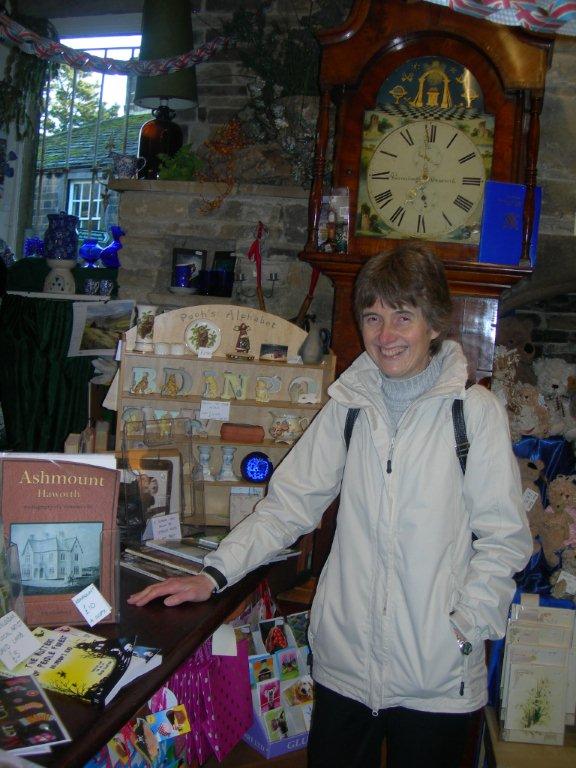
Last weekend I was in Haworth and heard that it was lucky to touch the old wooden post office counter, over which the Bronte sisters‘ manuscripts were sent on their way to London publishers. The counter is now in a gift shop (with a very friendly and obliging owner) and here is a photo of me trying to generate myself some luck! It was a shame I couldn’t actually send one of my stories over the counter and off to ‘success land’ – but perhaps a little bit of the Bronte success might rub off on me…
The highlight of this trip to Haworth was a guided tour with BronteWalks. I was brought up in West Yorkshire and had many trips to Howarth when I was younger but all that stuck in my mind from those visits was the tiny handwritten books that the sisters made as children and the drunken lifestyle of their brother, Branwell.
Our guide, Johnnie Briggs (no, not Mike Baldwin from Coronation Street!), soon put that right. For instance, I didn’t know that:
- There were 2 older Bronte siblings who died in childhood.
- The Bronte sisters disliked their work as governesses and dreamed of opening their own school.
- It was the precarious state of the family finances that gave the sisters the final push they needed to complete novels and submit them to publishers (that reminded me of Jeffrey Archer who wrote Not A Penny More Not A Penny Less to rescue himself from bankruptcy)
- Charlotte was pregnant when she died
- Branwell painted himself out of his famous portrait of the sisters – see it here.
- The sisters’ father, Patrick, outlived his wife and all 6 of his children. He died aged 84.
Following the tour I visited the sisters’ Parsonage home with my eyes newly opened. I imagined the sisters discussing and critiquing each others work in the dining room and saw the room where Branwell died, with his family gathered around him. The Brontes lives were shadowed in sadness and beset by difficulties but despite this (or maybe because of this?) they produced world-class fiction.
So no more excuses – get writing and submitting! (A little bit of luck wouldn’t go amiss though…)
Celebrating Charlotte – A Writing Competition
Posted by Sally Jenkins in Authors, Books, Competitions, Short Story on November 12, 2012
I came across the following competition on the blog Aiming For A Publishing Deal – many thanks to Charlotte C for highlighting it!

Charlotte Mary Yonge (1823-1901) (Photo credit: Wikipedia)
The competition is being run by Hampshire County Council and is asking for short stories (up to 1000 words) on the theme of Charlotte Mary Yonge. Charlotte was a best-selling Victorian novelist and her memory is kept alive by the Charlotte Mary Yonge Fellowship.Your story could be inspired by Charlotte’s life, one of her novels or maybe, a present day character discovering one of Charlotte’s books. There are 2 prizes of £50 Waterstones’ vouchers, one for under 16 and one for 16 +. Closing date is 12th December 2012 and you don’t have to live in Hampshire to enter. The full details are here.
Obviously this is a competition that will require some research but, on the plus side, that could deter many entrants – meaning that the field is smaller than that for many other competitions. And you may discover that you like Yonge’s books!
 Sally Jenkins