Win A Writing Mentor
Posted by Sally Jenkins in Competitions on May 5, 2016
Sophy Dale is offering a three month writing mentorship to the winner of the prize draw now running on her website, Spark for Writers.
The mentorship starts with a one to one coaching session to find out exactly what sort of support you need. This is followed by 12 weeks of email support, the submission of up to 5,000 words for editorial review, followed by a final one to one session. All of this usually costs £500 but you can be in with a chance to win it for free by simply joining Sophy’s mailing list before May 30th 2016. Please read the full details of the competition before entering.
Writing is a lonely business so a little bit of help and encouragement along the way can only be a good thing.
What are you waiting for?
What’s Your Musical Era?
Posted by Sally Jenkins in Lifestyle, Writing on April 28, 2016
What’s your musical era? When did you transition from child into young adult and have all those special first experiences: first teenage party, first visit to a pub or club, first kiss, first date etc. ?
For me it was the early 1980s. Songs by Adam and the Ants, Soft Cell, Human League and Frankie Goes to Hollywood always whisk me back to that time and I feel again the strong emotions that seemed to accompany everything I did. If I close my eyes when I hear ‘Tainted Love’, I’m at the university Union disco, dancing on a floor which is sticky with spilled beer. I feel the excitement and anticipation of a time when so many things were new and responsibilities were few.
Re-capturing this mood through music enables me to write from the heart about being young and in love. When I get in this zone it’s great – the words flow and I get lost in the story. Pete’s Story was the result of one such emotional interlude and my inspiration came (very loosely!) from a boy I went out with in my teens who was a member of a band.
What songs whisk you back to that heady time of new independence and experiences? And do they help with your writing today?
Pete’s Story is available as an individual ‘short‘ or as part of The Museum of Fractured Lives boxed set.
This blog post is part of a music themed blog event organised by Elaina James, a guest blogger on Mslexia. Her author page on Mslexia can be found at www.mslexia.co.uk/author/elainajames.
Details of participating bloggers in this event can be found on Elaina James’ blog.
National Stationery Week 2016
Posted by Sally Jenkins in Lifestyle on April 25, 2016
Want an excuse to go and indulge in a pile of luscious new notebooks, a pack of brightly coloured pens, some pretty patterned ring-binders or some delightful sticky notes? Well here it is!
25th April to May 1st is National Stationery Week and 27th April is World Stationery Day! 
The website has a suggested list of things to do during this week. I particularly like the idea of a ‘stationery crawl’ which is like a pub crawl but with stationery instead of beer (but there’s nothing to stop you downing a glass or too – choosing notebooks is thirsty work!).
There’s a quiz to find out what kind of writing implement you are. I came out as “… a stylish fountain pen! A little bit messy at times as your ink smudges, but classy and timeless. You’re writing is flicks, twists and curls and words are most definitely your thing. You only need one pen and it’ll be your best friend forever”.
So what are you waiting for? Get out there and start indulging in every writer’s guilty pleasure – the smell of fresh paper, the allure of new pens and the promise of writing success if only you can find that perfect notebook!
(And if nothing else, this post has drilled into me that stationery with an’e’ is paper and stationary with an ‘a’ is motionless!)
How Businesslike Are You?
Posted by Sally Jenkins in Lifestyle, Writing on April 15, 2016
I recently spoke to a successful copywriter on the telephone and was impressed by the businesslike way he handled both the call and his freelance working life.
We prearranged the call for a specific time and he rang me on the dot. He opened the conversation by determining how long I had available to talk. Then he briefly explained what he’d like to cover in the call (this gave us an agenda) and kept the discussion on track. It sounds rather strict but was all done in a very friendly manner.
During the course of the call he mentioned that he only checks email twice a day, once in the morning and again at the end of the afternoon. He doesn’t do social media and he doesn’t make himself available 24/7 via electronic gadgets.
I feel there’s a lesson to be learned here. Perhaps it’s something along the lines of : Successful writers act professionally and treat writing like a ‘proper’ job with proper hours. They don’t procrastinate or pretend that commenting on another writer’s cute kitten picture is a marketing activity.
Food for thought?
Lancashire Authors’ Association Open Competition 2016
Posted by Sally Jenkins in Competitions, Short Story on April 7, 2016
Peter Jones has been in touch from the Lancashire Authors’ Association to tell me about their 2016 Open Competition.
The competition is for a short story in exactly 100 words (excluding the title) on any theme or subject. There is a prize of £100 up for grabs which is sponsored by Langtec Composite Tube Manufacturers and in my opinion £100 for 100 words is a pretty good rate per word!
Entry is by email or post and the entry fee is £3 (or £2 if you are a member of the association).
Closing date is 31st October 2016. Check the full rules before entering.
A short story in exactly 100 words is known as a drabble. There are some useful tips on drablr.com about writing to such a tight word count and lots of examples. You can also publish your own drabbles on this website for others to read (but don’t publish the one you want to enter in the competition!).
Planning a Novel and the First Draft
Posted by Sally Jenkins in Self-publishing, Writing on April 1, 2016
I’ve been busy with a whiteboard and pretty coloured Post-It Notes trying to plan my second novel. There’s no ‘right’ way of writing a novel but, in my opinion, it helps to have some idea of where the story is heading. So I’ve taken novelist Bella Osborne‘s advice and tried working backwards from a pivotal moment in the plot. For example, if the pivotal moment is X stabbing Y to death in a fit of anger in a remote field, then scenes coming before that must show X procuring a knife, Y doing something to make X angry, X travelling to the remote field etc. etc. 
My plan looks very nice and it’s got my brain into gear but I know I will inevitably veer ‘off-piste’ as I get deeper into the story. That probably won’t matter and will make the writing process more exciting (the book is meant to be grip-lit!). And if I get totally lost then I’ll come back to my plan.
I intend to write the first draft as quickly as possible, NaNoWriMo style. But I can’t wait until November so throughout April I will be doing my own private NaNoWriMo. I want to write as quickly as possible to keep my brain focused and the story continuously moving forward in my head. The resulting manuscript will be for my eyes only and will require a lot of additional work. But I find it less frightening to edit and play around with words I’ve already written, until they’re at a publishable standard, than try to write to that standard in the initial draft.
And I will be repeating the mantra of writing tutor Alison May, “It’s OK to hate your first draft. It’s OK to hate your first draft.”
Finally I leave you with news that Bedsit Three (another grip-lit novel) has been accepted for inclusion into Kobo‘s ‘Deals Page Spotlight – Thrillers’ promotion for the first two weeks in April. Hurray! And, of course, Bedsit Three is also available on Kindle and in paperback.
Dianne Noble – From Rejection to Success
Posted by Sally Jenkins in Authors, Books, Events on March 21, 2016
Most writers get used to rejection early in their careers. The trick is to have a little cry, eat some chocolate, take on board any constructive criticism offered and then get back to the business of writing. And it always helps to know that you are not the only one being constantly kicked in the teeth.
I first met Dianne Noble on a weekend novel writing course in 2013 and then again at Swanwick a couple of years ago. Dianne’s first novel, Outcast,  was published last week by Tirgearr Publishing and she’s kindly agreed to share her rocky journey to publication:
It started with a journal.
I’d been doing voluntary work in India for several months, teaching English to street children in Kolkata and keeping a diary. My experiences seemed to be a good basis for a novel. Alas! Agents and publishing houses alike thought differently and 32 rejections later I stopped submitting, sat back and licked my wounds.
The painful truth was that my writing was just not good enough. After nursing my bruised ego for several months I started another book, based in India but with a different story. This time I took it in, chapter by chapter, to each of two writing groups I had joined. Their critique was merciless and I often felt like abandoning the whole idea. Why did I think I could write? What made me think I could be a published author? However, bit by painful bit, my work was pulled into shape and I felt ready to start the submission process again.
I trawled through the Writers’ and Artists’ Yearbook highlighting a) agents and b) publishing houses who not only handled contemporary women’s fiction but also accepted unsolicited manuscripts. I found them to be thin on the ground!
The plan was to have three submissions out at any one time and as each rejection was received, submit one more. This didn’t always prove to be viable as response times varied dramatically.
Conville & Walsh refused me in 17 days, Curtis Brown took 5 weeks, Aitken Alexander 8 weeks. Some were many months in responding, others didn’t reply at all.
It’s hard not to take rejections personally, to feel that you are deluding yourself that you can write, but all you can do is plough on and hope. One morning I opened an email from Tirgearr Publishing with the usual sinking heart, without noticing there was an attachment. A contract. How many times I read this before I could believe that someone liked my novel!
This small, independent publishing house requests the complete manuscript and guarantees an answer within 4 weeks and this is exactly what they delivered. Once I had signed the contract I was fully prepared for them demanding radical changes to my book but they accepted it as it was, other than a small amount of editing for grammar, punctuation and the occasional anomaly i.e. he had dark hair in Chapter 1 and by Chapter 12 he’s gone bald! Art work for the cover was organised in house, a website was set up linked to Tirgearr and the book was released on March 16th 2016.
The most important thing for any author, in my view, is to join a writing group. Not a cosy one where gossip is exchanged over coffee and cake but a tough one. A group who will critique, pull your writing to pieces, maybe reduce you to tears. Then, when your novel is as good as you can possibly make it, start submitting. Again and again and again. You’ll get there.
Good advice from Dianne. Her success has been hard won and well-deserved. Outcast is already sitting on my Kindle and I’m looking forward to reading it.
Find out more about Dianne and her itinerant life on her website and why not take a look inside Outcast?
International Women’s Day 2016
Posted by Sally Jenkins in Events, Self-publishing on March 14, 2016
Last week I took part in an event for International Women’s Day organised by Birmingham Adult Education Service .  I was asked to speak about something to do with women and writing. Women are flourishing in the field of self-publishing so that’s the area I chose to focus on.
An early female ‘self-publisher’ was Jane Austen. Sense and Sensibility was only taken by the London publisher Thomas Egerton on the condition that the Austen family made good any losses suffered by the book if it didn’t sell. In my mind that equates to self-publishing because the author was taking all the financial risk. This story removes much of the stigma attached to self-publishing – showing that even classic writers have done it.
Jump forward 200 years and books by indie women authors are outselling those by men. An article in the Guardian stated that in early 2015 67% of the top-ranking self-published books were by women, compare that to the Telegraph’s ‘Best Books of 2014’ list – 70% of those were by men.
This article in the Daily Mail showcases three women who’ve sold thousands of their books on Kindle. We all know that they are the exception but they provide inspiration to the rest of us and show that it is possible, with hard work and an understanding of the marketplace, to make it big.
Having (hopefully) enthused my audience with these facts, I went on to give them a whistle stop guide to self-publishing on Kindle, based on Kindle Direct Publishing for Absolute Beginners. Afterwards a couple of ladies came and told me that they’d been inspired which was very gratifying.
Just in case I’ve inspired you too, my non-fiction e-books on writing are both only 99p/99c (UK & US only) until Sunday 20th March 2016. And men are allowed to make use of them too!


Writing for The Weekly News
Posted by Sally Jenkins in Events, Markets, Short Story on March 6, 2016
On Saturday The Birmingham Chapter of the RNA held a Writers’ Day and I was asked to do a session on short stories. I chose to talk about writing tales with a twist for The Weekly News. 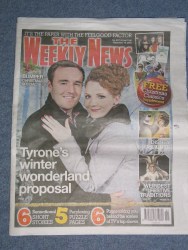
The official guidelines for The Weekly News are on that treasure trove of information, Womagwriter’s Blog, but here are some of the other points that I made in my presentation:
Research the market. The Weekly News can be hard to get hold of but I find it more readily available in smaller newsagents and convenience stores rather than WH Smith or large supermarkets. Ask your newsagent to reserve a copy for you. Alternatively, stories that have been previously published in The Weekly News can be found in these two e-collections: House Guests and Other Stories and Old Friends.
The twist should come as late as possible in the story and will often turn the tale completely on its head BUT the reader should not be lied to. The story should make complete sense whether read with the twisted ending in mind or the ending that you hope the reader will assume is coming.
Types of Twist
- Character Identity – the small boy nervous about going to school turns out to be the headmaster
- Character Motive – the head juror is pushing for a quick verdict not because he’s in a hurry to get home but because he’s actually committed the crime and therefore wants the defendant sent down ASAP
- Location – the stranded climber is not on a mountain top but is on a climbing frame in the park
Things that (seem to) work for me:
- Having a male main character (both sexes read The Weekly News)
- Aiming at the lower end of the 1200- 1500 required words. These stories pull the wool over the reader’s eyes and the fewer words, the easier that is.
- Keep the time period for the story as short as possible (I’m talking seconds/minutes rather than days) to keep it snappy
I know that a lot of you are successful Weekly News writers and probably have your own personal set of ‘rules’. You might prefer to keep them secret from the competition(!) but if not, do they differ greatly from mine?
Finally a shout-out to some of the people who helped Saturday go with a swing:
Marilyn Rodwell who ably orgainsed the whole day
Bella Osborne who taught us how to plan our novel (and gave us post-its to play with)
Lizzie Lamb who talked about her self-publishing and marketing experiences
Alison May who educated us about editing and said it’s OK to hate your first draft
Helen Barrell who talked about all things social media
and fellow blogger Maria Smith who came and introduced herself to me – lovely to put a face to a name.
Thoughts from Madeira
Posted by Sally Jenkins in Travel on February 28, 2016
I’m just back from a week in Madeira.

Before I went I selected a brand new empty notebook from my stash and packed it in my suitcase – ready to fill with wonderful words as I basked in foreign climes. The notebook has returned completely empty. I didn’t write a single word.
But I’m not counting that as a failure. We also took far fewer pictures than usual on holiday. I’d like to think that instead of making a point of recording everything in pictures or words, we were actually living in the moment (and enjoying it!). I have returned with memories of some of the emotions I felt whilst on holiday and I’m hopeful that I can draw on these to add depth to my fiction when trying to imagine how a character might feel in a particular situation. For example:
- The nausea I felt when the pilot tried to land at Funchal airport in high winds (the landing was aborted 3 times before we diverted to Faro). The plane was buffeted from side to side and I had to locate the sick bag, just in case!
- The claustrophobic fear that overcame me when we walked through a 1.4 km long tunnel. It was pitch black, the low, rough ceiling forced us to bend over and we had one tiny torch between us. My husband banged his head and had blood trickling down his face when we finally emerged into the light and … realised we’d gone the wrong way – we should have turned down a path before the tunnel.
- The respect and admiration that was due to the native Madeirans who are trying to eke a living by farming small plots of land on the steep hillsides. They have to walk a long way along steep, rough paths to get to their land and then pay for water from the levadas to irrigate their crops.
It can be good to relish the moment and store away those feelings to pull out a later date.
What about you – do you write whilst on holiday?
 Sally Jenkins