Updated for 2015 – Kindle Direct Publishing for Absolute Beginners
Posted by Sally Jenkins in Computers & Technical, Resources, Self-publishing on April 8, 2015
In February 2014 I pulled together everything I’d learnt about publishing a Kindle e-book and produced Kindle Direct Publishing for Absolute Beginners. This concise e-book covers everything a writer needs to know in order to publish their first Kindle e-book and it’s written in simple language. 
But nothing stays the same and over the last twelve months there have been some changes over at Amazon KDP. For example, UK writers who enter their National Insurance number in the Amazon on-line tax interview (not as scary as it sounds!) no longer have 30% tax withheld on their US royalties, pricing for EU Amazon sites is now inclusive of VAT (see my previous blog post for more information) and it’s now possible to allow pre-orders of a new e-book before it is published.
Therefore, I have updated Kindle Direct Publishing for Absolute Beginners to reflect these changes plus a few more bits and pieces, such as the advent of Kindle Unlimited allowing e-books enrolled in KDP Select to be borrowed and earn royalties and the ability for authors to run paid-for ad campaigns on Amazon.com.
So, if you’re thinking about e-publishing a collection of short stories, a ‘how-to’ book or a novel then Kindle Direct Publishing for Absolute Beginners will show you the way – and it currently costs less than a nice coffee (but I’m toying with the idea of putting it up slightly to reflect the extra work that’s gone into it).
And remember, the nice thing about e-publishing is that anything goes! There’s no rules about genres or word counts – as long as the product description and price reflect the content.
Extract from one of several 5* Amazon reviews:
“The field of e-publishing through Amazon’s Kindle Direct Publishing is full of tall grasses and hedges, but Sally’s straightforward advice offered a tidy path for my first foray into becoming an online author! Easy-to-read, this guide is clearly written by a writer who has experience with the format, and can either be read as a standalone account or dipped into as you’re on the Amazon website.”
Two Poetry Competitions
Posted by Sally Jenkins in Competitions, Markets, Poetry on March 31, 2015
Poempigeon is running a free competition on the theme ‘Awakenings’. Poems can be any form and any length. To enter, register on the site and upload your poem. Closing date is 30th April and the prize is a £25 Amazon voucher.
The thing I like about Poempigeon is that it’s an interactive site, so other poets can read and comment on your work. Everybody likes a nothing-to-lose freebie, so, even if you don’t usually write poetry, why not have a go?
Carillon is running a sonnet competition (any style, any subject) to raise money for Worldwide Cancer Research. Entry fee is only £2 and 80% of the entry fees will be shared among three winners (each getting a minimum of £25 but could be much more). The winners will also receive a subscription to Carillon. Closing date 1st August 2015. All profits will go to the charity.
Carillon also accept submissions of articles, stories, fillers and writing news. Payment is a contibutor’s copy of the magazine.
Finally, I’d like to say ‘thank you’ to everybody who took the time to comment and congratulate me on my shortlisting. It never ceases to amaze me what a warm and friendly lot writers are, despite us all competing with one another for ever decreasing markets.
Shortlisted in a Novel Writing Competition!
Posted by Sally Jenkins in Successes on March 24, 2015
A bit of blowing my own trumpet today – I have been shortlisted in the SilverWood-Kobo-Berforts Open Day Writing Competition!
There are eight of us on the shortlist and there will now be a nail-biting time until the end of April when the winner is announced.
First prize is an ebook publishing package provided by SilverWood Books, with an additional print edition sponsored by Berforts Information Press. The publishing package will include a full copy-edit, proofreading, ebook and paperback cover design, formatting and conversion to epub, with a corresponding print edition. Plus, very importantly, publicity.
The shortlisting was done on the basis of a synopsis of the novel plus the first 5,000 words. I’ve now submitted the completed manuscript for final judging. I know there’s ‘many a slip twixt cup and lip’ so the chances of me actually winning are tiny but I’m going to enjoy just a little bit of the limelight while I can! And it’s good to know that the first 5,000 words of my novel aren’t absolute twaddle whatever the outcome of the competition.
Do Contemporary References ‘Date’ a Novel?
Posted by Sally Jenkins in Authors, Books on March 10, 2015
I recently read A Green and Pleasant Land by Judith Cutler. 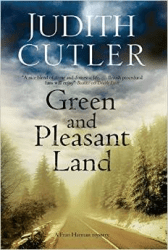 It’s a contemporary cold case crime novel and very engaging. Years ago an abandoned car was found containing a dead, disabled baby. The child’s mother and sibling were missing, feared dead and have never been found. What happened to them?
One of the things I particularly liked about the story was the many topical references to current events and today’s technology – these made the story much more immediate and real for me. One of Judith’s characters is a police and crime commissioner, there are references to the Huhne & Pryce speeding ticket fiasco, the sad case of Madeleine McCann and the terrible flooding that has hit areas of the country over the last few years. The two retired police officers investigating the cold case use iPads and have a coffee machine which uses pods.
Then I thought that anybody picking up this book in five or ten years time might find the technological references rather quaint and may not remember or have ever been aware of the current events mentioned. Would this spoil their enjoyment of the novel? Would they deem it old-fashioned? I asked Judith for her comments.
” I usually make my novels as topical as I can, because they tend to be library-only editions and therefore as evanescent as a may-fly.

Judith Cutler
So when rain and floods messed up my research, I decided to turn that to a strength, so it messed things up for my detectives too. A good police commissioner is as rare as a hen’s wisdom tooth, so it was obvious I could use one as a baddie. McCanns? Can you write about a missing child without mentioning them? So yes, a snapshot of 2014. Some might call this meticulous research, others opportunism.”
So the nature of the way Judith’s books are published means she doesn’t worry about how they may appear some years down the line. And probably most writers are more concerned about the immediate impact of a book on its publication day rather than in the future when sales have dwindled and readers attention has drifted elsewhere.
Judith’s going historical for her next book and finding it much more difficult to get the facts right.
” I’m currently setting a book in 1813 and some historical facts are proving a damned nuisance. How can my hero waltz in April 1813 when the waltz didn’t appear till about 5 months later? There’s no national police force to summon to his rescue and I’d give a lot for some penicillin too. I’m not a proper historian but I’m going to get 1813 right. If a novelist boobs over details, can you trust him or her with the big picture?”
In a few decades time people may read ‘A Green and Pleasant Land‘ as a historical novel and enjoy learning the small details of how we lived in 2014. So maybe it’s a good thing to stuff in all those contemporary references – what do you think?
It’s the taking part that counts
Posted by Sally Jenkins in Competitions, Non-writing, Short Story on March 3, 2015
‘It’s the taking part that counts’ is a phrase often bandied about to make people feel better if they don’t win or get placed in a competition. Mostly it just washes over us and we’re still fed up that we didn’t get a prize. Perhaps we even think about throwing in the towel and not bothering to enter any more competitions. Last week I had an experience that made me truly agree that it’s not the winning, it’s the taking part that counts.
My Speakers’ Club asked me to represent them in a Speech Evaluation Contest against two other clubs. This involves giving a four minute speech on the strengths and weaknesses of a ‘target’ speech which all three competitors have just watched. I was a bit reluctant since I’ve only been in the club eighteen months but decided to have a go anyway. My fear was that I wouldn’t be able to think of anything to say or I would dry up or I would speak in a muddled, incoherent way.
On the night, I discovered that one of my competitors runs a public speaking coaching business and the other had been education director of his club for fifteen years. This gave plenty of opportunity for making a fool of myself! Needless to say I came third (i.e. last!) in the competition BUT I was surprised to feel good in the face of defeat. There were lots of positives from the evening: I’d spoken to a larger audience than usual, I’d taken part in a speaking competition for the first time, I lasted the full four minutes, I’d been a ‘team player’ by agreeing to take part and my fellow Club members told me I hadn’t disgraced myself or let down the Club. I came away on a high!
So, what’s all this got to do with writing? It’s to urge you to enter writing competitions even if you think you don’t stand a chance of winning. You will learn and gain experience from each competition entry, it might be writing to a tight deadline, trying to write to a different word count than usual or experimenting with a new genre. Don’t worry about winning, concentrate on the challenge of producing the best work you can.
And to get you started, have a go at one (or more!) of these:
Erewash Writers’ Group New Writers’ Competition – 3,000 word short story. There is a £40 first prize and a FREE basic critique. Closes 26th March 2015.
Nuneaton Writers’ Circle Flash Fiction Competition – free entry. Prize is 1 year’s free membership of Nuneaton Writers’ Circle. Closes 27th March 2015.
Alfie Dog Review Competition – download a story from Alfie Dog during March 2015 and write a short review. First prize £100.
Enjoy the taking part!
Amazon Asked Me to Change My Book Title
Posted by Sally Jenkins in Computers & Technical, Self-publishing on February 24, 2015
Regular followers of this blog will know that I published my first Kindle e-book, One Day for Me – 8 Award-Winning Stories, two years ago. It’s a collection of short stories, all of which have either won or been placed in UK writing competitions. 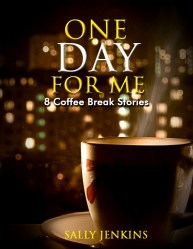
A few weeks back I received an email about this book from Amazon. It told me that the book’s title contained ‘extra descriptive content ‘ which was not allowed. It said that this extra content could be ‘distracting or misleading to our customers’. I was given five days to change the title of the book or have it removed from the Kindle store.
Initially I was confused about was wrong with the title and queried it. Amazon replied that I must remove the words ‘Award-Winning’. My first reaction was to argue the point because I feel justified in using these words since all the stories have done well in competitions. But I decided it would be a David and Goliath contest and David would probably end up with all his books being removed from the Amazon store.
So, I complied and changed the title to One Day for Me – 8 Coffee Break Stories. Then I realised that I didn’t know how to change the cover image to reflect this new title. The cover was all my own work (following some wonderful advice from many of you about what worked and what didn’t) two years ago but since then I’ve forgotten how to get back in and edit it. I decided time was too precious to waste trying to sort it out so I’ve had a new cover created by Helen Measures on http://www.fiverr.com. It’s quite different from the first cover so I’m hoping that it will attract readers who dismissed the book first time around.
I post this as a warning to those of you thinking of publishing on Amazon KDP. Don’t put any spurious claims or words such as ‘free’ or ‘best’ in your title. If you do you may be asked to remove them.
Can Creative Writing be Taught?
Posted by Sally Jenkins in Uncategorized on February 17, 2015
I was telling a writing friend of mine about my PTLLS (Preparing to Teach in the Lifelong Learning Sector) course, she made various encouraging noises and supportive comments but then she asked that awkward question, “But do you think creative writing can be taught or is it a natural talent?”
That made me think. There’s no doubt that some people have a natural flair for grabbing ideas out of nowhere and turning them into wonderful finished pieces. Others put in hours at the PC but have very little success. But that’s true of many creative skills, such as playing a musical instrument, painting or drama.
Lots of us do believe that at least certain aspects of creative writing can be taught – just think of all the courses advertised in the writing magazines and the many, many more advertised only in their own locality.
Personally, I believe that it is possible to teach someone how to structure a story, how to edit their work and write ‘tighter’, how to pitch an article to an editor, how to give that article an arresting opening, the mechanics of writing a haiku or a limerick and much more. I believe this because these are all skills that I’ve learned over the years.
Maybe it’s not possible to teach someone to see the poetic value of a sunset or imagine themselves into a character’s head. Or maybe it is, if you give them enough practice and constructive feedback.
Perhaps I’m biased because one day in the future I hope to teach Creative Writing. What do the rest of you think?
I Passed My PTLLS Micro-Teach!
Posted by Sally Jenkins in Poetry, Preparing to Teach in the Lifelong Learning Sector, Successes on February 10, 2015
Today I did my micro-teach session on the PTLLS course (Preparing to Teach in the Lifelong Learning Sector) and I’m pleased to say that I passed!
I had a thirty minute session to fill, which at first sounded daunting but in reality, it is a very short time to teach anyone anything, especially when faced with a class of non-writers (i.e. my PTLLS classmates, none of whom are ‘into’ creative writing). I chose Haiku as my topic because it’s a simple, short form of poetry which can be ‘learned’ quite quickly.
Working in three small groups, my learners brainstormed a list of words from pictorial prompts which I provided and then they fitted the words together to create a 17 syllable, 3 line (5, 7, 5) Haiku. We heard them all read out and they were very good.
I’ve now got to write-up the experience for my PTLLS portfolio and am going through the peer review forms I received after the session. One lady (for whom English is not her first language) wrote, “I am now thinking of joining a Creative Writing class” and another, “It made me realise I actually could write a Haiku, which I didn’t believe at all when you first introduced the subject.”
So I’m chuffed to think that I may have inspired two non-writers to have confidence in their creative ability!
Finally I pointed the class in the direction of the PoemPigeon website, where anyone can post poetry and/or leave comments. The site also runs occasional competitions.
Review of ‘The Museum of Fractured Lives’ by Sally Jenkins
Posted by Sally Jenkins in Uncategorized on February 3, 2015
I wanted to share this timely review of ‘Museum’ by Charlie Britten. It’s wonderful how bloggers, writers & readers all support each other. Thanks Charlie! The Museum e-book is only 99p until Sunday 8th Feb.

Available from Sally Jenkins’ blog.
 http://en.wikipedia.org/wiki/Museum_of_Broken_Relationships
The inspiration for ‘The Museum of Fractured Lives’ came from the author alighting – purely by chance – on the website of The Museum of Broken Relationships in Zagreb. (There is a similar museum in Brussels too, by the way.) In 2011 the Zagreb museum was the winner of the EMF Kenneth Hudson Award for demonstrating the most ‘unusual, daring and, perhaps, controversial achievement that challenges common perceptions of the role of museums in society’. Now, I want to go myself!
Back to Sally Jenkins’ book, this very short work consists of a prologue, which takes the reader through how the Museum came to be set up, followed by what are, in reality, three short stories told in dialogue to the main character, and then a final chapter entitled ‘Last Word’. The three short stories (Maxine’s Story, Karen’s Story and Pete’s Story) were…
View original post 299 more words
Bag a Bargain!
Posted by Sally Jenkins in Promotion on February 2, 2015
Just a quick post to let you know that The Museum of Fractured Lives is reduced to half-price until Sun Feb 8th 2015. It’s only 99p in the UK and 99c in the US. 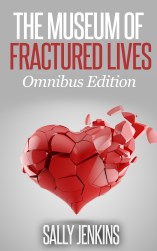
This e-book is a compelling collection of four emotive long stories. Each one is perfect for filling a lunch break, coffee break or commute to work. Dip into this collection and escape into someone else’s life, experience their ups and downs, joys and sorrows.
The Amazon reviews are excellent and there’s also a growing number of reviews on Goodreads.
Here are just a few short comments:
“I just loved this book. From the prologue to the end.” Federica.
“It was a great read and I didn’t want it to end.” ShellyH
“…if I could have given this story six stars, I would have.” Sparky
After the EU e-book VAT hike on 1st Jan 2015, 99p is the cheapest price that independent authors can set on Amazon. So I hope you’ll take advantage of getting this ‘boxed set’ of all three Museum stories (plus an exclusive prologue) for the same price as a single story when bought individually.
Click here to buy on your local Amazon site.
 Sally Jenkins